Small holes, rough edges, and fragile beads demand more control than a standard drill can provide. The right bead reamer helps enlarge openings gradually, remove burrs, and smooth surfaces without sacrificing delicate materials.
We compared 10 options across tip design, handle style, power source, versatility, and suitability for detailed jewelry work so you can choose a tool that matches your beads, workload, and preferred level of precision.
Best 10 Bead Reamers for Detailed Work Picks for 2026
Versatile Five-Piece Set
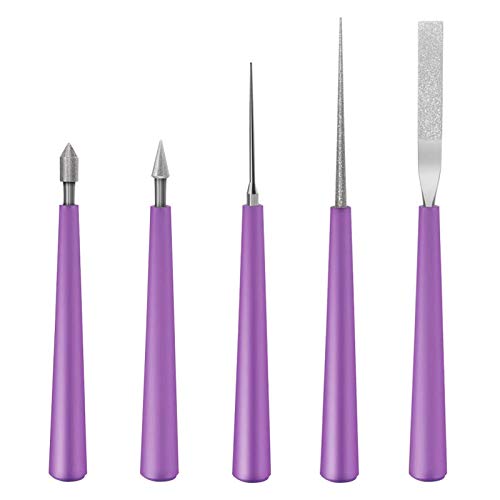
- Five shapes and widths for varied bead holes
- Diamond-encrusted stainless-steel tools
- Works on glass, plastic, metal, and wood
Best For: Multi-material hand finishing and burr removal
Organized Precision Pick
The Beadsmith Diamond Reamer Set

- Four interchangeable diamond-grit tips
- Includes a sturdy wooden handle
- Storage tube keeps tips together
Best For: Precise manual enlargement and edge smoothing
Powered Finishing Option

- Battery-operated for portable use
- Includes two diamond reamer tips
- Works on pearls, gemstones, glass, and ceramic
Best For: Powered bead-hole smoothing and enlargement
Rotary Tool Kit

- Twenty diamond-coated burrs included
- Five cone and cylinder shapes
- 1/8-inch shanks for compatible rotary tools
Best For: Rotary-tool hole expansion in stone, glass, and ceramics
Precision Starter Set

- Four diamond-tipped reamers
- Smooths and enlarges bead holes
- Designed for precise handwork
Best For: Glass, ceramic, and stone bead finishing
Versatile Workshop Set
SE 10-Piece Diamond Bead Reamers

- Ten tapered diamond-coated reamers
- Works with 1/8-inch rotary-tool shanks
- Covers multiple craft materials
Best For: Broad material and rotary-tool versatility
Versatile Value Set
Mudder 10-Piece Diamond Bead Reamers

- 10 tools in five types and multiple sizes
- Diamond tips enlarge holes and remove burrs
- Suitable for glass, plastic, metal, and wood
Best For: Crafters wanting broad size and shape coverage
Deluxe Precision Pick
The Beadsmith Deluxe Diamond Coated Reamer

- Three interchangeable diamond-coated tips
- Includes enlargement and 45-degree edging tips
- Aluminum handle stores the tips
Best For: Precise, organized jewelry-making work
Established Crafting Choice
The Beadsmith 3-Tip Reamer Set

- Three diamond-coated interchangeable tips
- Dedicated tips for enlargement and smoothing
- Handle stores tips and suits many bead materials
Best For: Detailed multi-material bead finishing
Versatile Five-Piece Set – Multi-Shape Bead Reamer Set
This five-piece set is a practical option when you need bead reamers for detailed work across several materials. Its stainless-steel, diamond-encrusted tools are designed to enlarge holes, remove burrs, and smooth edges on glass, plastic, metal, and wood beads.
Best For: Crafters who want multiple shapes and widths for hand-finishing a variety of bead materials.
Pros:
- Five shapes and widths cover a range of bead-hole tasks.
- Diamond-encrusted steel is designed for hand grinding and repeated bead finishing.
- Acrylic handles provide a dedicated grip for detailed work.
- Suitable for glass, plastic, metal, and wood beads.
Cons:
- Manual operation requires more effort than a battery-operated reamer.
- The supplied notes do not specify individual tip sizes.
Choose this set if flexibility matters more than powered convenience. The five-piece format makes it useful for general bead repair, hole enlargement, and edge cleanup.
Organized Precision Pick – The Beadsmith Diamond Reamer Set
The Beadsmith set is well suited to bead reamers for detailed work because it combines four interchangeable diamond-grit tips with a sturdy wooden handle. Different tip lengths and shapes support hole enlargement, rough-edge smoothing, and more controlled finishing on many bead materials.
Best For: Detailed jewelry work where interchangeable tips, a substantial handle, and organized storage are useful.
Pros:
- Includes four interchangeable industrial-grade diamond-grit tips.
- Long 1.25-inch and 2-inch tips are intended for enlarging bead holes.
- Rounded and triangular tips help soften rough edges.
- Four-inch wooden handle and storage tube support comfortable, organized use.
Cons:
- Changing tips is less immediate than using a dedicated tool for each size.
- As a manual set, it does not provide powered assistance.
This is a strong choice for makers who want one adaptable hand tool rather than several separate reamers. Its tip selection is especially practical for switching between enlargement and edge-softening tasks.
Powered Finishing Option – Beadalon Battery Bead Reamer
For bead reamers for detailed work with less manual filing, this Beadalon tool uses battery operation to widen, smooth, and refine bead holes. Its compact handheld design is intended for pearls, gemstones, glass, ceramic beads, and other jewelry components.
Best For: Jewelry makers who prefer portable powered assistance for delicate bead-hole finishing.
Pros:
- Battery-operated design supports controlled handheld use.
- Designed to enlarge, smooth, and refine bead openings.
- Includes two diamond reamer tips.
- Suitable for pearls, gemstones, glass, and ceramic beads.
Cons:
- Battery operation requires batteries, unlike a fully manual reamer.
- Only two tips are included, providing less shape variety than larger sets.
This model is a convenient fit when portability and reduced hand effort are priorities. It is particularly practical for finishing bead holes during stringing, repair, wire wrapping, and custom jewelry projects.
Rotary Tool Kit – 20-Piece Diamond Burr Reamers
This 20-piece kit is aimed at bead reamers for detailed work with a compatible rotary tool. Its 1/8-inch shanks and diamond-coated alloy heads include cone and cylinder shapes for expanding holes in stone, glass, ceramics, jewelry, and related materials.
Best For: Rotary-tool users who want a broad supply of small diamond burrs in multiple shapes and sizes.
Pros:
- Twenty pieces provide replacements and multiple working options.
- Includes 1.5mm and 3mm cones plus 1mm, 2mm, and 3mm cylinders.
- Standard 3mm, or 1/8-inch, round shanks suit compatible rotary tools.
- Designed for stone, glass, ceramics, jewelry, and similar materials.
Cons:
- Requires a compatible rotary tool and is not a standalone handheld reamer.
- The supplied guidance recommends lubricant for longer tool life.
- Rotary use may offer less hand-by-hand control than a manual reamer for delicate work.
This kit makes sense for makers already equipped with a Dremel-style rotary tool and needing variety or spare burrs. Use lubricant as recommended and match the cone or cylinder size to the hole-finishing task.
Precision Starter Set – Bead Buddy 4pc Reamer Set
For bead reamers for detailed work on glass, ceramic, and stone beads, this four-piece Bead Buddy set focuses on smoothing rough edges and enlarging existing holes. Its ultra-fine diamond tips are suited to controlled handwork.
Best For: Beaders who want a compact, color-coded set for precise hand-finishing and hole adjustments.
Pros:
- Includes four reamers for smoothing and enlarging bead holes.
- Diamond-tipped tools are designed for glass and ceramic beads.
- Ultra-fine tips support precise bead and jewelry-making work.
- Compact 1.76-ounce set is easy to keep with craft supplies.
Cons:
- Offers four tools, fewer than the 10-piece SE set.
- Designed for hand use rather than powered rotary-tool operation.
This is a practical choice when precision and portability matter more than a large range of sizes or powered operation.
Versatile Workshop Set – SE 10-Piece Diamond Bead Reamers
For bead reamers for detailed work across several materials, the SE set provides 10 tapered, diamond-coated reamers. The standard 1/8-inch shank also makes it compatible with most die grinders and rotary tools while remaining manageable for handwork.
Best For: Crafters who want multiple reamer options for beads, glass, ceramics, stone, wood, and other soft to semi-soft materials.
Pros:
- Includes 10 diamond-coated tapered reamers.
- 1/8-inch shanks fit most die grinders and rotary tools.
- Suitable for sculpting, drilling, and enlarging holes in several materials.
- Plastic pouch supports organized storage and transport.
Cons:
- Power-tool compatibility may be unnecessary for strictly manual beadwork.
- The supplied notes do not specify variable speed control.
Choose this set when range and tool compatibility are priorities, especially if your detailed projects extend beyond glass and ceramic beads.
Powered Precision Option – EUROTOOL Pro-Electric Bead Reamer
For bead reamers for detailed work with added speed control, the EUROTOOL Pro-Electric combines a 24-volt motor with adjustable operation from 5,000 to 18,000 RPM. It includes three diamond-coated tips for smoothing edges and enlarging existing bead holes.
Best For: Frequent beadworkers who want powered control, interchangeable tips, and multiple collet sizes for detailed finishing.
Pros:
- Variable speed control ranges from 5,000 to 18,000 RPM.
- Includes small, large, and 45-degree edge-reamer tips.
- Three interchangeable collets support 1/8-inch, 3/32-inch, and 3mm options.
- Compact, lightweight design is intended for comfortable handling.
Cons:
- Requires an AC power adapter and is less portable than hand reamers.
- Intended to enlarge existing holes, not drill new ones from scratch.
- Powered operation may be more equipment than occasional users need.
This is the most specialized option of the three, offering the strongest control for repeated, detailed bead-hole enlargement and edge smoothing.
Versatile Value Set – Mudder 10-Piece Diamond Bead Reamers
For shoppers seeking bead reamers for detailed work, this 10-piece Mudder set offers multiple shapes and sizes for enlarging holes and removing burrs by hand. Its diamond-tipped stainless-steel tools are designed for use with glass, plastic, metal, and wood beads.
Best For: Crafters who want a varied, affordable set for general bead-hole filing and edge smoothing.
Pros:
- Includes 10 reamers in five types and multiple sizes.
- Diamond tips help enlarge holes and remove unwanted burrs.
- ABS handles are designed for comfortable hand use.
- Works on glass, plastic, metal, and wood beads.
Cons:
- The set does not specify interchangeable tips or built-in storage.
- The range may be more than needed for occasional, single-size projects.
Choose this set when variety matters more than a compact interchangeable design. The different shapes and sizes make it practical for detailed bead preparation across several materials.
Deluxe Precision Pick – The Beadsmith Deluxe Diamond Coated Reamer
For bead reamers for detailed work, The Beadsmith Deluxe set combines three diamond-coated tips with an anodized aluminum hollow handle. Its longer tips target hole enlargement, while the shorter 45-degree tip helps soften rough edges.
Best For: Jewelry makers who want a compact, organized tool for precise hole enlargement and edge finishing.
Pros:
- Includes three interchangeable industrial-grade diamond grit tips.
- Long 2-inch and 3-inch tips are intended for enlarging holes.
- The 1.75-inch, 45-degree tip helps smooth rounded edges.
- Hollow aluminum handle stores the interchangeable points.
Cons:
- It provides three tips rather than a larger assortment of separate tools.
- The interchangeable design requires swapping tips between tasks.
This is a strong choice for controlled, repeatable finishing work. The tip-specific design and storage handle keep the kit focused and organized without sacrificing material versatility.
Established Crafting Choice – The Beadsmith 3-Tip Reamer Set
Those comparing bead reamers for detailed work may prefer this Beadsmith set for its three interchangeable diamond-coated tips and hollow aluminum handle. The 2-inch and 3.25-inch tips enlarge holes, while the 1.75-inch 45-degree tip smooths rough edges.
Best For: Beaders who need dedicated tips for enlarging, softening, and refining bead holes across varied materials.
Pros:
- Uses industrial-grade diamond coating for repeated use.
- Three tips cover hole enlargement and edge smoothing.
- Hollow anodized aluminum handle provides tip storage.
- Suitable for glass, stone, shell, pearl, ceramic, wood, metal, and plastic beads.
Cons:
- It has three interchangeable tips rather than ten separate reamers.
- Tips must be changed when moving between hole enlargement and edge finishing.
The BR600 is a practical dedicated set for detail-oriented bead preparation. Its distinct tip lengths and storage handle make it especially useful when one compact tool needs to handle several finishing tasks.
How We Picked the Best Bead Reamers for Detailed Work
We focused on the features that matter when working with small, valuable, or easily damaged beads. The lineup includes compact hand tools, interchangeable-tip sets, battery-operated models, multi-piece kits, and rotary-tool-compatible reamers.
Our comparison considers diamond coating, tip variety, shaft compatibility, grip and storage, power control, and the types of materials each tool can reasonably handle. For detailed work, we gave extra weight to gradual material removal and steady control rather than speed alone.
Quick Comparison
- Best for general hand use: A single diamond reamer or a compact interchangeable-tip set.
- Best for varied bead sizes: A multi-piece kit with several tapered diameters.
- Best for repetitive projects: A battery-operated or electric reamer.
- Best for rotary-tool users: A set with a compatible 1/8-inch shank.
- Best for portability: A hollow-handle model with stored interchangeable tips.
Key Buying Factors for Bead Reamers for Detailed Work
Tip Material and Shape
Diamond-coated tips are useful for glass, ceramic, stone, plastic, and other hard materials because they abrade gradually. Tapered tips provide more control when widening a hole, while multiple diameters make it easier to match the tool to the bead opening.
Manual Versus Powered Operation
Manual reamers offer the best feedback for delicate beads and precise adjustments. Battery-powered and electric models can reduce hand fatigue during larger batches, but they require a lighter touch. Excessive pressure or speed can crack beads, enlarge holes unevenly, or generate unwanted heat.
Handle, Grip, and Storage
Look for a comfortable, non-slip handle that lets you rotate the tool slowly and consistently. Interchangeable-tip sets are convenient, especially when tips store inside the handle or case. Check that replacement tips are secure and easy to change without introducing play.
Compatibility and Project Materials
If you plan to use a rotary tool, verify the shank size before buying. For hand use, consider whether the tool is appropriate for the materials in your projects. Always test on a spare bead first, use light pressure, and follow any recommended lubrication or cooling instructions.
Who Should Buy Which Bead Reamers for Detailed Work?
Choose a single manual reamer if you mostly make occasional repairs or work with a consistent bead size. Choose an interchangeable-tip set if your jewelry projects use varied holes and materials. Choose a multi-piece diamond kit if you want broad size coverage or need backup tips for frequent crafting.
Choose a battery-operated model when repetitive hand rotation is tiring but portability still matters. Choose the electric or rotary-compatible option for production-style work, provided you can control speed and pressure carefully. For beginners, a manual diamond-coated tool is usually the easiest way to learn how much material to remove without overworking a bead.