A comfortable craft-room chair needs to do more than support desk work. It should let you sit close to your project, change position between tasks, and reach your materials without fighting bulky armrests.
These 10 picks include tall drafting chairs for raised worktables and standard-height office chairs for lower surfaces. The right choice starts with your table height, then comes down to fit, adjustability, and how you move around the room.
Best 10 Ergonomic Chairs for Craft Rooms Picks for 2026
Compact Drafting Pick

- Adjustable foot ring
- Flip-up armrests
- Mesh back and adjustable lumbar support
Best For: Standing-height craft desks with limited storage space
Adjustable Footrest Pick
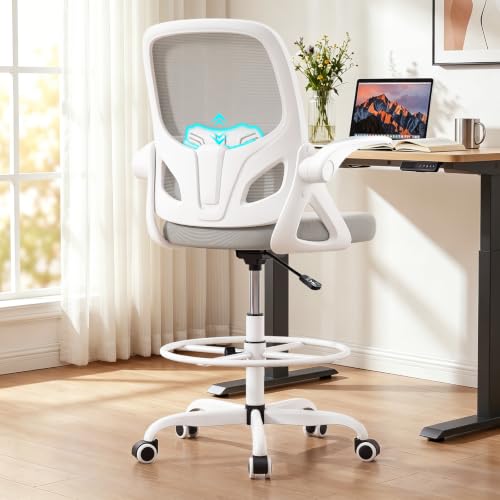
- Locking foot ring adjusts 9.45 inches
- 2-inch vertical lumbar adjustment
- 300-pound stated capacity
Best For: High craft tables and standing desks
Standard-Desk Pick

- 17.7–21.7-inch seat-height range
- Depth-adjustable lumbar support
- Molded foam seat and mesh back
Best For: Standard-height craft desks
Flexible Armrest Pick
Marsail Ergonomic Office Chair

- 3D armrests flip up
- Lumbar support adjusts in two directions
- Mesh back and thick foam seat
Best For: Desk-level crafts needing flexible arm positions
Best for Standing-Height Craft Tables

- Adjustable height and foot ring
- Breathable mesh back
- Armless, space-saving design
Best For: Elevated craft tables and standing desks
Best Cushioned Pick for Small Spaces

- 3-inch high-density foam cushion
- Flip-up armrests
- Adjustable height and rocking tilt
Best For: Padded seating at a standard-height craft desk
Best Compact Flip-Up-Arm Option

- 23.5-inch overall width
- Padded flip-up arms
- Adjustable height and tilt tension
Best For: Smaller craft desks needing flexible arm clearance
Best for Head and Neck Support
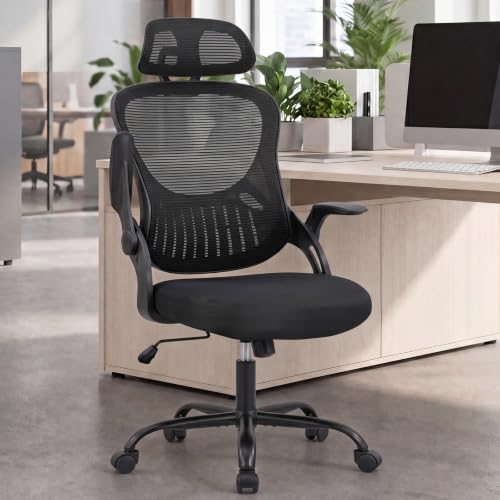
- Height- and angle-adjustable headrest
- Flip-up armrests
- 18.5–22.2-inch seat-height range
Best For: Crafters who want head and neck support
Best for Adjustable Lumbar Support

- Vertically adjustable lumbar support
- Wipe-clean PU-leather seat
- Flip-up arms; 300-pound listed capacity
Best For: Crafters wanting lumbar adjustment and easy cleanup
Compact Drafting Pick – Primy Drafting Chair
Among ergonomic chairs for craft rooms, the Primy is a practical option when your work surface is taller than a standard desk. Its adjustable foot ring supports your feet, while the flip-up armrests help it tuck away between projects.
Best For: Crafters using a standing-height desk or drafting table who want a compact rolling chair.
Pros:
- Adjustable foot ring provides support at elevated work surfaces.
- Flip-up armrests make it easier to slide under a desk.
- Mesh back, adjustable lumbar support, and a thick foam cushion address comfort during longer sessions.
Cons:
- 250-pound maximum weight recommendation is lower than those of some other chairs in this roundup.
- Assembly is required.
The swivel base and rolling casters suit a workspace where supplies are spread out. Check that a drafting-height seat fits your table before choosing it.
Adjustable Footrest Pick – Kensaker Drafting Chair
The Kensaker stands out among ergonomic chairs for craft rooms with high worktables: its locking foot ring has a stated 9.45-inch adjustment range, and the chair offers 7.9 inches of height adjustment. Flip-up armrests help free space when the project is done.
Best For: Crafters who switch between elevated work surfaces and want an adjustable place to rest their feet.
Pros:
- Locking, adjustable foot ring is designed to stay in position.
- Lumbar support adjusts vertically by 2 inches.
- PU casters, 360-degree swivel, and a 300-pound stated capacity suit an active workstation.
Cons:
- Its drafting-chair design is aimed at high desks rather than standard-height tables.
- Assembly is required.
The breathable mesh and foam seat make this a sensible tall-chair choice for drawing or crafting. Measure your worktable and desired sitting height before ordering.
Standard-Desk Pick – TRALT Ergonomic Office Chair
If your craft table is standard desk height, the TRALT is a more conventional entry among ergonomic chairs for craft rooms. Its stated 17.7- to 21.7-inch seat-height range pairs with a molded foam seat and breathable mesh back.
Best For: Crafters who work at a standard-height desk and prefer adjustable lower-back support.
Pros:
- Lumbar support adjusts in depth to fit your back.
- High-resilience molded foam seat is designed to retain its shape.
- 19.7-inch-wide seat and 330-pound stated weight capacity offer a roomy seating option.
Cons:
- No foot ring is listed for use at elevated drafting or standing-height tables.
- The supplied specifications do not establish how well it fits every desk or user.
This is the floor-height choice of the group: consider it for seated cutting, sewing, or other desk-level tasks, and compare the seat-height range with your table.
Flexible Armrest Pick – Marsail Ergonomic Office Chair
For ergonomic chairs for craft rooms where projects call for different arm positions, the Marsail offers 3D adjustable armrests that also flip up. Its high mesh back, adjustable headrest, and recline add options for longer desk-based sessions.
Best For: Crafters at a standard desk who alternate between close-in detail work and tasks that need more arm clearance.
Pros:
- Armrests move forward and back, swivel, and flip up.
- Lumbar support adjusts forward and backward as well as up and down.
- Mesh back and 3.14-inch-thick foam seat combine airflow with cushioning.
Cons:
- No foot ring is listed for a standing-height worktable.
- Assembly is required.
The range of back and arm adjustments is its main advantage for craft tasks that change throughout the day. It is a better match for a regular desk than an elevated drafting station.
Best for Standing-Height Craft Tables – Armless Drafting Chair
Among ergonomic chairs for craft rooms, this tall drafting chair is a practical match for a standing-height worktable. Its adjustable seat and foot ring help you set up for elevated work, while the armless design lets you move close to your materials.
Best For: Crafters using bar-height tables or standing desks who want an armless rolling chair.
Pros:
- Adjustable seat height and foot ring accommodate elevated work surfaces.
- Mesh back and foam cushion provide breathable, padded seating.
- Armless design can slide under a desk to save space.
Cons:
- No armrests for forearm support during detailed work.
- Tall drafting format may be unnecessary at a standard-height craft desk.
Choose this one if your craft setup is higher than a conventional desk; the foot ring is the feature that makes its extra height more useful.
Best Cushioned Pick for Small Spaces – amseatec Mesh Office Chair
If you’re comparing ergonomic chairs for craft rooms with standard desks, the amseatec pairs a 3-inch high-density foam cushion with a breathable mesh back. Its flip-up arms offer support when wanted and more room to tuck the chair away afterward.
Best For: Crafters who want a padded office chair with armrests that fold up in a compact room.
Pros:
- Flip-up arms help the chair fit under a desk.
- Thick cushion and mesh back balance padding and airflow.
- Height adjustment, 90–110° rocking tilt, and 360° swivel offer positioning options.
Cons:
- At 27.4 inches wide overall, it takes more lateral space than the other two listed chairs.
- No adjustable foot ring for elevated craft tables.
This is a sensible option when seat padding matters more than a narrow footprint; check your desk clearance before relying on the flip-up arms for storage.
Best Compact Flip-Up-Arm Option – NEO CHAIR Mesh Desk Chair
For ergonomic chairs for craft rooms where floor space is limited, the NEO CHAIR offers padded flip-up arms and a 23.5-inch overall width. Its contoured mesh back, adjustable seat height, and rolling swivel base suit a desk shared between crafting and other tasks.
Best For: Crafters who want a relatively narrow office chair with arms that move out of the way.
Pros:
- Padded arms flip up for easier storage beneath a desk.
- Breathable mesh back offers contoured support.
- Seat height and tilt tension are adjustable.
Cons:
- No foot ring for use at a standing-height worktable.
- Assembly is required.
Its main advantage is flexibility around a smaller desk: keep the arms down for support, or raise them when you need clearance or want to tuck the chair away.
Best for Head and Neck Support – DUMOS High-Back Mesh Chair
Among ergonomic chairs for craft rooms, this DUMOS model is worth considering if you want a high mesh back and an adjustable headrest at your worktable. Its flip-up arms can move out of the way when a project calls for more elbow room.
Best For: Crafters who want head and neck support alongside a breathable backrest.
Pros:
- Headrest adjusts for both height and angle.
- Flip-up armrests offer flexibility at the worktable.
- Seat height adjusts from 18.5 to 22.2 inches; rocking mode offers a change of position during breaks.
Cons:
- Lumbar support is prominent but not listed as adjustable.
- Its 26.7-inch-wide footprint may be a consideration in a tight craft room.
Choose this one if an adjustable headrest matters more to you than fine-tuning the lumbar position. Check its footprint against your table and available floor space before buying.
Best for Adjustable Lumbar Support – X XISHE Mesh-Back Task Chair
If you are comparing ergonomic chairs for craft rooms, this X XISHE task chair stands out for lumbar support you can move up or down. Its PU-leather seat is wipe-clean, while the mesh back adds airflow during seated projects.
Best For: Crafters who prioritize adjustable lower-back support and an easy-to-clean seat.
Pros:
- Lumbar support adjusts vertically, and seat height ranges from 17.72 to 22.44 inches.
- PU-leather cushion can be wiped clean.
- Flip-up armrests help clear space when not needed.
- Listed maximum weight capacity is 300 pounds.
Cons:
- The backrest is mesh, but the seat surface is PU leather rather than mesh.
- Rocking requires loosening the tension knob first.
This is a practical pick if you want to adjust where the lumbar support meets your back. The wipe-clean seat may also appeal if your projects leave dust or small scraps behind.
Best Pink Option – Sweetcrispy Mid-Back Mesh Chair
For shoppers looking at ergonomic chairs for craft rooms with a pink color scheme, this Sweetcrispy chair offers a mesh mid-back, sponge seat, and flip-up arms. It provides core desk-chair adjustments without a headrest.
Best For: Crafters who want a pink chair with a breathable back and arms that fold out of the way.
Pros:
- Breathable mesh back and high-density sponge seat.
- Flip-up armrests can clear space around a craft table.
- Seat height adjusts from 18.5 to 22.2 inches, with 360-degree swivel and a rocking mode.
Cons:
- Mid-back design does not include the headrest offered by some high-back chairs.
- Lumbar support is described as prominent, not adjustable.
Pick this model if its pink finish suits your room and flip-up arms fit the way you work. If you need to reposition lumbar support or want a headrest, consider a different design.
How We Picked the Best Ergonomic Chairs for Craft Rooms
We focused on features that matter at a craft table: seat-height options, lumbar support, armrest clearance, foot support on tall chairs, and casters for moving between work areas. This selection includes both drafting-height and standard desk-height models because neither style suits every setup. Product names and listed features are a starting point, not proof of comfort; check current dimensions, adjustment ranges, and buyer feedback before ordering.
Quick Comparison: Drafting Chair or Desk Chair?
Choose a drafting chair if you work at a raised cutting table or standing desk and need a higher seat with a foot ring. The Primy and Kensaker models offer flip-up arms, while the listed armless drafting chair may be easier to pull close to a wide work surface. Measure carefully: a chair described as “tall” may still be too low or too high for your table.
Choose a standard-height office chair for a conventional desk or sewing table. Options in this group include mesh-backed chairs such as the Marsail, TRALT, amseatec, NEO CHAIR, DUMOS, and Sweetcrispy. If you often move your elbows outward while sewing or drawing, consider a model with flip-up arms, or verify that fixed arms will fit under your tabletop.
Key Buying Factors for Ergonomic Chairs for Craft Rooms
Match the Seat to Your Work Surface
Measure from the floor to the underside of your table, then compare that clearance with the chair’s seat-height range and armrest height. Your feet should rest flat on the floor or on a stable foot ring, with enough room to keep your shoulders relaxed. For precision work, check whether you can sit close enough to avoid leaning forward.
Prioritize Useful Adjustments
Adjustable lumbar support can help you find a better fit, but its position matters more than the label “ergonomic.” Check seat depth and width against your body size, and consider whether the backrest supports the way you actually sit. Flip-up or armless designs can free up space around a sewing machine or craft mat; arms are useful if you want forearm support during computer work.
Consider Surfaces and Cleanup
Casters make it easier to move between stations, but confirm they suit your flooring or budget for a protective mat. Mesh may feel airier during long sessions; wipeable upholstery may be simpler to clean after messy projects. Also check the chair’s weight capacity, assembly requirements, and return policy.
Who Should Buy Which Ergonomic Chairs for Craft Rooms?
For a raised cutting or standing-height table, start with the drafting-chair options and verify the seat and foot-ring ranges. For a standard sewing desk, start with an office chair whose arms clear the table—or one with flip-up arms. If you switch frequently between crafting and computer work, prioritize adjustable support and easy armrest clearance. If space is tight, compare each chair’s full width and base diameter before choosing. The best Ergonomic Chairs for Craft Rooms fit both the maker and the work surface; no feature list can replace those measurements.