Turning a ring blank, shaping a pendant component, or making a tiny bushing calls for a lathe that fits both the work and your bench. The smallest desktop machines save space, while heavier bench-top models offer more capacity and control for metalworking.
These 10 options span educational micro lathes and more capable metal-turning machines. The right choice depends less on headline RPM than on the metals you use, the parts you make, and the accuracy you need.
Best 10 Small Metal Lathes for Jewelry Picks for 2026
Best for Angled Details

- Four axes with indexed angle control
- 0.02 mm handwheel graduations
- All-metal build with crash guard
Best For: Indexed cuts on small soft-metal pieces
Best for Automatic Feed
Proxxon PD 250/E Precision Lathe

- Automatic feed
- Quiet, vibration-free operation
- Two-year limited warranty
Best For: Buyers prioritizing automatic feed
Best for Larger Workpieces
VEVOR 8 x 14-Inch Mini Metal Lathe

- 50–2,250 RPM variable speed
- Cast-iron build and 3.9-inch chuck
- Manual or automatic feed
Best For: Larger parts and mixed metalworking projects
Best Starter Tooling Kit
All-Metal Mini Lathe with Five Cutters

- Five carbide-tipped cutters included
- 0.02 mm handwheel scales
- 50 mm diameter, 150 mm turning length
Best For: Beginners turning small soft-metal pieces
Best for Learning
Universal 24W Mini Metal Lathe

- Works with pure copper and aluminum
- Compact 6.24-pound build
- Includes tool-height shims
Best For: Beginners practicing on small, soft-metal parts
Best for Metalworking Capacity

- 550W motor; 50–2250 RPM
- Manual or adjustable auto feed
- 100-pound bench-top machine
Best For: Dedicated benches needing speed and feed control
Best Compact All-Metal Build

- All-metal components
- 0.02mm molded handwheel scales
- 50mm diameter; 150mm length limits
Best For: Small copper or aluminum parts on a desktop
Best for Versatile Metalworking
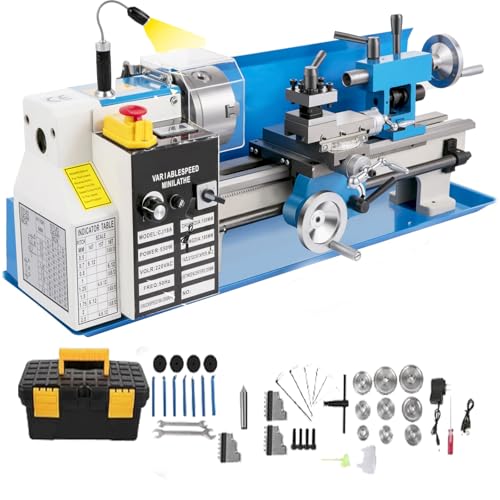
- 550W motor; reversible 0–2,500 RPM
- 4-inch three-jaw chuck
- Turning, drilling, boring, and threading
Best For: Makers machining brass or aluminum components
Best for Model-Scale Parts

- All-metal construction and three-jaw chuck
- Molded 0.02 mm handwheel scales
- 50 mm diameter; 150 mm length capacity
Best For: Small copper or aluminum craft and model parts
Best for Precious-Metal Practice

- Lists gold and silver among supported metals
- 70 mm diameter; 130 mm length capacity
- 36W motor rated up to 20,000 RPM
Best For: Small gold and silver practice pieces
Best for Angled Details – 4-Axis 60W Mini Metal Lathe
Among small metal lathes for jewelry, this 60W model stands out for its four axes and quick indexer. Its compact footprint and stated compatibility with gold, silver, copper, and aluminum make it worth considering for small, angled components.
Best For: Makers who need indexed, multi-face cuts on small soft-metal pieces.
Pros:
- A-axis adjusts from -90° to +90° for angled work.
- 0.02 mm handwheel graduations support controlled adjustments.
- All-metal components, a chuck crash guard, and travel limiters add practical workshop features.
Cons:
- Its 60W motor is specified for soft metals, not harder stock.
- A 4-jaw chuck for square or hex stock is optional.
Choose this one when indexing and angle control matter more than motor power; check the chuck configuration against the shapes you plan to turn.
Best for Automatic Feed – Proxxon PD 250/E Precision Lathe
If you’re comparing small metal lathes for jewelry and want automatic feed, the Proxxon PD 250/E deserves a look. Its listed strengths are quiet, precise, vibration-free operation and a slim design, though the supplied specifications give limited detail on work capacity.
Best For: Buyers who prioritize automatic feed and a quieter turning setup.
Pros:
- Automatic feed reduces the need for continuous manual feeding.
- Described as quiet and vibration-free for more comfortable sessions.
- Includes a two-year limited warranty for the original purchaser.
Cons:
- The supplied specifications do not state swing, distance between centers, or chuck size.
- At 34.3 pounds, it is heavier than the compact micro lathes in this roundup.
Its feed feature is the clearest reason to choose it. Confirm the work capacity and included tooling before deciding whether it fits your jewelry projects.
Best for Larger Workpieces – VEVOR 8 x 14-Inch Mini Metal Lathe
For shoppers considering small metal lathes for jewelry who also expect to turn larger parts, this VEVOR offers an 8 x 14-inch format, a cast-iron build, and a 3.9-inch three-jaw chuck. Its variable-speed drive spans a stated 50–2,250 RPM.
Best For: Makers who want capacity for larger metalworking projects alongside jewelry components.
Pros:
- Variable speed, forward and reverse operation, and manual or automatic feed offer flexibility.
- Cast-iron construction and metal gears suit a more substantial bench setup.
- Includes a backsplash guard, emergency button, nine cutters, and metal gears.
Cons:
- Its 8 x 14-inch format requires more bench space than a micro lathe.
- The notes list both 600W and 650W motor ratings; verify the current specification before ordering.
This is the capacity-oriented choice of the group rather than the smallest bench option. Check its footprint and confirmed motor specification against your workspace and intended cuts.
Best Starter Tooling Kit – All-Metal Mini Lathe with Five Cutters
Among small metal lathes for jewelry, this all-metal mini lathe is a convenient pick if you need turning tools in the box. It comes with five 4 x 4 mm carbide-tipped cutters and is specified for soft metals, wood, acrylic, and plastic.
Best For: Beginners making small rings, pens, or components who want included cutters.
Pros:
- Five carbide-tipped turning and boring tools are included.
- 0.02 mm handwheel scales help with small adjustments.
- Compact 9.28-pound machine has a stated 50 mm turning diameter and 150 mm turning length.
Cons:
- Its stated 50 mm turning diameter limits larger workpieces.
- Material compatibility is described for soft metal; harder-metal capability is not specified.
The included cutters make this a practical starting point for small work. Choose a larger machine if your projects exceed its stated turning capacity.
Best for Learning – Universal 24W Mini Metal Lathe
Among small metal lathes for jewelry, this 24W model is a compact option for practicing on tiny parts made from pure copper or pure aluminum. It also works with wood and plastic, making it useful for learning basic turning techniques.
Best For: Beginners practicing on small projects in soft, non-alloy metals.
Pros:
- Compact, 6.24-pound machine takes up little workspace.
- Metal headstock, sliders, and handwheel.
- Runs through a 12V DC transformer and includes shims for tool-height adjustment.
Cons:
- Not specified for metal alloys.
- Harder workpieces require a slower feed rate.
Choose this for learning and light-duty soft-metal work, not for jewelry projects that require turning alloys.
Best for Metalworking Capacity – VEVOR 7 x 12-Inch Mini Lathe
If your search for small metal lathes for jewelry calls for a more substantial metalworking machine, this VEVOR has a 550W motor, a 7 x 12-inch stated size, and variable speed from 50 to 2250 RPM. Its bench-top footprint and 100-pound weight make it a workshop choice rather than a casual desktop tool.
Best For: Makers with dedicated bench space who want speed and feed control for metal turning.
Pros:
- Variable speed with forward and reverse operation.
- Manual operation or adjustable auto feed.
- Self-centering 3-jaw chuck, compound rest, and emergency stop button.
Cons:
- At 100 pounds and 33 x 14 x 18 inches, it needs substantial space.
- Nylon gears may not suit buyers specifically seeking all-metal gearing.
This is the capacity-focused pick of the three, provided you have room for its weight and footprint.
Best Compact All-Metal Build – 36W Desktop Mini Lathe
For shoppers comparing small metal lathes for jewelry, this 36W desktop model offers an all-metal structure for small parts in copper or aluminum. Its stated 50mm maximum diameter and 150mm maximum length help you check whether your intended workpieces will fit.
Best For: Hobbyists making small soft-metal parts with limited desk space.
Pros:
- All-metal headstock, gears, sliders, and chuck.
- 0.02mm molded scales on the Z-axis and tailstock handwheels.
- Compact 310mm stated desktop size with a 12V supply and electrical protections.
Cons:
- Limited to workpieces up to the stated 50mm diameter and 150mm length.
- Described as a hobbyist machine, not for industrial use.
Its compact size and molded scales are appealing for repeatable small-part setups; check your material and workpiece dimensions before buying.
Best for Versatile Metalworking – 7 x 14-Inch Mini Metal Lathe
Among small metal lathes for jewelry, this 7 x 14-inch model offers room for larger workpieces while retaining the controls needed for small-part turning. Its 550W motor, reversible 0–2,500 RPM spindle, and digital speed display make it a practical choice for makers working with brass or aluminum.
Best For: Makers who want a benchtop lathe for turning, drilling, and threading metal components.
Pros:
- Supports turning, drilling, boring, and threading.
- Includes a 4-inch self-centering three-jaw chuck and adjustable automatic feed.
- Cast-iron construction, digital speed display, and emergency stop button.
Cons:
- Its larger 7 x 14-inch working capacity may be more than a small jewelry-parts setup needs.
- The supplied notes do not specifically list gold or silver among its materials.
Choose this one when broader machining capability matters more than having the smallest possible machine; confirm its capacity suits your workspace and intended materials.
Best for Model-Scale Parts – All-Metal 36W Mini Lathe
If you are comparing small metal lathes for jewelry-sized parts, this 36W all-metal machine is geared toward compact work in copper, aluminum, wood, acrylic, and plastic. Its 50 mm maximum workpiece diameter and 150 mm maximum length suit small components rather than large stock.
Best For: Model makers and crafters turning small parts from soft metals and other listed materials.
Pros:
- All-metal spindle housing, gears, handwheels, sliders, and three-jaw chuck.
- Z-axis and tailstock handwheels have molded 0.02 mm scale markings.
- Motor is rated up to 20,000 RPM and includes a cooling fan.
Cons:
- 36W rating and stated materials point to soft-metal work, not heavier metal cutting.
- The supplied notes do not specifically confirm gold or silver compatibility.
The marked handwheels and compact capacity make it appealing for repeatable small-part adjustments. Match your projects to its stated material range and 36W power rating.
Best for Precious-Metal Practice – VEVOR Didactical Mini Lathe
For shoppers seeking small metal lathes for jewelry, this VEVOR didactical model stands out because its listed materials include gold and silver alongside copper and aluminum. Its 36W motor and up-to-20,000 RPM speed are intended for small, intricate workpieces.
Best For: Hobbyists practicing small-part machining with listed soft metals, including gold and silver.
Pros:
- Listed for gold, silver, copper, aluminum, acrylic, and plastic.
- Accepts material up to 70 mm in diameter and 130 mm long.
- Integrated motor and spindle housing, cooling fan, and electrical protection features.
Cons:
- 130 mm workpiece length limits longer projects.
- 36W power rating makes it a small-part option rather than a heavier-duty metal lathe.
This is the clearest match here for buyers who specifically need listed precious-metal compatibility. Keep the stated capacity and modest motor rating in mind when planning cuts.
How We Picked the Best Small Metal Lathes for Jewelry
We organized the 10 selected machines around the decisions jewelry makers face: workpiece capacity, stated material compatibility, motor power, speed control, tooling, and bench space. The list includes small educational-style machines, compact all-metal desktop models, and larger bench-top lathes. Published specifications are a starting point, not proof of cutting performance; verify current dimensions, included accessories, and warranty terms before ordering.
Quick Comparison: Which Type Fits Your Work?
For tiny parts in soft metals, the 36W and 60W desktop models prioritize a small footprint. Their high advertised RPM figures do not necessarily mean they can take heavy cuts. The Proxxon PD 250/E suits buyers looking for a dedicated precision-turning setup in a compact format. The VEVOR 7-by-12 and 8-by-14 models, along with the upgraded 7-by-14 machine, offer more room for larger blanks and broader metalworking tasks. Check each listing’s actual distance between centers, swing, and chuck capacity rather than relying on the size in its name.
Key Buying Factors for Small Metal Lathes for Jewelry
Materials and Cutting Strength
Start with the metal you plan to turn. A listing that specifies copper or aluminum should not be assumed suitable for stainless steel or other harder materials. Motor wattage alone cannot predict results: rigidity, tooling, workholding, and cut depth matter too. If your projects regularly involve harder metals, look for a machine whose manufacturer explicitly supports them.
Capacity and Workholding
Match the swing and distance between centers to your largest blank, allowing room for a chuck or collet and the cutting tool. Small jewelry parts benefit from secure, accurately centered workholding; confirm which chuck, collets, jaws, and tailstock accessories are included or available separately.
Speed, Feeds, and Usable Precision
Variable speed helps when switching between small-diameter parts and larger blanks. High maximum RPM is less valuable if the machine lacks usable low-speed torque. Check how the carriage and cross-slide move, whether the machine supports the threading or drilling you intend to do, and how easily you can adjust the tool position. A claimed 0.02 mm scale marking describes a graduation, not guaranteed finished-part accuracy.
Setup and Safety
Budget for suitable cutting tools, measuring instruments, eye protection, and a stable mounting surface. Confirm the machine’s voltage, overall dimensions, replacement-part availability, and guard arrangement. Keep loose clothing and hair clear of rotating work; never wear gloves near a running spindle.
Who Should Buy Which Small Metal Lathes for Jewelry?
Choose a 36W or 60W micro lathe if space is tight and your work is primarily tiny soft-metal components or educational projects. Consider the Proxxon if compact precision turning is the priority and its capacity covers your blanks. Look to a 7-by-12, 7-by-14, or 8-by-14 bench-top machine for larger pieces, more versatile setups, or frequent metalworking—provided you can accommodate its weight, noise, and tooling needs. For any of these Small Metal Lathes for Jewelry, confirm material suitability and accessory costs before deciding on price alone.