Embroidery statistics highlight a craft that spans hobby needlework, small-business customization, and industrial textile production—supported by steady growth in embroidery machinery, expanding demand for decorated apparel, and rising participation in structured embroidery education.
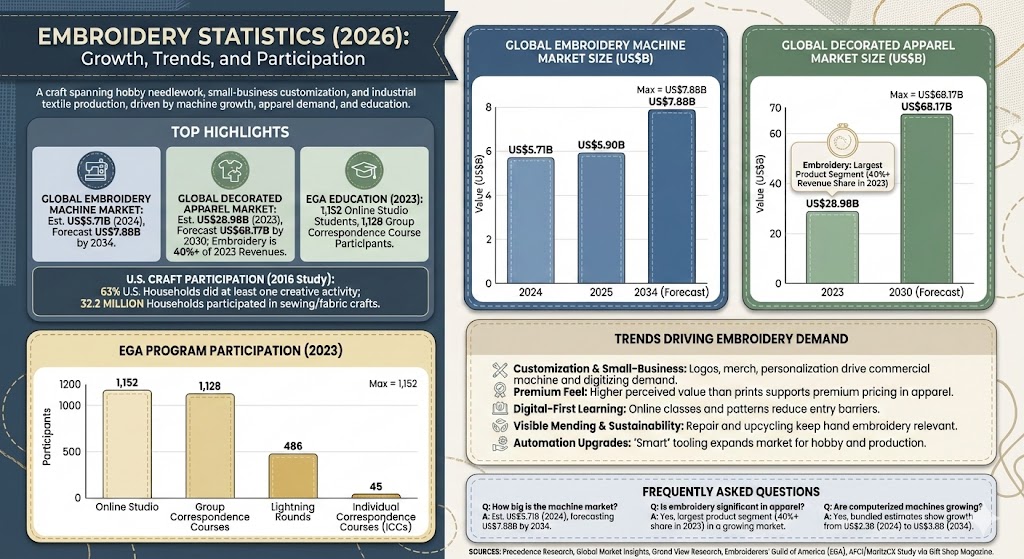
Embroidery Statistics (Top Highlights)
- The global embroidery machine market was estimated at US$5.71B (2024) and forecast to reach US$7.88B by 2034.
- The computerized sewing & embroidery machine market was valued at US$2.3B (2024) and projected to reach US$3.8B by 2034.
- The global decorated apparel market was estimated at US$28.98B (2023) and projected to reach US$68.17B by 2030; embroidery accounted for 40%+ of 2023 revenues (by product).
- In 2023, the Embroiderers’ Guild of America (EGA) reported 1,152 students in Online Studio courses and 1,128 students participating in Group Correspondence Courses.
- A large U.S. craft participation study (fielded 2015–2016) reported 63% of U.S. households did at least one creative activity in the past 12 months, and 32.2 million households participated in sewing and fabric crafts.
Embroidery Machine Market Size (Global)
Market estimates vary by definition (household vs industrial equipment, and whether “embroidery machines” are bundled with broader textile machinery). Still, multiple trackers point to steady growth driven by customization, small-business demand, and ongoing automation upgrades.
Bar chart: Global embroidery machine market size (US$B)
| Year | Bar | Value | ||
|---|---|---|---|---|
| 2024 |
| US$5.71B | ||
| 2025 |
| US$5.90B | ||
| 2034 (forecast) |
| US$7.88B |
Max = US$7.88B. Widths: 2024 72.46%, 2025 74.87%, 2034 (forecast) 100.00%.
Embroidery’s Role in Decorated Apparel
Embroidery is a major decoration method inside the broader decorated apparel economy (alongside screen printing, dye sublimation, and digital printing). As personalization demand rises—logos, teamwear, workwear, and creator-led merch—embroidery remains a high-perceived-value finish that supports premium pricing and brand identity.
Bar chart: Global decorated apparel market size (US$B)
| Year | Bar | Value | ||
|---|---|---|---|---|
| 2023 |
| US$28.98B | ||
| 2030 (forecast) |
| US$68.17B |
Max = US$68.17B. Widths: 2023 42.51%, 2030 (forecast) 100.00%.
Embroidery Education Participation (Example: EGA)
One way to track hobby momentum is to look at structured learning. The Embroiderers’ Guild of America (EGA) reported strong participation across multiple education formats in 2023, including online classes and correspondence-style programs.
Bar chart: EGA program participation (2023)
| Program | Bar | Value | ||
|---|---|---|---|---|
| Online Studio |
| 1,152 | ||
| Group Correspondence Courses |
| 1,128 | ||
| Lightning Rounds |
| 486 | ||
| Individual Correspondence Courses (ICCs) |
| 45 |
Max = 1,152. Widths: Online Studio 100.00%, Group Correspondence Courses 97.92%, Lightning Rounds 42.19%, Individual Correspondence Courses (ICCs) 3.91%.
U.S. Craft Participation Context
Embroidery sits inside a larger ecosystem of fabric and needle crafts. In the widely cited 2016 U.S. Creative Products Size of the Industry Study (surveyed 6,209 adults from late 2015 through 2016), 63% of U.S. households reported doing at least one creative activity in the prior 12 months, and sewing and fabric ranked among the highest-participation craft categories at 32.2 million households.
Trends Driving Embroidery Demand
- Customization and small-business production: Logo work, merch, teamwear, and personalization keep demand high for compact commercial machines and digitizing services.
- “Premium feel” decorated apparel: Embroidery often commands higher perceived value than prints, supporting higher margins in branded apparel and accessories.
- Digital-first learning: Online classes, subscriptions, and pattern marketplaces reduce barriers to entry and shorten the beginner-to-project timeline.
- Visible mending and sustainability: Repair-focused stitching and upcycling keep hand embroidery culturally relevant beyond traditional motifs.
- Automation upgrades: Computerized features (and broader “smart” tooling) continue to expand the addressable market for both hobby and production use.
Frequently Asked Questions
How big is the embroidery machine market?
One widely cited estimate places the global embroidery machine market at US$5.71B in 2024, with forecasts reaching US$7.88B by 2034.
Is embroidery a meaningful part of decorated apparel?
Yes. In decorated apparel research that breaks out decoration methods, embroidery is reported as the largest product segment (40%+ revenue share in 2023) within a market projected to expand substantially through 2030.
Are computerized sewing and embroidery machines growing?
Estimates that bundle computerized sewing and embroidery machines show growth from US$2.3B (2024) to US$3.8B (2034), reflecting continued adoption in both home and commercial settings.
What’s a simple indicator that people are learning embroidery?
Participation in structured classes is one indicator. For example, EGA reported 1,152 Online Studio students and 1,128 Group Correspondence Course students in 2023.
How does embroidery relate to broader crafting participation in the U.S.?
Large U.S. participation research shows a majority of households do at least one creative activity annually, and fabric-related crafts (a category that includes many stitch-based hobbies) rank among the most common.
Sources used
Precedence Research — Embroidery Machine Market size (2024–2034).
Global Market Insights — Computerized Sewing & Embroidery Machine Market (2024, 2034).
Grand View Research — Decorated Apparel Market (2023, 2030) and embroidery share.
Embroiderers’ Guild of America (EGA) — 2023 Annual Report (education participation).
Gift Shop Magazine coverage of AFCI/MaritzCX “Creative Products Size of the Industry Study” highlights (2015–2016 fielding).