Sharp carving tools produce cleaner cuts, smoother surfaces, and more predictable results. The right sharpener also helps professional crafters spend less time correcting rough edges and more time working efficiently.
This roundup compares 10 options for honing gouges, knives, gravers, and other carving tools, including whetstones, contour strops, powered sharpeners, and precision angle accessories.
Best 10 Carving Tool Sharpeners for Professional Crafters Picks for 2026
Best All-Around Strop

- Profiled for V, sweep, and U gouges
- Includes Flexcut Gold polishing compound
- Made in the USA
Best For: Portable finishing and deburring of carving gouges
Best Powered Option
Consfly 4000RPM Sharpening Machine

- Variable speed up to 4,000 RPM
- Four discs from 200 to 3,000 grit
- Compact desktop or handheld design
Best For: Powered grinding and polishing in small workshops
Best Grooved Whetstone
1000 Grit Wood Carving Sharpener
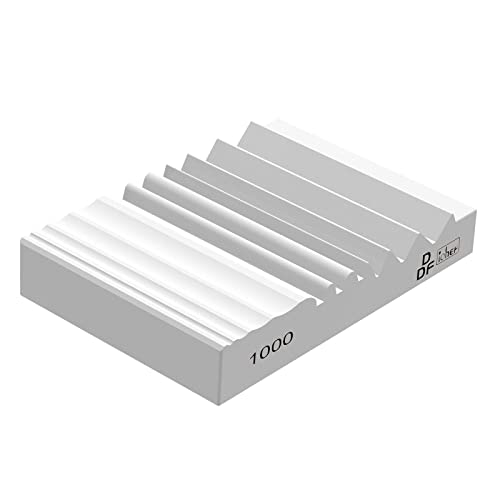
- Multiple grooves fit contoured tools
- 1000 grit for sharpening and maintenance
- Water-based and easy to clean
Best For: Manual sharpening of chisels and curved gouges
Best for Precise Angles
Jewelry Engraving Sharpener Angler

- Supports precise sharpening angles
- Includes fixer and angle ring
- Stainless steel and aluminum construction
Best For: Repeatable graver sharpening at jewelry workbenches
Leather-and-Wax Edge Finisher
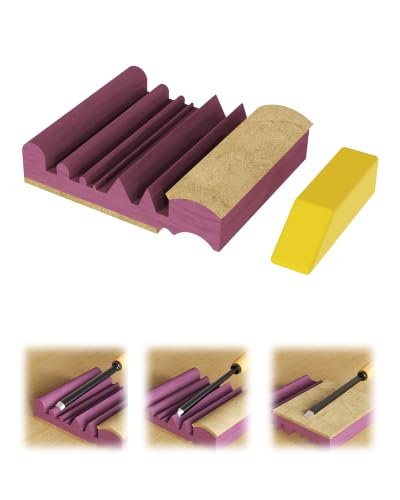
- Flat, curved, and V-groove profiles
- Leather strop with polishing wax
- Designed for deburring and edge finishing
Best For: Routine honing and polishing of contoured carving tools
Dual-Grit Gouge Specialist
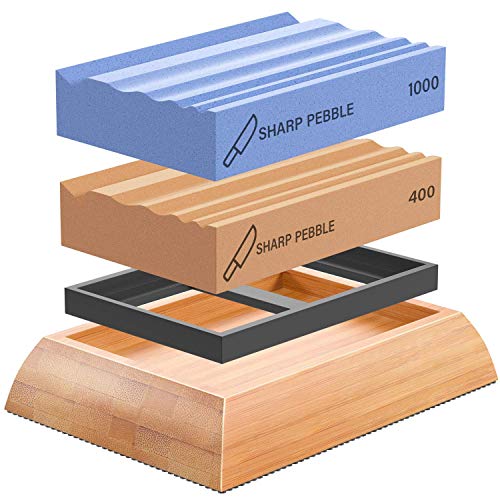
- 400 and 1000 grit stones
- Multiple grooves for contoured tools
- Water-based sharpening with bamboo base
Best For: Repairing and maintaining gouges and curved chisels
Versatile Single-Stone Option
Dual-Sided 1000-Grit Sharpener

- Grooved and flat sharpening sides
- Works with carving and household blades
- Water stone requires 10–15 minute soaking
Best For: Routine honing across contoured and straight blades
Best Contoured Waterstone Set
Multi-Groove Carving Sharpener
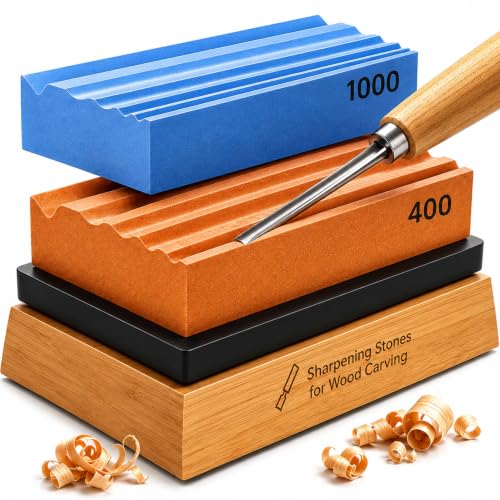
- 400/1000 grit combination
- Grooves for curved tools
- Bamboo base and water-based use
Best For: Carvers maintaining gouges, chisels, V tools, and curved knives
Best Leather Honing Kit

- Leather and sandpaper sides
- Includes compound and sandpaper
- Made for polishing and light sharpening
Best For: Spoon carvers maintaining finely finished tool edges
Best Dual-Sided Stone

- Wavy and flat sharpening sides
- 400/1000 grit stones
- Non-slip pads and bamboo base
Best For: Small carving tools, gouges, and occasional straight-blade sharpening
Best All-Around Strop – Flexcut SlipStrop PW12
For professional crafters seeking carving tool sharpeners for professional crafters, the Flexcut SlipStrop offers a compact way to polish and debur V, sweep, and U gouges. Its varied profiles help match contoured tools, while the included polishing compound supports a smoother, longer-lasting edge.
Best For: Wood carvers who need a portable finishing strop for multiple gouge profiles.
Pros:
- Multiple profiles suit V, sweep, and U gouges.
- Polishes and deburs edges for a smoother finish.
- Includes a 1-ounce bar of Flexcut Gold Polishing Compound.
- Made in the USA.
Cons:
- Designed primarily for polishing and deburring rather than major edge reshaping.
- Its compact dimensions may be less convenient for unusually large tools.
The SlipStrop is a focused finishing solution rather than a powered sharpener. It is a practical choice when edge refinement and profile compatibility matter most.
Best Powered Option – Consfly 4000RPM Sharpening Machine
The Consfly machine brings adjustable power to carving tool sharpeners for professional crafters who want repeatable grinding and polishing at a workbench. Its pure copper motor, variable speed, reversible direction, and four discs cover a broad range of sharpening tasks.
Best For: Crafters and workshop users who prefer a compact powered sharpener with multiple grit options.
Pros:
- Adjustable speed from 0 to 4,000 RPM.
- Forward-reverse switch supports different grinding needs.
- Includes 200-, 800-, 2,000-, and 3,000-grit discs.
- Compact design has four foot pads for stability.
Cons:
- Powered grinding requires more control than a manual stone or strop.
- The small format may not suit larger production tools.
With coarse-to-fine discs and speed control, this is the most versatile powered choice in the group. It can also handle delicate items such as ceramics, glass, and watch-repair screwdrivers.
Best Grooved Whetstone – 1000 Grit Wood Carving Sharpener
This grooved 1000-grit whetstone is a straightforward choice among carving tool sharpeners for professional crafters working with contoured edges. Its multiple grooves accommodate different chisels and gouges, while the water-stone design avoids the need for expensive sharpening oils.
Best For: Woodworkers sharpening curved, triangular, round, and other contoured carving tools manually.
Pros:
- Multiple contours fit a range of chisels and gouges.
- Made from durable white corundum.
- 1000 grit supports edge sharpening and maintenance.
- Uses water and is easy to clean.
Cons:
- It is a manual stone, so sharpening takes more hands-on effort.
- The 1000-grit surface is geared toward maintenance rather than aggressive material removal.
The grooved shape is its main advantage over a flat whetstone. Choose it when matching the stone’s contours to carving tools is more important than powered speed.
Best for Precise Angles – Jewelry Engraving Sharpener Angler
For professional crafters who prioritize consistency, this angle device adds controlled positioning to carving tool sharpeners for professional crafters. The stainless steel and aluminum construction, angle ring, fixer, and metric indexing chuck are intended for precise graver sharpening at jewelry workbenches.
Best For: Jewelry engravers and craftsmen who need repeatable sharpening angles for graver tools.
Pros:
- Designed for precise angle control.
- Includes a fixer and angle ring for different angles.
- Constructed from stainless steel and aluminum.
- Suited to jewelry tools and workbenches.
Cons:
- It is an angle device rather than a complete grinding machine.
- The metric indexing chuck may require metric-compatible setup practices.
- Its specialized design is less suitable for general-purpose sharpening.
This tool makes the most sense when sharpening accuracy and repeatability outweigh versatility. It is a specialized fixture for engraving-focused work rather than a general carving sharpener.
Leather-and-Wax Edge Finisher – 3-in-1 Contour Carving Strop
For professional crafters comparing carving tool sharpeners for professional crafters, this compact 3-in-1 strop focuses on honing and deburring rather than coarse stock removal. Its flat, curved, and V-groove profiles are designed to reach a range of carving-tool contours, including inner corners.
Best For: Woodcarvers who want a portable finishing and deburring tool for maintaining already-sharpened edges.
Pros:
- Three shaping profiles accommodate flat surfaces, curved areas, and V-grooves.
- Leather and fine polishing wax help remove burrs and polish edges toward a mirror-like finish.
- Compact 3.98-by-3.2-inch wood-and-leather construction is easy to keep at the bench.
Cons:
- Its fine-grit strop format is better suited to polishing and deburring than repairing heavily damaged edges.
- The single included tool may be less comprehensive than a multi-stone sharpening kit.
This is a focused maintenance option for carvers who value quick edge touch-ups and contour access. Pair it with a coarse sharpening method when working on badly dulled tools.
Dual-Grit Gouge Specialist – Grooved 400/1000 Waterstones
Among carving tool sharpeners for professional crafters, this two-stone set is built for shaping and maintaining contoured edges. Multiple grooves accommodate gouges, chisels, lathe tools, and triangular or round profiles, while the water-based setup avoids sharpening oils.
Best For: Professional woodworkers who need both aggressive edge repair and finer maintenance in one grooved stone set.
Pros:
- Includes 400 grit for dull or damaged edges and 1000 grit for sharpening and polishing.
- Multiple contours make it easier to match grooves to gouges and other curved tools.
- Waterstones clean with water and include a non-slip bamboo base.
Cons:
- Water-based stones require water during use and cleanup afterward.
- The 2-pound set is less lightweight than a compact strop-style sharpener.
This is the most complete sharpening progression of the three options, offering a coarse-to-fine workflow for workshop use. Its grooved design is particularly useful when flat stones do not fit a tool’s contour.
Versatile Single-Stone Option – Dual-Sided 1000-Grit Sharpener
This dual-sided water stone is a practical choice for crafters seeking carving tool sharpeners for professional crafters with broader workshop utility. Its wavy grooved side handles contoured carving tools, while the flat side supports straight blades such as knives, scissors, and hatchets.
Best For: Carvers who want one water stone for routine honing of gouges plus occasional sharpening of household and workshop blades.
Pros:
- Wavy grooves support lathe tools, chisels, gouges, and other contoured blades.
- Flat side expands use to straight blades, scissors, kitchen knives, and hatchets.
- Uses water instead of honing oil; soaking for 10–15 minutes prepares the stone for use.
Cons:
- Only one 1000-grit stone is included, so it offers less coarse-edge repair capability than a 400/1000 set.
- Soaking time adds preparation before sharpening.
- The broad versatility may be less specialized than a dedicated multi-profile strop.
This stone suits users who prioritize versatility and straightforward maintenance over a full sharpening progression. It is a sensible everyday option for smaller carving tools and mixed blade duties.
Best Contoured Waterstone Set – Multi-Groove Carving Sharpener
For professional crafters looking for carving tool sharpeners that handle curved edges, this 400/1000 grit waterstone set is designed for knives, chisels, gouges, and V tools. The contoured grooves help maintain contact with shaped edges, while the bamboo base supports controlled hand sharpening.
Best For: Wood carvers who need a water-based sharpener for routine maintenance and basic edge restoration on curved tools.
Pros:
- Includes 400 grit for dull edges and 1000 grit for refining and polishing.
- Multiple grooves accommodate chisels, gouges, V tools, and curved carving edges.
- Uses water instead of honing oil and includes a non-slip bamboo base.
Cons:
- Requires wetting or soaking before use.
- Hand sharpening still depends on matching the groove and controlling the angle.
This is a practical all-around choice for crafters who want coarse and fine sharpening in one compact, contoured waterstone setup.
Best Leather Honing Kit – BeaverCraft Paddle Strop
Among carving tool sharpeners for professional crafters, this BeaverCraft paddle strop is focused on honing and polishing rather than heavy edge repair. Its double-sided design combines a leather polishing surface with sandpaper for light sharpening, making it useful for keeping spoon-carving tools finely finished.
Best For: Spoon carvers and woodworkers who want a compact honing strop for maintaining already-shaped edges.
Pros:
- Double-sided construction provides leather polishing and sandpaper sharpening surfaces.
- Includes polishing compound and two sheets of sandpaper.
- Compact 12.2-inch paddle design is suitable for a range of skill levels.
Cons:
- Designed for polishing and light sharpening, not restoring heavily damaged edges.
- Leather stropping requires appropriate technique for gouges and hook knives.
Choose this kit when your carving tools are already close to sharp and you want a convenient final honing step with the necessary accessories included.
Best Dual-Sided Stone – Compact Gouge Sharpener
This dual-sided waterstone is one of the more versatile carving tool sharpeners for professional crafters who work with both shaped and straight blades. Its wavy side suits carving tools, gouges, and lathe tools, while the flat side can handle knives, scissors, and other straight edges.
Best For: Crafters who want one compact sharpening kit for small carving tools, gouges, and occasional household blades.
Pros:
- Wavy and flat surfaces support contoured and straight-edge sharpening.
- Includes separate 400 and 1000 grit stones for sharpening and polishing.
- Removable non-slip pads and a bamboo base improve stability during use.
Cons:
- Requires a 10–15 minute water soak before sharpening.
- The compact format is specifically suited to smaller tools and hobby work.
Its combination of shaped and flat surfaces makes this a flexible pick for small-tool work, especially when storage space and water-based maintenance are priorities.
How We Picked the Best Carving Tool Sharpeners for Professional Crafters
We focused on sharpening systems that address the needs of frequent carving work: consistent edge maintenance, compatibility with curved and straight blades, manageable setup, and durable construction. The selection includes stones in different grits, leather strops for honing and polishing, grooved tools designed for gouges, and powered equipment for users who prioritize speed.
We also considered whether each format supports repeatable results. Professional crafters often work with several edge profiles, so versatility and access to awkward interior curves matter as much as abrasive performance.
Quick Comparison
| Sharpener type | Best suited to | Main advantage |
|---|---|---|
| Whetstone | Knives, chisels, and general tools | Controlled, economical sharpening |
| Grooved stone | Gouges and curved carving tools | Better contact with shaped edges |
| Leather strop | Final honing and polishing | Refines an already sharp edge |
| Powered sharpener | High-volume sharpening | Fast material removal |
| Angle guide | Precision graver work | More consistent bevel control |
Key Buying Factors for Carving Tool Sharpeners for Professional Crafters
Abrasive Grit and Sharpening Stages
Around 400 grit is useful for repairing damaged or very dull edges, while 1,000 grit is a practical general-purpose sharpening level. Finer abrasives and compounds are better for finishing and polishing. A stone or kit with multiple stages can reduce the need to buy separate accessories.
Edge Shape and Tool Compatibility
Flat stones work well for straight blades, but gouges and hook knives need grooves, rounded surfaces, or flexible leather. Check the sharpener’s profile against the tools you use most. A narrow groove may suit small gouges, while broader contours are more versatile for larger carving tools.
Control, Stability, and Speed
Non-slip pads, a solid base, and a comfortable working height improve consistency. Powered machines save time but can remove material quickly and generate heat if used aggressively. Manual stones and strops offer slower, more controlled work and are often preferable for delicate or expensive tools.
Maintenance and Portability
Consider whether stones require soaking, flattening, or frequent cleaning. Strops may need honing compound and occasional conditioning. Compact systems are convenient for classes, studios, and field work, while larger setups may be more stable for production benches.
Who Should Buy Which Carving Tool Sharpeners for Professional Crafters?
- Choose a whetstone if you want affordable, deliberate sharpening for standard knives and straight-edged tools.
- Choose a grooved stone or contour strop if your work relies on gouges, spoon carving tools, hook knives, or other curved profiles.
- Choose a leather stropping kit if your edges are already shaped and you mainly need polishing and burr removal.
- Choose a powered sharpener if you maintain many tools regularly and value speed over the most hands-on control.
- Choose an angle device if repeatable bevel geometry is especially important for engraving or precision tool work.
For a professional setup, combining a medium-grit stone with a compatible curved sharpener and finishing strop is often more useful than relying on one universal tool.