A refractometer helps narrow down a gemstone’s identity by measuring its refractive index (RI). But the right choice depends on the stones you test, the measurements you need, and whether you prefer an optical reading or a digital display.
These 10 options span conventional 1.30–1.81 instruments and wider-range digital models. Use the guide below to compare their practical trade-offs before you buy.
Best 10 Gem Refractometers for Testing Picks for 2026
Wide-Range Digital Pick

- Stated 1.000–3.000 RI range
- Liquid-free digital readings
- Includes 50-plus-gemstone reference software
Best For: Desktop testing across a broad range of stones
RI-Fluid Bundle

- Stated 1.30–1.81 RI range
- Includes 30 ml of RI fluid
- Compact ABS construction
Best For: Traditional testing with fluid included
Beginner Kit
- Stated 1.30–1.81 RI range
- Includes liquid, tweezers, light, and case
- Comes with a step-by-step manual
Best For: First-time users testing non-diamond stones
Compact Prism Model

- Stated 1.30–1.81 RI range
- Compact prism-and-eyepiece design
- Oil and light source needed for use
Best For: Conventional RI testing within the stated range
Compact Standard-Range Pick
Taidda Portable Gem Refractometer
- 1.30–1.81 RI range
- Compact 5.12-inch body
- Accessories not specified
Best For: Compact routine gemstone RI measurements
Best for Everyday Use
Digital Gemstone Refractometer

- 1.300–3.000 stated RI range
- Oil-free measurement process
- Calibration blocks included
Best For: Digital readings over a wider stated RI range
Accessory Kit Pick

- 1.30–1.81 RI range
- 30x loupe and oil included
- Metal body with LED light
Best For: A standard-range tester with bundled accessories
Oil-Free Digital Pick
Rechargeable Gemstone Refractometer

- Stated RI range: 1.300–3.000
- Backlit LCD and rechargeable battery
- Two calibration blocks included
Best For: Oil-free testing in shops or the field
Traditional Optics Pick

- Stated RI range: 1.30–1.81
- Metal body with built-in LED
- Filter and storage pouch included
Best For: Illuminated optical testing with a polarizing filter
Wide-Range LCD Pick
Oil-Free Jewelry Refractometer
- Stated RI range: 1.300–3.000
- Backlit LCD and rechargeable battery
- Oil-free testing; calibration blocks included
Best For: Digital readings without refractive oil
Wide-Range Digital Pick – Presidium PRIM II
Among gem refractometers for testing, the Presidium PRIM II stands out for its stated 1.000–3.000 refractive-index range and liquid-free operation. Its digital display gives quick readings without the cleanup required by contact-liquid models.
Best For: Jewelers who want a desktop tool for checking diamonds, moissanite, simulants, and colored stones.
Pros:
- Wide stated RI range of 1.000–3.000.
- No RI liquid needed for testing.
- Includes a digital display and software with a 50-plus-gemstone reference database.
- Offers USB or battery power.
Cons:
- Desktop format is less pocketable than a compact handheld refractometer.
- Database matches should be considered alongside other identification evidence.
This is the most versatile option here by stated RI range, particularly if testing high-RI stones matters. The included reference tools add convenience, but an RI reading alone is not a complete gem identification.
For buyers comparing traditional gem refractometers for testing, the Gugxiom RHG181 offers a stated 1.30–1.81 RI range and comes with a 30 ml bottle of refractive-index fluid. Its compact ABS construction is suited to carrying between appraisal tasks.
Best For: Buyers who want a conventional refractometer with contact fluid included.
Pros:
- Includes 30 ml of RI fluid.
- Stated 1.30–1.81 measurement range.
- Compact, wear-resistant ABS design.
Cons:
- Requires fluid and prism cleanup during use.
- Its stated range does not cover diamond’s approximately 2.42 RI.
The included fluid reduces the need for a separate initial purchase. Choose it for stones within its stated range, not as a direct RI-reading tool for diamonds.
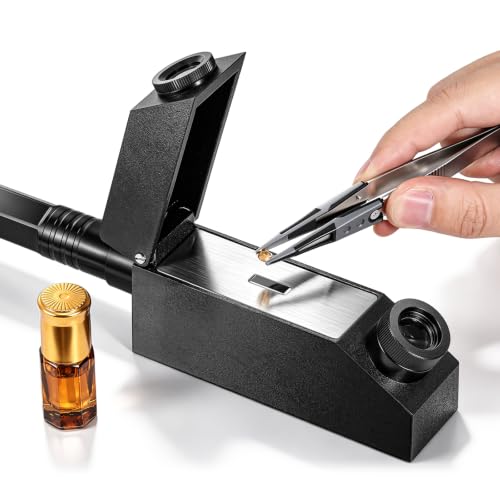
The Mxmonofree RHG-181 is one of the gem refractometers for testing that packages the essentials for a first setup: RI liquid, tweezers, a flashlight, a carrying case, and a step-by-step manual. Its stated measurement range is 1.30–1.81 RI.
Best For: Beginners who want the listed accessories together in one kit for stones within the stated RI range.
Pros:
- Includes RI 1.78 liquid, tweezers, flashlight, and carrying case.
- Step-by-step manual supports first-time use.
- Non-destructive measurement method.
Cons:
- Not suitable for measuring diamond’s approximately 2.42 RI.
- Requires RI liquid rather than offering liquid-free operation.
This kit prioritizes getting started over covering the widest range. Its explicit diamond limitation makes it easier to judge whether it fits your intended stones.
Despite “Diamond Tester” in its title, this RHG181 has a stated 1.30–1.81 RI range. Among gem refractometers for testing, it is better considered a compact, prism-based option for stones whose refractive indices fall within that range.
Best For: Buyers comfortable using refraction oil, an eyepiece, and an external light source for conventional RI measurements.
Pros:
- Compact stated dimensions of about 5.1 × 2.4 × 1.4 inches.
- Uses a prism and adjustable eyepiece for RI observation.
- Stated 1.30–1.81 RI range covers many common gem measurements.
Cons:
- Cannot directly measure diamond’s approximately 2.42 RI despite the product title.
- Instructions require refraction oil and a light source; the notes do not confirm either is included.
Check what comes in the package before buying. The listed procedure is clear, but the stated RI limit is the deciding factor if diamond testing is your goal.
Compact Standard-Range Pick – Taidda Portable Gem Refractometer
For shoppers comparing gem refractometers for testing, this compact model covers the 1.30–1.81 refractive-index range and is designed for gemstones and other solid materials. It is a straightforward choice when portability matters more than bundled accessories.
Best For: Buyers who want a compact refractometer for routine gemstone RI measurements.
Pros:
- Specified 1.30–1.81 measurement range.
- Compact body measures 5.12 x 2.36 x 1.38 inches.
- Designed to help distinguish singly and doubly refractive gems.
Cons:
- The supplied notes do not specify included accessories or calibration materials.
- The 1.81 upper limit is narrower than the digital model’s stated range.
At a listed 1.26 pounds, it offers a relatively compact format. Check whether you need additional testing supplies before choosing this model.
Best for Everyday Use – Digital Gemstone Refractometer
Among gem refractometers for testing, this digital model stands out for its stated 1.300–3.000 refractive-index range, backlit LCD, and oil-free measuring process. The listing specifies a ±0.005 measurement error, so its 0.001 display resolution should not be read as guaranteed accuracy.
Best For: Buyers who want digital RI readings across a wider stated range without refractive oil.
Pros:
- Stated 1.300–3.000 RI measurement range.
- No refractive oil required for the described measuring process.
- Includes 1.487 and 1.806 calibration blocks and a rechargeable 700mAh battery.
- Backlit LCD supports reading the result.
Cons:
- Requires calibration before measurement according to the supplied notes.
- Listed measurement error is ±0.005 despite the 0.001 resolution claim.
This is the most feature-rich option here on paper, particularly if you prefer a digital readout. Its specified calibration step is worth factoring into your workflow.
Accessory Kit Pick – RHG-181 Gem Refractometer
If you are shopping for gem refractometers for testing and want accessories in the package, the RHG-181 pairs a stated 1.30–1.81 RI range with a 30x jeweler’s loupe and 3 mL of refraction oil. Its metal construction and built-in LED flashlight round out the listed features.
Best For: Buyers who want a standard-range gem refractometer bundled with a loupe and refraction oil.
Pros:
- Includes a 30x loupe and 3 mL bottle of refraction oil.
- Stated 1.30–1.81 measurement range.
- Metal construction and a built-in LED flashlight.
Cons:
- Refraction oil is part of the described testing setup.
- Its stated range stops at 1.81.
The included loupe and oil make this a practical package if you do not already own those supplies. Choose based on the RI range you need rather than the listing’s broad gemstone-identification claims.
Oil-Free Digital Pick – Rechargeable Gemstone Refractometer
For buyers comparing gem refractometers for testing without refractive oil, this digital model offers a stated refractive-index range of 1.300–3.000 and a backlit LCD. The included 1.487 and 1.806 calibration blocks need to be used before measurement.
Best For: Collectors and jewelry professionals who want a portable, rechargeable tester with an oil-free measurement process.
Pros:
- Stated 1.300–3.000 range with 0.001 resolution and ±0.003 measurement error.
- Backlit display and rechargeable 700mAh battery; the listing claims up to 10,000 measurements per charge.
- Includes two calibration blocks and has an aluminum-alloy body.
Cons:
- Requires calibration before measurement.
- Listing gives conflicting weight information: approximately 250 g in the bullets versus 8.8 pounds in the details.
Its oil-free setup and broad stated range are the main attractions, but confirm the listed weight if portability is important to you.
Traditional Optics Pick – Ade Advanced Optics GL500
Among gem refractometers for testing commonly encountered stones, the Ade Advanced Optics GL500 offers a stated refractive-index range of 1.30–1.81. Its all-metal body, built-in LED light, and included polarizing filter make it a practical kit for optical examination.
Best For: Jewelers and gemology learners who want an illuminated refractometer with a filter for double-refraction testing.
Pros:
- All-metal construction provides a sturdy testing instrument.
- Built-in LED light runs on three included 1.5V batteries.
- Includes a polarizing filter and soft storage pouch.
Cons:
- The stated range stops at 1.81, limiting readings above that value.
- LED illumination depends on replaceable batteries.
Choose the GL500 for its included optical accessories and durable build, while checking that your intended stones fall within its stated range.
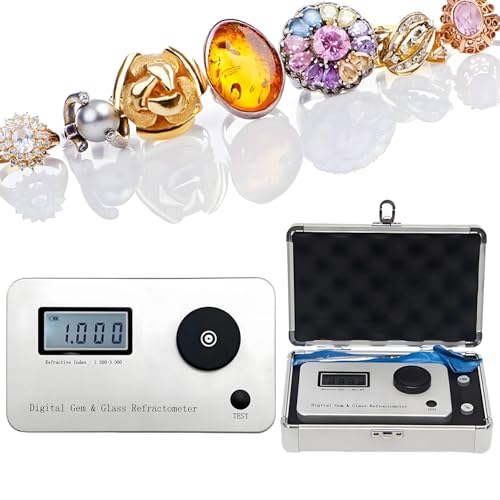
Wide-Range LCD Pick – Oil-Free Jewelry Refractometer
If you are shopping for gem refractometers for testing a variety of solid materials, this LCD model lists a refractive-index range of 1.300–3.000. It measures without refractive oil and comes with 1.487 and 1.806 blocks for calibration before use.
Best For: Gemology users who prefer a backlit digital reading and an oil-free setup.
Pros:
- Stated 1.300–3.000 range with 0.001 resolution and ±0.005 measurement error.
- Backlit LCD and rechargeable 700mAh battery; the listing claims up to 10,000 measurements per charge.
- Includes two calibration blocks and a scratch-resistant aluminum-alloy work surface.
Cons:
- Needs calibration before measurement.
- Listed package weight is 2.2 pounds, which may matter for travel.
This is a useful option if you prioritize the stated range and oil-free operation; allow time to calibrate it before taking readings.
How We Picked These Gem Refractometers for Testing
We focused on the specifications that affect everyday use: stated RI range, optical versus digital readout, lighting, portability, and how clearly a listing explains its measurement method. We also considered who each format suits, from someone learning to read an optical scale to a buyer prioritizing quick digital results. Product names alone are not proof of accuracy, and these selections should not be read as laboratory validation or hands-on test results.
Quick Comparison: Optical Vs. Digital
The RHG181-style optical models in this roundup list ranges around 1.30–1.81. They suit buyers who want a conventional scale reading and are comfortable learning the technique. Confirm whether a model includes a usable light source and what accessories must be bought separately.
Several digital listings advertise broader ranges, reaching approximately 3.000 RI, with an on-screen result. That can be convenient when speed matters, but a wider advertised range does not automatically mean better accuracy across every material. Check the actual measurement method, stated tolerance, supported stones, and instructions before relying on a reading.
Key Buying Factors for Gem Refractometers for Testing
Range and Measurement Method
Start with the RI values of the materials you expect to examine. A 1.30–1.81 optical range covers many common gemstones, but not every material. If you need readings beyond that interval, investigate a wider-range device carefully rather than assuming it works like a traditional contact refractometer.
Readability and Accessories
Optical scales require clear illumination and careful viewing; an integrated light can make bench work easier. Check whether the package includes a case, calibration materials, instructions, and any contact liquid required by its method. Budget for consumables where applicable, and follow the manufacturer’s handling guidance.
Accuracy, Surfaces, and Claims
Look for a stated accuracy or resolution figure, plus instructions for calibration and repeatable readings. Stone condition matters: mounted gems, small facets, rough surfaces, or inaccessible flat faces can limit what a contact reading tells you. Be wary of listings that call an RI instrument a definitive diamond tester, metal tester, or authenticity checker without explaining how those claims are supported. RI is one clue, not a complete identification.
Who Should Buy Which Gem Refractometers for Testing?
Learning gemstone identification? Choose a clearly documented optical model if you want to practice reading RI and understand the measurement process. Testing varied stones frequently? Consider a digital model for its display and advertised range, but verify its method and tolerances first. Working at a bench? Prioritize readable lighting, stable handling, and available accessories over the smallest size. Checking a high-value purchase? Use the refractometer as a screening tool and seek a qualified gemologist or laboratory report when a conclusive identification matters.