If you need clean curves, consistent edge shaping, and better control on small to medium woodworking projects, a quality spindle sander can save time and sanding fatigue.
This roundup focuses on heavy-duty spindle sanders built for steadier performance, stronger motors, and more demanding shop use.
Best 10 Heavy-Duty Spindle Sanders Picks for 2026
Shop-Ready Compact Pick
WEN 6510T 3.5 Amp Oscillating Spindle Sander
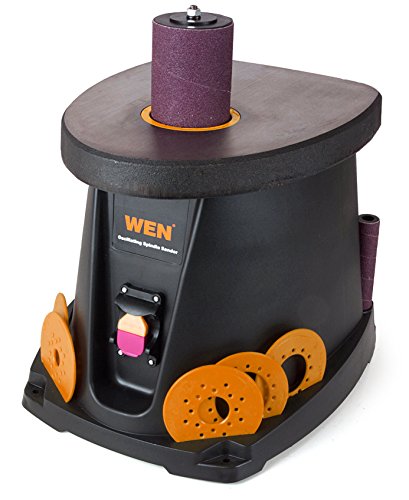
- 3.5-amp motor with 58 OPM and 2000 RPM
- Onboard storage for accessories
- Dust port helps reduce cleanup
Best For: users who want a simple, capable benchtop spindle sander with easier dust collection
Precision Shop Favorite
JET JBOS-5 Benchtop Oscillating Spindle Sander
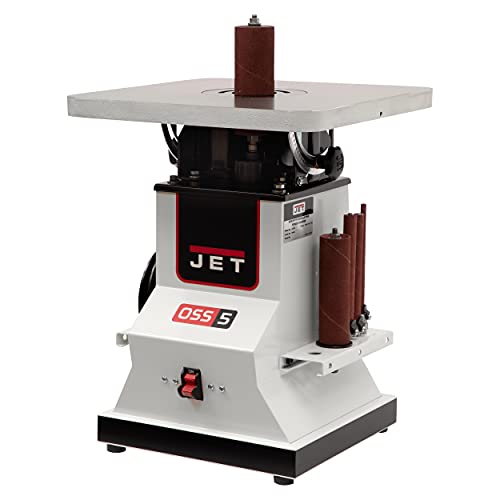
- Precision bearings and worm-gear oscillation
- Cast iron table tilts to 45 degrees
- Includes multiple spindle assemblies and inserts
Best For: woodworkers seeking a durable benchtop sander with precise motion and bevel sanding support
Two-in-One Workshop Value
WEN 6524 Oscillating Belt and Spindle Sander
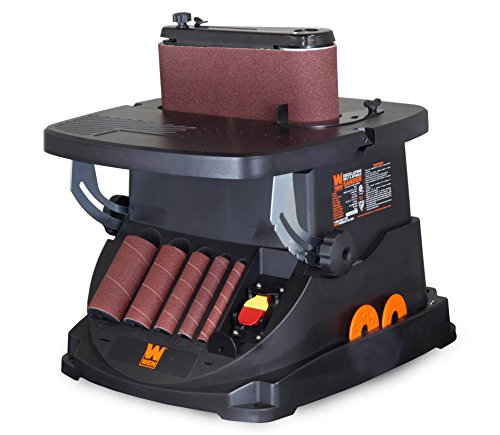
- Spindle and belt sanding in one machine
- 3.5-amp motor with 58 OPM and 2000 RPM
- Onboard storage and multiple accessories included
Best For: shops that want a versatile sanding setup for both spindle and belt work
High-Speed Workspace Pick
VEVOR Oscillating Spindle Sander 2400RPM

- 2400 RPM for efficient sanding
- Six sleeve sizes from 1/2 in. to 3 in.
- Large cast iron table and dust port
Best For: woodworkers needing a fast benchtop spindle sander with a roomy, stable work surface
Extra-Large Tilting Work Surface
WEN AT6535 3.5-Amp Oscillating Spindle Sander
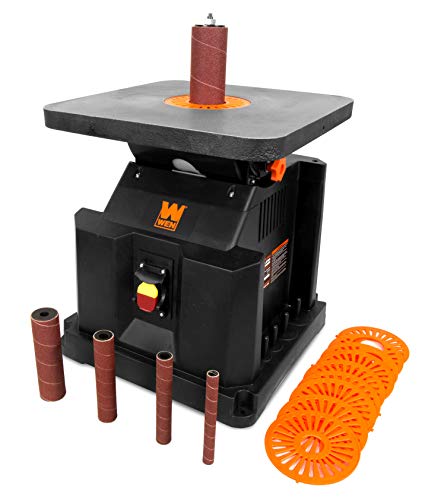
- 3.5-amp motor with 2000 RPM and 58 OPM
- 14-1/2 x 14-1/2-inch table bevels to 45 degrees
- Five sleeve sizes plus onboard storage
Best For: Users who want a roomy benchtop sander with angled-table support
Variable-Speed Heavy Sanding Pick
Woodskil Variable Speed Oscillating Spindle Sander

- 2/3HP 4A motor for tougher sanding jobs
- Variable speed from 1000 to 1800 RPM
- Six sleeves and a dust port for cleaner work
Best For: Users who want more power and adjustable speed for demanding tasks
Compact Benchtop Shop Helper
Rikon Benchtop Oscillating Spindle Sander

- 12-5/8 x 12-inch work surface
- 1/2 HP motor with 1-1/2-inch dust port
- Includes 5 spindles and 6 table inserts
Best For: Shops needing a compact benchtop sander with basic essentials
Portable Dual-Use Pick
WEN HA5932 Variable Speed Oscillating Spindle Sander
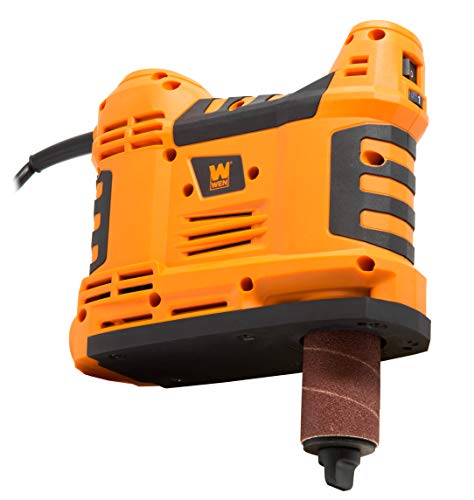
- 5-amp motor with variable speed control
- Portable handheld design can mount to a bench
- Includes multiple spindle sizes, clamps, and dust port
Best For: People who want a portable sander that can also work like a benchtop unit.
Heavy-Duty Shop Pick
Rikon 50-300 Oscillating Spindle Sander

- All-steel construction with heavy-duty gearing
- 1/2 HP motor for steady shop sanding
- Five spindle sizes and six table inserts included
Best For: Woodworkers who want a durable stationary sander for curved edges.
High-Capacity Cabinet Pick
JET JOSS-S 1 HP Oscillating Spindle Sander

- 1 HP motor with large 24.5" x 24.5" table
- Wide spindle range from 1/4" to 4"
- Built-in cabinet storage and 4" dust port
Best For: Shops that need a powerful stationary sander with broad capacity.
Shop-Ready Compact Pick – WEN 6510T 3.5 Amp Oscillating Spindle Sander
If you want heavy-duty spindle sanders with a practical benchtop footprint, the WEN 6510T focuses on core sanding performance and easy cleanup. Its 3.5-amp motor delivers up to 58 oscillations per minute and 2000 RPM, while onboard storage and a dust collection port help keep the workflow organized.
Best For: Buyers who want a straightforward oscillating spindle sander with strong speed and simple dust management.
Pros:
- 3.5-amp motor reaches 58 OPM and 2000 RPM for efficient sanding.
- Onboard storage keeps accessories close at hand.
- Dust collection port supports cleaner operation with a dust extractor.
Cons:
- No table-size or tilt details are provided in the supplied notes.
- Accessory range is not as extensively listed as some larger-feature competitors.
This WEN model is a sensible choice if you want a capable oscillating spindle sander that emphasizes speed, storage, and dust control without adding unnecessary complexity.
Precision Shop Favorite – JET JBOS-5 Benchtop Oscillating Spindle Sander
For shoppers comparing heavy-duty spindle sanders, the JET JBOS-5 stands out with a precision-driven oscillating mechanism and a cast iron work surface. The motor drives a heavy-duty worm and gear system, and the sealed lubricated gearbox is built to support durability over time.
Best For: Woodworkers who want a sturdy benchtop spindle sander with precision parts and bevel-capable setup.
Pros:
- Precision ball bearings and worm-and-gear oscillation support consistent performance.
- Sealed lubricated gear box is designed to help prolong gear life.
- 14-1/2 in. cast iron table tilts to 45 degrees for bevel sanding.
- Includes multiple spindle assemblies and table inserts for broader setup options.
Cons:
- Benchtop format may be less compact than simpler lightweight units.
- Specification-heavy design may be more than occasional users need.
The JBOS-5 is a strong fit if your priority is a more engineered spindle sander built around stable support, tilting capability, and durable internal components.
Two-in-One Workshop Value – WEN 6524 Oscillating Belt and Spindle Sander
If you want heavy-duty spindle sanders plus belt sanding in one machine, the WEN 6524 adds versatility without giving up the core oscillating spindle functions. It combines multiple drum sizes, a belt attachment, and onboard storage, making it a flexible pick for mixed sanding tasks.
Best For: Shops that need both oscillating spindle sanding and a bench belt option in one tool.
Pros:
- Combines spindle sanding with a 4 x 24-inch belt attachment.
- 3.5-amp motor delivers up to 58 oscillations per minute and 2000 RPM spindle speed.
- Includes multiple drum sizes, throat plates, and sanding accessories.
- Onboard storage helps keep parts and sandpaper organized.
Cons:
- Added versatility may make it less focused than a dedicated spindle-only machine.
- More accessories can mean more setup and storage management.
The WEN 6524 makes sense when you want one benchtop sander to handle both curved spindle work and belt sanding tasks, with enough included parts to get started quickly.
High-Speed Workspace Pick – VEVOR Oscillating Spindle Sander 2400RPM
Among heavy-duty spindle sanders, the VEVOR model is built around a high-speed 2400 RPM rotation, a large cast iron worktable, and quick sleeve changes for different shapes. It is aimed at furniture finishing, crafts sanding, and DIY woodworking where a stable surface and flexible sleeve sizing matter.
Best For: Users who want a fast benchtop spindle sander with a roomy cast iron table and broad sleeve coverage.
Pros:
- 2400 RPM rotation supports smooth, efficient sanding.
- Six sleeve sizes cover workpieces from 1/2 in. to 3 in.
- Large 15.6 x 11.6 in. cast iron table adds stable workspace.
- Dust port is designed for vacuum hose hookup to reduce cleanup.
Cons:
- No oscillation speed is listed in the supplied notes beyond the 5/8-inch stroke.
- Focuses on core sanding features rather than advanced convenience extras.
This VEVOR sander is a strong option if you value speed, sleeve variety, and a larger work surface for finishing and contour work.
Extra-Large Tilting Work Surface – WEN AT6535 3.5-Amp Oscillating Spindle Sander
WEN AT6535 3.5-Amp Oscillating Spindle Sander with Extra Large Beveling Table Top
Check Price On AmazonIf you need a heavy-duty spindle sander for curved cuts, edge cleanup, and angled workpieces, the WEN AT6535 brings a strong mix of capacity and convenience. Its 3.5-amp motor runs at 2000 RPM with 58 oscillations per minute, while the 14-1/2 x 14-1/2-inch table gives you a roomy surface that also bevels up to 45 degrees.
Best For: Woodworkers who want a larger benchtop spindle sander with a tilting table and organized accessory storage.
Pros:
- Five sleeve sizes cover 1/2 inch, 3/4 inch, 1 inch, 1-1/2 inch, and 2 inch sanding tasks
- 3.5-amp motor with 2000 RPM and 58 oscillations per minute for steady sanding
- Extra-large 14-1/2 x 14-1/2-inch table bevels up to 45 degrees
- Onboard storage keeps accessories and sandpapers organized
Cons:
- Fixed-speed setup may not suit users who want variable control
- Heavier 33.2-pound build is less portable than compact options
This model stands out for shop-friendly size and practical features, especially if angled work and accessory organization matter in your sanding workflow.
Variable-Speed Heavy Sanding Pick – Woodskil Variable Speed Oscillating Spindle Sander
The Woodskil oscillating spindle sander is built for heavier sanding jobs, with a 2/3HP 4A motor and variable speed control from 1000 to 1800 RPM. For heavy-duty spindle sanders, that combination gives you more flexibility when working on hardwood, curves, slots, or larger surfaces.
Best For: Woodworkers who want more power and variable speed for demanding sanding tasks.
Pros:
- 2/3HP 4A motor is positioned for tougher sanding work
- Variable speed range from 1000 to 1800 RPM adds control
- Includes 6 sanding sleeves from 1/2 inch to 3 inches
- Dust port supports vacuum hookup for cleaner sanding
Cons:
- At 26 pounds, it is portable but still a benchtop tool
- Maximum speed tops out at 1800 RPM, which may be modest for some users
This is the strongest fit if you value adjustable speed and a broad sleeve range over simple fixed-speed operation. The compact design also makes it easier to fit into a smaller shop.
Compact Benchtop Shop Helper – Rikon Benchtop Oscillating Spindle Sander
The Rikon benchtop oscillating spindle sander focuses on a practical work area and straightforward setup for contour sanding. It offers a 12-5/8 x 12-inch work surface, a 1-1/2-inch dust port, a 1/2 HP motor, and multiple inserts, making it a solid choice for general spindle sanding in a smaller footprint.
Best For: Shops that need a compact benchtop spindle sander with useful dust collection and included inserts.
Pros:
- 12-5/8 x 12-inch work surface provides a usable sanding area
- 1/2 HP motor supports everyday oscillating spindle sanding
- 1-1/2-inch dust port helps with dust collection hookup
- Includes 5 spindles and 6 table inserts
Cons:
- No variable speed is listed in the supplied details
- Smaller work surface than larger benchtop models
If you want a straightforward spindle sander with the essentials included, this Rikon is easy to size into a shop. It leans more toward practical utility than extra features.
Portable Dual-Use Pick – WEN HA5932 Variable Speed Oscillating Spindle Sander
If you want heavy-duty spindle sanders support in a tool that can move from the bench to the workpiece, the WEN HA5932 is built around that flexible approach. Its 5-amp variable-speed motor, multiple spindle sizes, and included mounting hardware make it a practical option for sanding curves, contours, and hard-to-reach spots without giving up benchtop convenience.
Best For: Users who need a portable oscillating spindle sander that can also be clamped down for stationary work.
Pros:
- 5-amp variable-speed motor runs from 1,800 to 3,200 rotations per minute with 50 to 90 oscillations per minute.
- Lightweight portable design is meant for handheld sanding in hard-to-reach places.
- Includes mounting hardware to convert it into a benchtop spindle sander.
- Comes with four spindle diameters plus sleeves, drums, clamps, guide plate, and a dust port.
Cons:
- Smaller portable format may not suit users who want a full-size stationary machine.
- Uses a 1/4-inch stroke, which is more compact than heavier shop units.
This is a versatile choice if you need sanding flexibility more than maximum cabinet-shop size. The included accessories and dual-use setup make it especially appealing for tasks that shift between bench work and on-site touch-ups.
Heavy-Duty Shop Pick – Rikon 50-300 Oscillating Spindle Sander
For buyers comparing heavy-duty spindle sanders, the Rikon 50-300 stands out as a solid shop machine with all-steel construction and a stout 1/2 HP motor. It is designed for fast, accurate sanding of curved edges, and the oscillating action plus multiple spindle diameters make it a strong fit for regular bench-top shaping work.
Best For: Woodworkers who want a durable, all-steel oscillating spindle sander for curved-edge sanding.
Pros:
- All-steel build with heavy-duty construction.
- 1/2 HP motor and all-steel gearing support steady shop use.
- Oscillates 15/16-inch, 29 times per minute for efficient abrasive cutting.
- Includes five spindle diameters and six table inserts.
Cons:
- At 76 pounds, it is not a portable option.
- Designed for specialized curved-edge sanding rather than general-purpose portability.
This model fits the buyer who wants a dedicated machine with a more substantial feel and shop-ready hardware. Its cast iron table, metal housing, and spindle range make it well suited to repetitive shaping tasks.
High-Capacity Cabinet Pick – JET JOSS-S 1 HP Oscillating Spindle Sander
If you need heavy-duty spindle sanders with more capacity and shop-focused features, the JET JOSS-S is the most substantial machine in this group. Its 1 HP motor, large tilting table, wide spindle assortment, and built-in dust collection details make it a strong choice for demanding bench work where consistency and setup convenience matter.
Best For: Shops that want a high-capacity oscillating spindle sander with a wide spindle range.
Pros:
- 1 HP, 115V motor provides more power than the smaller units in this roundup.
- Large 24.5″ x 24.5″ table tilts 45° front and 15° back with a 90° quick index.
- Includes spindle assemblies from 1/4″ up to 4″ for broad sanding versatility.
- 4″ dust port and table baffles are designed to improve dust collection.
Cons:
- Full cabinet-style machine is less suited to small shops that need portability.
- More machine than needed if you only do occasional curved-edge sanding.
Among the listed options, this is the most feature-rich stationary sander for a dedicated shop setup. The wide spindle selection and cabinet storage make it easier to keep accessories organized and ready for frequent use.
How We Picked the Best Heavy-Duty Spindle Sanders
We looked for machines that balance motor strength, oscillation performance, worktable stability, and ease of sleeve changes. For Heavy-Duty Spindle Sanders, the goal is not just sanding power, but repeatable results on curved cuts, templates, and edge cleanup.
We also prioritized practical shop features such as cast-iron or large tabletops, variable speed controls, dust collection, and whether the machine is better suited to bench-top or portable use.
Quick Comparison
In general, benchtop models are best for steady, repeated sanding tasks, while portable options are useful when space is tight or the tool needs to move between job sites. Higher-powered units and larger tables tend to offer better control on longer workpieces, while variable-speed machines give you more flexibility across softwoods, hardwoods, and detail work.
Key Buying Factors for Heavy-Duty Spindle Sanders
Motor Power and Speed Control
More power helps maintain consistent sanding pressure on dense stock and wider contact areas. Variable speed is especially valuable when switching between delicate curves and more aggressive stock removal.
Oscillation Stroke and RPM
A longer stroke can reduce heat buildup and help extend sleeve life, while the right RPM range affects surface finish and sanding aggressiveness. Look for a balance that matches the type of work you do most.
Table Size and Stability
A larger, flatter table makes it easier to support panels and maintain square contact. For Heavy-Duty Spindle Sanders, table rigidity matters as much as motor size because wobble can affect edge accuracy.
Sleeve Range and Accessory Support
Check the available spindle diameters and sleeve sizes to make sure the tool can handle both small contours and larger curves. Easy sleeve changes and readily available replacements are also important for long-term use.
Dust Collection
Good dust collection improves visibility, keeps abrasive sleeves working longer, and makes cleanup easier. This matters even more during extended sanding sessions.
Who Should Buy Which Heavy-Duty Spindle Sanders?
Choose a benchtop model if you want a stable, shop-friendly tool for recurring woodworking tasks. If you need more flexibility, a portable unit is a better fit for smaller shops or mobile work. Buyers who regularly sand hardwoods, thicker parts, or production quantities should lean toward the most robust Heavy-Duty Spindle Sanders with stronger motors, larger tables, and better vibration control.
If your priority is detail work on cabinets, furniture parts, or templates, focus on machines with smooth oscillation, variable speed, and a wide range of spindle sizes rather than maximum raw power alone.