A mini CNC can turn a small workbench into a space for cutting parts, engraving designs, and making prototypes. But compact machines vary widely: an entry-level router for wood and plastics is not the same purchase as a rigid machine intended for aluminum.
These 10 picks span beginner-friendly kits, more capable all-metal routers, and enclosed desktop systems. Use the guide below to match a machine to the materials you want to cut, the space you have, and the setup work you are willing to do.
Best 10 Mini Cnc Milling Machines Picks for 2026
Best for PCB and Rotary Projects
Carvera Air 4th Axis & PCB Kit

- Includes 4th axis and PCB pack
- Auto-probing and leveling
- Approximately 10-second tool changes
Best For: PCB fabrication and small rotary projects
Best for Rotary Machining
Carvera Air 4th Axis Rotary Kit

- Included simultaneous 4th axis
- 3.6-inch by 7.9-inch rotary capacity
- Auto-probing and quick tool changes
Best For: Small cylindrical and 3D parts
Best Enclosed 3-Axis Pick
Carvera Air Standard Desktop CNC
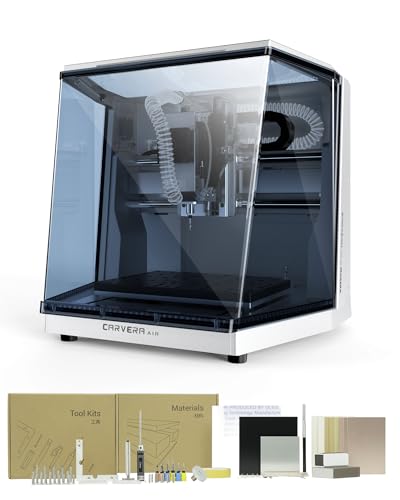
- Enclosed 11.8 × 7.9 × 5.1-inch workspace
- Auto-probing and leveling
- Approximately 10-second tool changes
Best For: Enclosed 3-axis desktop projects
Best for Learning GRBL

- 300 × 180 × 45 mm work area
- GRBL control with Candle
- Included offline controller
Best For: Beginners learning small CNC projects
Best for Metal Projects

- 710W digital spindle
- Dual rails and ball screws on every axis
- Stated ±0.03mm precision
Best For: Rigid aluminum and acrylic engraving
Best Compact Learning Kit

- 15-pound desktop design
- 300 × 180 × 40mm work area
- Wired USB control only
Best For: Small projects and hands-on CNC learning
Best Beginner Upgrade Path

- Pre-assembled main parts
- Engraves wood, plastics, and soft metals
- Optional spindle and offline-control upgrades
Best For: First-time CNC users seeking room to grow
Best for Upgrades

- 800W six-speed trim router
- Dual linear guides on all axes
- Multiple optional upgrades
Best For: Hobbyists planning to expand a compact CNC setup
Best for Z-Axis Clearance

- 300 × 180 × 80 mm work area
- 500W spindle
- Six limit switches plus emergency stop
Best For: Desktop projects needing extra vertical travel
Best for Quick Setup

- 800W router
- Ball screws and linear guides on all axes
- Arrives largely assembled
Best For: Desktop users seeking limited assembly and ball-screw drives
Best for PCB and Rotary Projects – Carvera Air 4th Axis & PCB Kit
Among mini cnc milling machines, this Carvera Air bundle stands out if your projects span both PCB fabrication and rotary machining. It pairs the enclosed desktop mill with a 4th-axis module and a PCB Fabrication Pack.
Best For: Makers who want one desktop setup for circuit boards, cylindrical parts, and detailed 3D work.
Pros:
- Included 4th axis supports simultaneous rotary machining within a 3.6-inch-diameter by 7.9-inch-long work area.
- Auto-probing and leveling help with setup on uneven stock.
- Quick tool changer supports approximately 10-second tool changes for multi-step jobs.
- Includes a PCB Fabrication Pack alongside accessory, tool, and material kits.
Cons:
- The rotary work area limits the size of cylindrical pieces.
- Makera CAM runs on Mac OS and Windows, so users of other desktop systems may need a different CAM workflow.
Choose this version when the included PCB pack matters as much as the rotary capability; check the rotary dimensions against your planned parts before buying.
Best for Rotary Machining – Carvera Air 4th Axis Rotary Kit
If cylindrical work is your priority when comparing mini cnc milling machines, this Carvera Air package includes the desktop CNC and its 4th-axis module. The rotary setup supports simultaneous 4-axis machining for shapes that go beyond flat stock.
Best For: Makers producing small cylindrical pieces, double-sided objects, or detailed 3D models.
Pros:
- Included rotary module accommodates work up to 3.6 inches in diameter and 7.9 inches long.
- Quick tool changer allows tool swaps in about 10 seconds.
- Auto-probing and leveling simplify workpiece calibration.
- Wi-Fi or USB control, with Makera CAM available for Mac OS and Windows.
Cons:
- Rotary stock must fit the stated work area.
- This package’s listed contents do not include the PCB Fabrication Pack found in the separate PCB-kit bundle.
This is the more focused Carvera Air bundle for rotary work. If circuit-board supplies are also on your list, compare the included components of the PCB-kit version.
Best Enclosed 3-Axis Pick – Carvera Air Standard Desktop CNC
For buyers looking at mini cnc milling machines without needing a rotary axis, the standard Carvera Air offers an enclosed 3-axis workspace measuring 11.8 by 7.9 by 5.1 inches. It is aimed at desktop prototyping, engraving, and small-part work across materials including wood, acrylic, aluminum, and brass.
Best For: Makers who want an enclosed desktop CNC for flat-stock parts, engraving, and PCB milling.
Pros:
- Enclosure helps contain chips and dust and reduce noise.
- Auto-probing and surface leveling assist with accurate setup.
- Built-in quick tool changer supports approximately 10-second bit changes.
- Includes accessory, tool, and material kits to help get started.
Cons:
- This is the standard 3-axis version; a 4th-axis module is not listed in the package.
- Makera CAM supports Mac OS and Windows, despite broader platform support for the controller.
Its enclosed design and setup aids make it a practical choice for varied small projects. Pick a 4th-axis bundle instead if rotary machining is central to your plans.
Best for Learning GRBL – Genmitsu CNC 3018-PRO
The Genmitsu 3018-PRO is an approachable entry among mini cnc milling machines for learning G-code and making small wood, acrylic, PVC, plastic, or PCB projects. Its 300 by 180 by 45 mm working area fits modest carving, engraving, and prototyping jobs.
Best For: Beginners who want hands-on GRBL practice and small-scale desktop CNC projects.
Pros:
- GRBL control and Candle provide a documented path into CNC operation.
- Included offline controller can run compatible G-code without a connected computer.
- Compact workspace suits small signs, circuit-board prototypes, and custom parts.
- Can work with soft aluminum when paired with suitable bits and cutting settings.
Cons:
- The 45 mm Z travel restricts taller workpieces.
- Soft-aluminum cutting depends on the right bits and settings; it is not presented as an all-purpose metal mill.
Choose the 3018-PRO if learning the CNC workflow matters more than a large work envelope or automated setup features.
Best for Metal Projects – Genmitsu 3030-PROVer Ultra
Among mini cnc milling machines, the Genmitsu 3030-PROVer Ultra is the more substantial choice for makers focused on aluminum and acrylic. Its 710W spindle, all-metal chassis, dual linear rails, and ball screws are designed for stable, detailed work.
Best For: Makers who prioritize rigid construction and precise engraving on aluminum or acrylic.
Pros:
- 710W digital spindle displays operating information in real time.
- Dual linear rails and ball screws on every axis support the stated ±0.03mm precision.
- Two pre-assembled modules simplify setup; a side-mounted emergency stop is easy to reach.
Cons:
- At 23 kg, it is less convenient to move than a lightweight desktop kit.
- Its listed power specification is 230V, so check compatibility with your workspace.
Choose this model when rigidity and metal-focused capability matter more than portability. Its app control and compatibility with Candle, UGS, and Easel also offer several ways to manage projects.
Best Compact Learning Kit – TTC3018 Pro
The TTC3018 Pro suits shoppers comparing mini cnc milling machines for a small desk or a hands-on introduction to CNC assembly. It weighs 15 pounds and provides a 300 × 180 × 40mm working area for modest projects.
Best For: DIY learners and makers producing small engravings or nameplates in limited space.
Pros:
- Compact 420 × 355 × 280mm footprint and 15-pound weight.
- All-metal Z-axis with a T8 backlash-eliminating lead screw and stated 0.1mm positioning accuracy.
- Kit includes 10 cutters, an ER11 collet, and a 775 spindle motor.
Cons:
- USB cable is the only stated file-transfer method; there is no built-in wireless connection or TF card slot.
- The 40mm working height limits taller pieces.
This is a practical pick if you want to learn how the axes work while assembling your machine. For control, plan around a wired USB connection rather than offline or wireless operation.
Best Beginner Upgrade Path – Genmitsu 3018-PROVer V2
For newcomers browsing mini cnc milling machines, the Genmitsu 3018-PROVer V2 offers a straightforward starting point. Its pre-assembled gantry and one-piece aluminum spoilboard reduce initial assembly, while optional accessories leave room to expand later.
Best For: Beginners engraving wood, plastics, acrylic, or occasional soft-metal pieces who want future upgrade options.
Pros:
- Pre-assembled main parts and organized cable management simplify setup.
- Can engrave wood, plastic, acrylic, PVC, PCB, carbon fiber, density board, and soft metals such as copper and aluminum.
- Supports add-ons including extension kits, a more powerful spindle, and offline control.
Cons:
- A more powerful spindle and offline control are described as accessories, not included features.
- Projects require CAD/CAM software to generate the G-code the machine runs.
Pick this machine if ease of entry and an upgrade path matter more than getting every capability in the base package. The included Z-probe, limit switches, and emergency stop add useful features for a first CNC setup.
Best for Upgrades – 3030-Evo Max CNC Router
Among mini cnc milling machines for a home workshop, the 3030-Evo Max stands out for its upgrade options. It pairs an 800W trim router with dual linear guides on all three axes for light-duty work in wood, plastics, and metals such as aluminum.
Best For: Hobbyists who want a compact machine they can expand as their projects grow.
Pros:
- Dual MGN-15 linear guides on the X, Y, and Z axes.
- Includes an 800W, six-speed router and a Z probe.
- Supports optional spindle, ball-screw, motor, and table upgrades.
- Offers Wi-Fi control through an ESP3D web interface.
Cons:
- Router speed requires manual dial adjustment.
- Major components arrive preassembled, but setup is still required.
This is the flexible pick if you value a defined upgrade path. Its metal-cutting claims are best read in the context of the manufacturer’s light-duty home-machine positioning.
Best for Z-Axis Clearance – LUNYEE 3018 PRO MAX
The LUNYEE 3018 PRO MAX is one of the mini cnc milling machines worth considering when vertical travel matters. Its 300 × 180 × 80 mm working area combines an 80 mm Z-axis stroke with a 500W spindle and an all-metal frame.
Best For: Desktop users who need more Z-axis travel for varied workpiece heights.
Pros:
- 80 mm Z-axis travel within its stated working area.
- 500W spindle with a stated speed range up to 12,000 RPM.
- Six limit switches and an emergency-stop button.
- Manual handwheels help position the X, Y, and Z axes.
Cons:
- The 300 × 180 mm XY working area limits larger projects.
- Installation and wiring are part of setup; videos are provided.
Choose this model for its combination of Z travel and safety hardware, while checking that your typical workpieces fit its modest XY footprint.
Best for Quick Setup – LUNYEE 3020 Nova
For shoppers comparing mini cnc milling machines with minimal assembly, the LUNYEE 3020 Nova arrives largely assembled with its wiring connected. Its 800W router, 1204 ball screws, and HG-15 linear guides on all three axes suit desktop projects in wood, acrylic, plastics, and metals such as aluminum and brass.
Best For: Buyers who want an all-metal desktop CNC with ball-screw drives and limited setup work.
Pros:
- 1204 ball screws and HG-15 linear guides on X, Y, and Z.
- 800W router with six speed settings from 6,000 to 30,000 RPM.
- Wiring comes connected; setup calls for installing the Z-axis module and plugging in power.
- Supports GRBL-compatible software including UGS and Fusion 360.
Cons:
- The Z-axis module still needs installation.
- The supplied notes do not specify the working area’s dimensions.
The Nova makes a practical choice when drive hardware and straightforward setup take priority. Confirm its usable work area against your project sizes before buying.
How We Picked These Mini Cnc Milling Machines
We focused on practical differences buyers can check before ordering: frame construction, motion hardware, spindle or router options, working area, enclosure, controls, and included accessories. We also considered whether a machine is better suited to learning CNC basics, cutting larger projects, or working with metal. Published power and precision figures are useful starting points, not guarantees of results; tooling, feeds, material, and setup matter just as much.
Quick Comparison by Machine Type
3018-class kits from Genmitsu, TTC, and LUNYEE generally suit small engraving jobs, plastics, wood, and introductory CNC work. Check each package closely: spindle power, limit switches, offline controls, and assembly requirements differ.
All-metal 3020 and 3030-style routers offer a step up for buyers who need more working room or plan to machine aluminum or brass. Compare their guides, drive systems, and included cutting motors rather than assuming machines with similar dimensions perform alike.
MAKERA Carvera Air configurations target buyers who value an enclosed desktop format. The listed versions differ in included options, including rotary and PCB-related kits, so choose based on the work you will actually do.
Key Buying Factors for Mini Cnc Milling Machines
Materials and Rigidity
Start with your hardest intended material. Wood, plastic, and PCB work place different demands on a machine than aluminum or brass. For metal, prioritize a stiff frame, well-supported axes, appropriate cutters, and realistic shallow passes. A high-wattage router alone does not make a flexible machine accurate.
Working Area and Tool Clearance
Compare usable travel with your largest workpiece, then allow room for clamps and toolpaths. If you plan to use a vise or thicker stock, check Z-axis clearance as well as advertised work area. A smaller machine can be easier to house, but undersizing it may limit projects immediately.
Software, Controls, and Safety
Confirm which design and CAM software you will need, what files the controller accepts, and whether your computer works with the machine’s connection method. Decide if you want a kit to assemble or a more integrated setup. Limit switches and an emergency stop are valuable, but they do not replace supervision, eye protection, chip control, and suitable ventilation. An enclosure can help contain mess and noise; check what it actually includes.
Total Setup Cost
Budget beyond the machine for cutters, workholding, a spoilboard, replacement bits, and material. PCB work or rotary projects may call for additional accessories. Before buying, verify what is in the specific bundle rather than relying on the product family name.
Who Should Buy Which Mini Cnc Milling Machines?
First-time users: consider a 3018-class machine if your projects are small and you want to learn at a lower commitment. Metal-focused hobbyists: look toward the more rigid all-metal 3020 or 3030 options, while keeping expectations tied to material and cut settings. Buyers wanting a contained desktop setup: compare the Carvera Air bundles and pay only for the rotary or PCB capabilities you need. The best choice is the one that fits your largest realistic project and leaves room in your budget for tooling and safe operation.