The right roller can make conditioning polymer clay faster, smoother, and more predictable. This roundup compares 10 options for home studios, including compact acrylic pins, texture rollers, tool kits, and adjustable machines.
Use the buying guide below to match roller style, thickness control, workspace, and cleanup needs with the way you actually craft.
Best 10 Polymer Clay Rollers for Home Studios Picks for 2026
Versatile Starter Kit

- Two transparent acrylic rollers
- Cutters, blades, and detail tools included
- Suitable for home, school, and jewelry projects
Best For: Beginners and casual home-studio crafters
Precision Workhorse

- Seven settings from 0.6 mm to 2.6 mm
- Stainless steel rollers with table clamp
- Compatible with optional electric motor
Best For: Repeat projects and higher-volume home studios
Thickness-Control Set

- Two solid transparent acrylic rollers
- Four thickness rings for guided slabs
- Includes dotting, cutting, and detail tools
Best For: Beginners making earrings and mixed clay crafts
Guided Geometry Kit
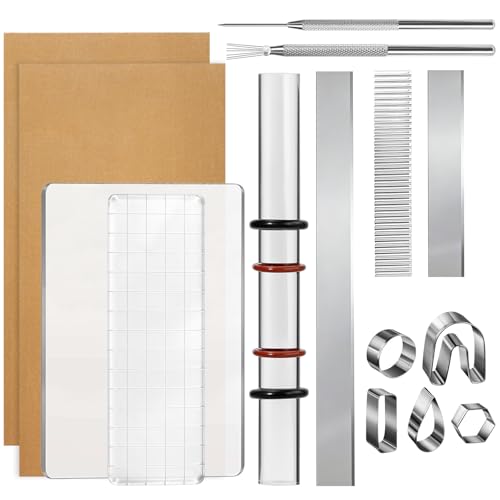
- Guide rings for 3 mm and 5 mm slabs
- Five stainless steel geometric cutters
- Includes grid, acrylic base, and PTFE sheets
Best For: Geometric jewelry and repeatable clay designs
Best Overall
6-Setting Polymer Clay Press Machine

- Six thickness settings for controlled sheets
- Clamp helps keep the machine firm
- Includes 40 clay cutters
Best For: Repeatable jewelry and craft clay sheets
Best for Texture Variety
10-Piece Clay Texture Roller Set

- Ten rollers with distinct patterns
- Lightweight plastic design
- Smooth surfaces wipe clean
Best For: Adding decorative patterns to clay
Best Compact Option
Clear Acrylic Clay Rolling Pin

- Transparent body keeps clay visible
- Solid acrylic construction
- Easy to wash after use
Best For: Hand-rolling and smoothing small clay projects
Starter Tool Kit

- Includes roller, press board, sculpting tools, and dot tools
- Transparent surfaces improve visibility while working
- Useful for beginner rolling and detail work
Best For: Beginners building a versatile home clay toolkit
Studio Essential

- Clear acrylic design keeps the clay visible
- Smooth surface is intended to resist sticking
- Compact roller is easy to clean and store
Best For: Crafters wanting a dedicated everyday roller
Precision Pick
Acrylic Roller Set with Thickness Rings

- Includes 3 mm and 5 mm thickness guides
- Two clear acrylic rollers support visible, even rolling
- Designed for jewelry, miniatures, and small projects
Best For: Makers needing consistent clay slab thickness
Versatile Starter Kit – Acrylic Roller and Cutters
For shoppers seeking polymer clay rollers for home studios, this 12-piece acrylic kit offers a straightforward manual setup with two transparent rollers, cutters, blades, and detail tools. The clear rollers help you see the clay while working, making the set practical for basic conditioning, shaping, jewelry projects, and sculpting.
Best For: Beginners, families, classrooms, and home crafters who want a compact manual clay-tool assortment.
Pros:
- Includes two acrylic rollers, including solid and hollow designs.
- Transparent rollers provide visibility while rolling clay.
- Includes cutters, blades, a texture wire, and a needle detail tool.
- Protective covers are provided for the acrylic sheets, and the blades come with a protective box.
Cons:
- Manual rolling requires more effort than a conditioning machine.
- The set does not list thickness-guide rings or adjustable roller settings.
This is a practical entry-level option when you want more than a roller alone. It is especially useful for small home projects, though creators focused on highly uniform slab thickness may prefer a guided roller or machine.
Precision Workhorse – 7-Level Clay Roller Machine
Among polymer clay rollers for home studios, this stainless steel roller machine is the choice for repeatable sheets and reduced hand fatigue. Its seven marked thickness levels, hand crank, and table clamp support consistent preparation for earrings, blending, and larger batches.
Best For: Home-studio artists and high-volume crafters who need adjustable thickness and more consistent conditioning.
Pros:
- Offers seven thickness settings from 0.6 mm to 2.6 mm.
- Heavy-gauge stainless steel construction is designed for regular use.
- Includes a table clamp, ergonomic hand crank, and instruction booklet.
- Can be paired with a compatible electric motor sold separately.
Cons:
- The machine is heavier and less portable than a handheld acrylic roller.
- The electric motor is not included.
- Users need to pre-flatten clay and follow setup tips to help prevent jamming.
This machine is the strongest fit for makers who value repeatability over compact storage. It costs more space and setup effort than a simple roller, but the adjustable gap and clamp make it better suited to ongoing studio production.
Thickness-Control Set – DIYOOHOMY Acrylic Roller Kit
This DIYOOHOMY set expands the basic polymer clay rollers for home studios concept with two solid acrylic rollers and four thickness rings. It also supplies blades, knives, dotting tools, and detail instruments for makers who want one kit for rolling, cutting, texturing, and jewelry work.
Best For: Beginners and hobbyists making polymer clay earrings, miniatures, classroom projects, and decorative crafts.
Pros:
- Two transparent solid rollers provide a smooth rolling surface.
- Four thickness rings help produce more consistent clay slabs.
- Includes five dotting tools for patterns, holes, and surface details.
- Comes with long blades, short knives, a craft knife, and replacement blades.
Cons:
- It is a manual kit without a machine or crank-operated roller.
- The supplied notes list differing piece counts in the title and product details.
- No warranty is listed in the supplied product details.
For a broad assortment of tools in a compact package, this kit is more versatile than a roller-only purchase. The thickness rings are useful for repeated slabs, while the numerous detailing tools make it a well-rounded option for exploratory crafting.
Guided Geometry Kit – Roller, Cutters, and Grid
Designed for organized home studios, this 19-piece set combines a clear roller with four silicone thickness rings, a grid guide, an acrylic base, shape cutters, blades, and nonstick sheets. It is a useful pick among polymer clay rollers for home studios when repeatable geometric designs and clean transfers matter.
Best For: Adult beginners and crafters creating earrings, tiles, miniatures, ornaments, and repeat geometric forms.
Pros:
- Four guide rings support 3 mm and 5 mm rolling options.
- Five stainless steel cutters create circles, arches, rectangles, teardrops, and hexagons.
- Grid guide and acrylic base help with alignment and work-surface control.
- Two PTFE nonstick sheets assist with lifting and transferring clay.
Cons:
- Clay is not included.
- The sharp blades are specified for adult use only.
- The roller has guided ring options rather than a machine-style adjustable thickness dial.
This is a strong choice for makers who prioritize repeatable shapes and a more structured workflow. The grid and transfer sheets add useful studio organization, while the included cutters make it especially suited to geometric designs.
Best Overall – 6-Setting Polymer Clay Press Machine
For home studios that need consistent sheets, this polymer clay roller for home studios combines manual pressing with six thickness settings. Its stainless-steel construction, table clamp, and included cutters make it suited to repeatable jewelry and craft work.
Best For: Crafters making earrings, ornaments, jewelry bases, and smooth blended clay sheets.
Pros:
- Offers six thickness levels from under 1 mm to 3 mm.
- Creates sheets up to 5⅞ inches wide.
- Includes a table clamp for steadier operation.
- Comes with 40 stainless-steel clay cutters.
Cons:
- Manual operation requires turning the roller by hand.
- Its 5⅞-inch width may be limiting for larger projects.
- It is intended for craft materials, not food use.
This is the most capable option of the three for uniform sheets and thickness control. Choose it when repeatability and included accessories matter more than portability.
Best for Texture Variety – 10-Piece Clay Texture Roller Set
This set is a practical choice for polymer clay rollers for home studios when surface detail is the priority. Ten patterned plastic rollers provide different textures for clay, pottery embellishment, and other soft craft materials.
Best For: Adding repeated patterns and decorative texture to polymer clay projects.
Pros:
- Includes 10 rollers with distinct designs.
- Lightweight plastic construction is easy to handle.
- Smooth surfaces are designed for quick cleanup.
- Works with polymer clay, pottery clay, and other soft materials.
Cons:
- Plastic construction may offer less rigidity than metal tools.
- The set is for texturing rather than producing adjustable sheet thicknesses.
With multiple patterns in one compact set, these rollers expand decorative options without taking much studio space. They are a good complement to a sheet-rolling machine or acrylic pin.
Best Compact Option – Clear Acrylic Clay Rolling Pin
For small home studios seeking a straightforward polymer clay roller for home studios, this clear acrylic rolling pin offers a compact, solid design. Its transparent body keeps the clay visible while the smooth surface supports easy cleanup.
Best For: Hand-rolling, shaping, and smoothing clay for small DIY projects.
Pros:
- Clear acrylic design provides an unobstructed view while rolling.
- Solid cylindrical construction feels sturdy in hand.
- Measures 7.87 inches long and 0.79 inches in diameter.
- Smooth surface can be washed with soap and water.
Cons:
- Provides no adjustable thickness settings.
- Offers only one roller and no cutters or texture patterns.
- Hand rolling may be less consistent than using a press machine.
This roller is an uncomplicated, portable tool for artists who prefer direct hand control. Its clear acrylic construction is especially useful when visibility and easy maintenance are priorities.
Starter Tool Kit – 15-Piece Acrylic Roller Set
For shoppers comparing polymer clay rollers for home studios, this beginner-friendly set combines a clear acrylic roller with sculpting, dotting, and pressing tools. The transparent roller and board help you monitor your work while shaping and smoothing clay.
Best For: Beginners who want an all-in-one clay tool set for sculpting, smoothing, carving, and detail work.
Pros:
- Includes an acrylic roller, clear press board, sculpting tools, and dot tools.
- Transparent roller and board make the clay and work surface easier to see.
- Multiple tool shapes support brushing, scraping, cleaning, smoothing, shaping, and carving.
- Compact, lightweight design is easy to carry and store.
Cons:
- The set is aimed at general beginner use rather than specialized slab thickness control.
- The included roller is part of a broader 15-piece kit, so it may be more than needed if you only want a rolling pin.
This is a practical starter option for a home studio where one purchase needs to cover rolling and basic clay detailing. Choose it if versatility matters more than adjustable thickness guides.
Studio Essential – 7.8-Inch Clear Acrylic Roller
This clear acrylic roller is a focused choice for polymer clay rollers for home studios, with a 7.8-inch length and smooth cylindrical surface. Its transparent design helps you watch the clay as you apply pressure, while the compact size is convenient for storage and portable crafting.
Best For: Crafters who want a dedicated, easy-clean roller for polymer clay, air-dry clay, fondant, or small studio projects.
Pros:
- Transparent construction supports visibility and pressure control.
- Solid acrylic body is described as sturdy, smooth, and resistant to deformation.
- Non-stick surface helps reduce residue during rolling.
- Seamless design can be cleaned with soap and warm water.
Cons:
- This listing includes one rolling pin rather than a broader tool set.
- No adjustable thickness rings are included.
For a home studio that already has sculpting and cutting tools, this streamlined roller keeps the focus on visibility, portability, and simple cleanup. It is a sensible pick when you do not need thickness guides or accessories.
Precision Pick – Acrylic Roller Set with Thickness Rings
Among polymer clay rollers for home studios, this set stands out for its included thickness guides. Two clear acrylic rollers come with 3 mm and 5 mm rings, helping you make more even slabs for jewelry, miniatures, pendants, and other small clay projects.
Best For: Jewelry makers, miniature artists, and hobbyists who need repeatable 3 mm or 5 mm clay thicknesses.
Pros:
- Includes two solid acrylic rollers plus 3 mm and 5 mm guide rings.
- Thickness rings help keep both sides level for consistent slabs.
- Clear rollers provide visibility while working.
- Suitable for polymer clay, air-dry clay, jewelry, miniatures, and small pottery projects.
Cons:
- Only two thickness settings are supplied.
- The guide rings add setup steps compared with a basic roller.
This is the strongest fit for makers who care about consistent slab thickness rather than simply flattening clay. The included 3 mm and 5 mm options make it especially practical for repeatable jewelry and miniature work.
How We Picked the Best Polymer Clay Rollers for Home Studios
We focused on tools suited to home crafting rather than production-scale equipment. The selection includes hand rollers, kits with cutters or sculpting tools, texture rollers, and manual press machines with multiple thickness settings. We considered adjustability, material, ease of cleaning, portability, included accessories, and how useful each option is for common projects such as jewelry, charms, ornaments, figurines, and decorative slabs.
Because product bundles vary, check the listed dimensions and included pieces before ordering. A large kit may offer better value, while a single roller can be the better choice if you already own cutters and finishing tools.
Quick Comparison
- Best for simple projects: A clear acrylic roller is compact, easy to control, and straightforward to clean.
- Best for repeatable sheets: An adjustable clay press provides more consistent thickness than hand rolling.
- Best for beginners: A kit with thickness rings, cutters, and basic sculpting tools reduces the need for separate purchases.
- Best for surface effects: Texture rollers add patterns quickly, although they are less versatile for plain conditioning.
- Best for small workspaces: A mini roller or compact tool set stores easily and needs no clamp or dedicated setup.
Key Buying Factors for Polymer Clay Rollers for Home Studios
Roller Type and Control
Acrylic pins work well for small batches, blending, and irregular shapes, but achieving an exact thickness takes practice. Press machines are faster for sheets and layered designs, particularly when you make repeated pieces. Texture rollers are specialized tools and usually work best alongside a smooth roller.
Thickness Options
Thickness rings can help beginners produce more even slabs, while numbered settings on a press are more repeatable. Look for a useful range rather than simply the highest number of settings. Thin sheets suit appliqué and earrings; thicker sheets are often easier to handle for sculpting and structural parts.
Materials, Cleaning, and Safety
Choose smooth, non-porous surfaces that will not trap clay residue. Stainless steel and clear acrylic are generally easy to wipe clean, but inspect edges and seams for areas that could collect material. Keep dedicated clay tools separate from food-preparation equipment, even when a product is also marketed for fondant or gum paste.
Workspace and Storage
Measure your work surface before choosing a press. Hand rollers are more portable, while machines need room for operation and storage. Kits with many accessories can be convenient, but they may require an organizer to keep small cutters and rings together.
Who Should Buy Which Polymer Clay Rollers for Home Studios?
Choose a basic acrylic roller if you are starting out, work on small pieces, or want the lowest-cost, easiest-to-store option. Choose a kit if you need cutters, thickness guides, and sculpting tools in one purchase. Choose an adjustable press if consistent slabs, repeated components, or larger projects are central to your workflow. Choose texture rollers if patterned surfaces are a priority, but pair them with a smooth conditioning tool for general use.
For most home studios, the best choice balances repeatability with available space. If you are unsure, a versatile acrylic roller kit is a practical starting point; you can add a press later as your project volume and precision requirements grow.