Choosing the right rotary welding positioner can improve weld quality, reduce repositioning, and make repetitive work far easier to control.
Below, we focus on practical differences like capacity, tilt, speed range, and portability so you can match the machine to your projects.
Best 10 Rotary Welding Positioner Picks for 2026
Heavy-Duty 30KG Pick
VEVOR 66LB Tilting Welding Positioner

- 80W motor with 1-12 rpm stepless control
- 0-90° tilting table with self-locking worm gear
- 315mm three-jaw chuck and torch stand holder
Best For: Heavier workpieces and shop setups that need stable, low-speed rotation
Compact Desktop Choice
Portable 10KG Rotary Welding Positioner

- Compact cast-iron build for small workspaces
- 10W motor with stepless speed control up to 10 rpm
- 0-90° tilt and three-jaw chuck for small parts
Best For: Small-part welding on a bench or desktop
High-Capacity Shop Pick

- 120W motor with 0.5-6 rpm low-speed control
- Up to 110 lbs horizontal load capacity
- 0-90° tilt, 315mm chuck, and torch stand holder
Best For: Medium-to-heavier shop work that needs stronger capacity and precision
Budget Small-Part Option
22LB Precision Rotary Welding Positioner
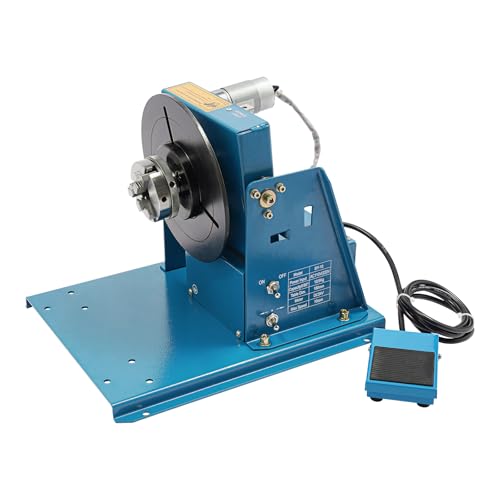
- 10W DC motor with 2-10 rpm variable speed
- Anti-electromagnetic interference design for TIG work
- 0-90° tilt and footswitch control for flexibility
Best For: Light-duty welding of small flanges, tubes, and round parts
Heavy-Duty Pick
100kg Rotary Welding Positioner with 360mm Table

- 100kg load capacity for larger workpieces
- 1-10 stepless speed adjustment
- 0-90° tilt with 300mm chuck
Best For: Steel pipe, flange, and heavier seam welding
Portable Value Pick
22 lb Rotary Welding Positioner with Worm Gear Drive

- 22 lb capacity for lighter work
- Self-locking worm gear for accurate positioning
- 0-90° tilt with three-jaw chuck
Best For: Lighter weldment handling and compact shop setups
Best with Extra Features
66LBS / 30KG Rotary Welding Positioner Turntable Table
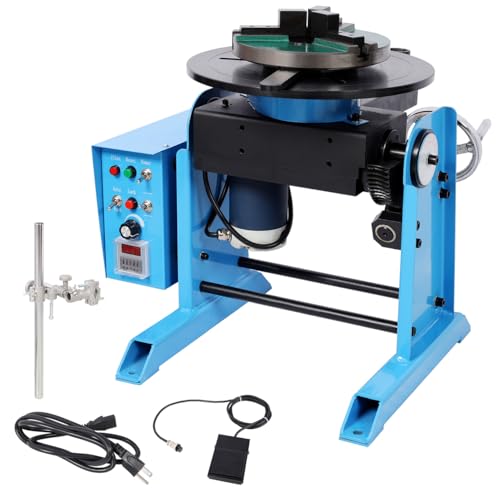
- 66 lb / 30 kg capacity
- 0-90° tilt with lock
- 1-12 r/min rotation plus foot pedal
Best For: Shops needing a heavier-capacity manual tilt turntable
Compact Precision Pick
10kg/22lbs Rotary Welding Positioner
- Compact 22 lb capacity for small parts
- 3-jaw chuck with 2-58mm clamping
- 0-90° tilt, foot switch, and 10 rpm max
Best For: Small-part welding and precision fabrication
Heavy-Duty 30KG Pick – VEVOR 66LB Tilting Welding Positioner
If you need a rotary welding positioner for larger, more demanding workpieces, this VEVOR model is built around stability and control. Its 80W motor, 1-12 rpm stepless speed adjustment, and 0-90° tilting table make it a practical choice for welding, cutting, grinding, assembly, and testing.
Best For: Users handling heavier parts who want a tilting, low-speed turntable with strong clamping and foot-pedal control.
Pros:
- 80W motor with smooth 1-12 rpm operation for stable, low-speed turning
- 0-90° tilting worktable with worm gear self-locking for secure positioning
- 315mm three-jaw chuck and welding torch stand holder for steadier work
- Supports up to 33.1 lbs vertical or 66.1 lbs horizontal for broader part sizes
Cons:
- Large footprint and 85.4 lb weight make it less portable
- May be more machine than needed for small desktop jobs
Overall, this is a solid rotary welding positioner if your priority is capacity, smooth motion, and dependable clamping. It fits well in a shop setup where consistent positioning matters more than compact size.
Compact Desktop Choice – Portable 10KG Rotary Welding Positioner
This rotary welding positioner is designed for small work and limited bench space. With a cast iron body, 10W motor, stepless speed adjustment up to 10 rpm, and a 0-90° tilting table, it covers basic positioning needs without taking up much room.
Best For: Small-part welding, desktop use, and users who want a compact positioner for light-duty tasks.
Pros:
- Compact 12.6 x 10.6 x 11.02 inch size saves workspace
- Cast iron construction adds durability and impact resistance
- Stepless speed control and direction change for flexible operation
- Three-jaw chuck helps keep small parts from shifting during welds
Cons:
- Lower load ratings limit it to smaller workpieces
- 10W motor is modest compared with larger shop models
For light fabrication, art welding, and other small projects, this positioner offers the basics in a small package. It’s a sensible pick if you want a simple, space-saving rotary welding positioner rather than a high-capacity unit.
High-Capacity Shop Pick – VEVOR 50KG Welding Positioner
When you need more load capacity, this VEVOR rotary welding positioner steps up with a 120W motor and a wider working range. The 0.5-6 rpm speed range, 0-90° tilting table, and 315mm three-jaw chuck make it well suited to precise welding and related fabrication tasks.
Best For: Shops that need a stronger positioner for medium-to-heavier parts and controlled, low-speed rotation.
Pros:
- 120W motor provides stable, smooth low-speed operation
- Higher load ratings: up to 55 lbs vertical and 110 lbs horizontal
- 0.5-6 rpm stepless control supports precise adjustments
- Includes a torch stand holder and foot pedal switch for easier use
Cons:
- Heavier machine at 84.9 lb, so it is not very portable
- May be oversized for light hobby or desktop work
This model is a strong fit if your workflow needs more capacity without giving up precision. As a rotary welding positioner, it balances power, speed control, and secure clamping for shop environments.
Budget Small-Part Option – 22LB Precision Rotary Welding Positioner
This rotary welding positioner is aimed at smaller jobs where accuracy and easy setup matter more than raw capacity. It uses a 10W DC motor, offers 2-10 rpm variable speed control, and tilts from 0-90° to handle a range of welding angles.
Best For: Small flanges, tubes, rounds, and other light workpieces that benefit from precise positioning and lower speed control.
Pros:
- Cast iron build with spray molding for durable use
- Anti-electromagnetic interference design helps reduce TIG welding interference
- Infinite speed adjustment from 2-10 rpm for process control
- Footswitch cord and power cord lengths add flexibility around the bench
Cons:
- 22 lb horizontal load limit keeps it in the light-duty category
- 10W motor is not intended for heavy production work
If your projects are small and precision-focused, this unit delivers practical features without unnecessary bulk. It’s a straightforward rotary welding positioner for users who want accurate turning and simple bench mounting.
Heavy-Duty Pick – 100kg Rotary Welding Positioner with 360mm Table
If you need a rotary welding positioner for larger seam welding and fabrication jobs, this model stands out for its 100kg load rating, 120W DC motor, and 0-90° tilt range. The 360mm table, 300mm chuck, and foot-switch rotation control make it a practical choice when you want smooth rotation and solid workpiece positioning.
Best For: Steel pipe, flange, and other heavier seam welding tasks where stable rotation and tilt control matter.
Pros:
- 100kg load capacity for larger workpieces
- 1-10 stepless speed adjustment for precise control
- 0-90° tilting table with locking wrenches
- Foot switch control and anti-electromagnetic design for TIG work
Cons:
- Heavier unit at 152 pounds
- Designed more for bench or tooling setups than portability
- May be more machine than needed for small parts
This is the most robust rotary welding positioner in the group, and its feature set is aimed at users who need accuracy and repeatability on larger parts. It’s also versatile enough for cutting, grinding, testing, and assembly beyond welding.
Balanced Shop Choice – 66 lb Rotary Welding Positioner with 3-Jaw Chuck
This rotary welding positioner is a solid middle-ground option for small to medium fabrication work. With a 66 lb load limit, 0-90° tilting table, 1-12 RPM variable rotation, and foot pedal control, it gives you the core adjustments needed for MIG, TIG, MAG, and CO2 welding jobs.
Best For: Small to medium parts that need secure clamping and repeatable positioning during welding or fabrication.
Pros:
- 0-90° tilting table with secure butterfly bolt lock
- 1-12 RPM variable speed for controlled rotation
- 3-jaw chuck helps clamp round or irregular workpieces
- Foot pedal control supports hands-free operation
Cons:
- 66 lb capacity is lower than heavier-duty models
- Better suited to smaller fabrication projects
- Not intended for very large workpieces
For buyers who want a practical rotary welding positioner without stepping up to a much larger machine, this one covers the essential functions well. It should fit bench-mounted setups and can also be integrated into automated welding workflows.
Portable Value Pick – 22 lb Rotary Welding Positioner with Worm Gear Drive
For lighter-duty work, this rotary welding positioner focuses on portability, accurate positioning, and simple speed control. The 10W motor, 10 rpm speed, self-locking worm gear structure, and 0-90° tilt make it a useful pick for cutting, grinding, assembly, testing, and seam welding on smaller parts.
Best For: Lighter weldment handling where compact size, accurate positioning, and basic tilt control are the priorities.
Pros:
- Compact 22 lb capacity for smaller work
- Self-locking worm gear helps hold position securely
- Three-jaw chuck improves part stability
- 0-90° tilt with side butterfly bolt locking
Cons:
- 22 lb max load is limited compared with larger positioners
- 10W motor is intended for lighter-duty use
- Not ideal for bigger fabrication projects
This model makes sense if your priority is precision rather than capacity. As a smaller rotary welding positioner, it should work well for light fabrication tasks where controlled rotation and stable clamping matter more than throughput.
Best with Extra Features – 66LBS / 30KG Rotary Welding Positioner Turntable Table
This rotary welding positioner is built for shops that need a heavier-capacity turntable with flexible tilt control. With a 66 lb load rating, 0-90° manual tilt, and 1-12 r/min rotation, it supports welding, cutting, grinding, assembly, and testing while helping keep workpieces oriented more efficiently.
Best For: Fabricators who want a heavier-duty 30KG welding turntable for mixed shop tasks and repeatable positioning.
Pros:
- 66 lb / 30 kg load capacity for larger workpieces
- 0-90° tilting table with butterfly bolt locking
- 1-12 r/min rotation range for flexible workflow control
- Foot pedal for 360° rotation control
Cons:
- At 84.7 lb, it is not especially portable
- Requires 110V power
- Manual tilt may be less convenient than powered angle adjustment
Overall, this is a practical rotary welding positioner for users who need a sturdy steel table with broad application support and straightforward angle locking. It fits well in a fixed work area where repeatable positioning matters more than portability.
All-Purpose Shop Pick – Rotary Welding Positioner, 66lbs Load Capacity
For buyers comparing a rotary welding positioner for general fabrication work, this model covers the core needs: accurate rotation, 0-90° tilt, and variable 1-12 RPM control. Its 66 lb capacity, foot pedal operation, and steel construction make it a solid fit for welding, cutting, grinding, polishing, inspection, and testing.
Best For: Welders and fabrication shops that want a versatile, steel-built positioner for multi-process use.
Pros:
- 66 lb load capacity for a range of workpieces
- 0-90° tilting table with secure butterfly bolt lock
- 1-12 RPM variable-speed rotation
- Foot pedal lets you keep both hands on the job
Cons:
- Heavy-duty setup is best suited to a fixed workspace
- 110V operation may limit use in some environments
- No compact or portable design claims in the notes
This is a straightforward choice if you want a welding turntable that balances capacity, adjustability, and process versatility. It is especially useful where repeatable positioning and hands-free control can improve consistency and reduce fatigue.
Compact Precision Pick – 10kg/22lbs Rotary Welding Positioner
This compact rotary welding positioner is designed for smaller workpieces that still need accurate, stable turning and tilt control. It offers 0-90° adjustment, a 3-jaw chuck, speed control up to 10 rpm, and a self-locking worm gear structure that helps hold position during welding and reduces high-frequency interference during TIG work.
Best For: Small-part welding, parts fabrication, and users who need precise positioning in a smaller footprint.
Pros:
- Compact 10kg / 22 lb capacity for small workpieces
- 3-jaw chuck with 2-58mm clamping range
- 0-90° tilt with secure butterfly bolt locking
- Foot switch and pre-drilled mounting holes
Cons:
- Much lower capacity than the 30 kg models
- Best suited to small metal structures and parts
- 10W motor and 10 rpm max speed may be limiting for heavier workflows
If you mainly work with small components, this positioner offers practical control without the bulk of a larger welding table. Its chuck, tilt range, and stable turning structure make it a strong fit for detailed tasks where accuracy matters more than capacity.
How We Picked the Best Rotary Welding Positioner Options
We looked for models that balance holding strength, rotation control, tilt flexibility, and real-world usability. For a Rotary Welding Positioner, the most important factors are not just maximum load, but how smoothly the table turns, how easily it tilts, and whether the controls suit your workflow.
We also prioritized models with clear capacity ratings, useful chuck or table configurations, and options that work for both light fabrication and heavier shop tasks.
Quick Comparison: What Matters Most
Think of these picks in three broad groups: portable low-capacity units for small parts, mid-range models for general fabrication, and heavier-duty positioners for larger assemblies. If you need frequent angle changes, a 0-90° tilt is especially useful. If repeatability matters, variable speed control and stable clamping are worth paying extra for.
Key Buying Factors for Rotary Welding Positioner
Load Capacity
Always choose a rated capacity above your typical workpiece weight. That gives you a safety margin and helps preserve stability, especially when parts are off-center.
Tilt Range and Table Movement
A 0-90° tilt is a major advantage for positioning seams, simplifying access, and reducing awkward weld angles. Also check whether the tilt is manual or powered, since that affects convenience and precision.
Speed Control
Variable RPM lets you tune rotation for welding, cutting, grinding, and fit-up. Lower speeds help with careful bead control, while higher speeds can speed up setup or light-duty positioning.
Chuck, Table Size, and Workholding
A 3-jaw chuck is useful for cylindrical parts and quick centering, while larger table surfaces can better support brackets, plates, and custom fixtures. Make sure the workholding style matches the shapes you handle most.
Portability and Power
Smaller 10kg to 22lb units are easier to move between benches or job sites. Heavier 30kg and 50kg class machines usually provide more stability and are better suited to dedicated shop stations.
Who Should Buy Which Rotary Welding Positioner?
If you do small part fabrication, repair work, or occasional bench welding, a compact Rotary Welding Positioner is usually enough. For general-purpose shop use, a mid-capacity model with variable speed and tilt gives the best balance of flexibility and value.
If you handle larger assemblies, repeated production tasks, or heavier cylindrical parts, choose a higher-capacity unit with stronger clamping, steadier rotation, and a build designed for longer sessions. Matching the machine to your actual work is the best way to get cleaner results and avoid paying for capacity you will not use.