Soldering fumes can linger around a workbench, especially when you work close to the joint. A well-placed extractor helps capture the plume before it reaches your breathing zone, but desktop absorbers and larger filtered units serve different needs.
These 10 options cover compact setups, adjustable desktop extraction, and higher-airflow machines. Use the guide below to weigh capture distance, filtration, noise, and ongoing filter costs—not just the advertised airflow figure.
Best 10 Soldering Ventilation Systems Picks for 2026
High-Airflow Pick

- 320 m³/h rated airflow
- H13 HEPA and high-iodine carbon
- Locking casters and adjustable arm
Best For: Movable workstations needing strong suction
Quiet Midrange Pick
Helucidy JJ-M131 Fume Extractor

- 180–200 m³/h rated airflow
- Stated noise below 50 dB
- Hood, arm, and 10 pre-filters included
Best For: Detailed bench work needing moderate airflow
Compact Bench Pick
Helucidy JJ-Z131 Fume Extractor

- 5.9 × 5.9-inch footprint
- 50 CFM rated airflow
- Flexible arm and five pre-filters
Best For: Space-limited hobby soldering benches
Small-Bench Filtration Pick
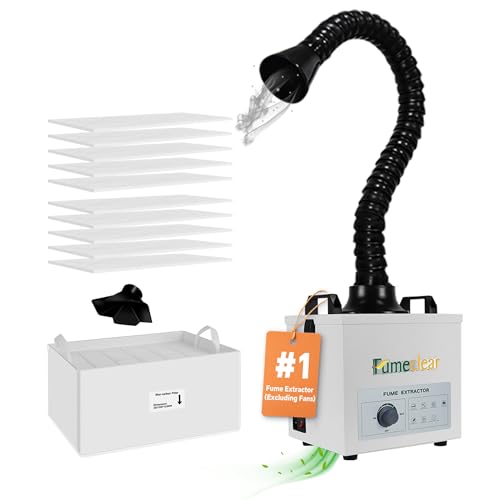
- 118–152 CFM stated suction
- Combined HEPA/carbon main filter
- 10 pre-filters included
Best For: Stationary small-bench soldering
Extended-Reach Pick
FC-2001A HEPA and Carbon Fume Extractor

- Listed 120–180 m³/h airflow
- H13 HEPA and activated carbon filter
- Includes hood, pipe, and five pre-filters
Best For: Dedicated soldering benches needing hose-based extraction
Simple Fan Pick
Compact Carbon-Filter Smoke Absorber
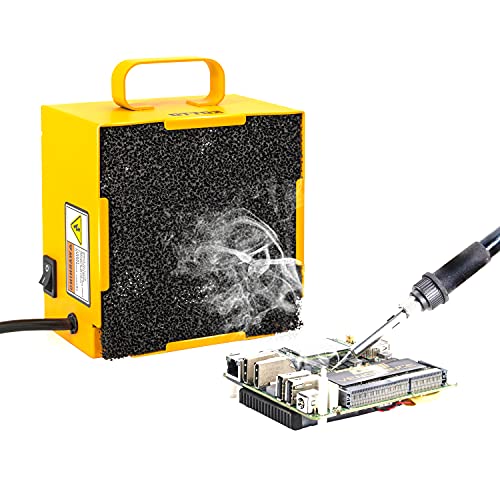
- 3,000 RPM fan with stated 5–6-inch reach
- Compact body with handle and nonslip feet
- Replaceable carbon filter; no HEPA specified
Best For: Occasional, close-range soldering at a small bench
Small-Desk Pick
NT-M1 Adjustable HEPA Fume Extractor
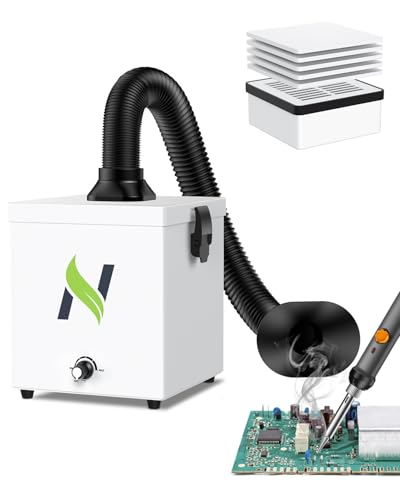
- Compact 5.1 x 5.1-inch footprint
- Listed 168 m³/h airflow with stepless control
- Positionable hose and layered filtration
Best For: Hobbyists with crowded desks and small soldering projects
Adjustable Desk Pick
YIHUA 948DQ-I Tilting Fume Extractor

- 30° tilting stand with side fenders
- Front and rear filtration adsorbers
- 10 cm stated effective capture distance
Best For: Close-range soldering and wood-burning benches
Flexible Hose Pick

- 168 m³/h stated airflow
- Adjustable gooseneck collection hood
- Pre-filter plus H13 HEPA and carbon cartridge
Best For: Benches needing a repositionable collection hood
Helping-Hands Pick
SainSmart Carbon-Filter Smoke Absorber

- Two removable magnetic helping hands
- Four activated-carbon filter pieces included
- 7.9-inch stated effective capture distance
Best For: DIY benches needing fume capture and work holding
High-Airflow Pick – Zericuf 180W Fume Extractor
For larger or changing workstations, this is one of the higher-airflow soldering ventilation systems here: its 180W brushless motor is rated at 320 m³/h, and an articulated arm lets you place the intake near the work.
Best For: Workstations that need strong suction, movable positioning, and a floor-standing unit.
Pros:
- Three-stage filtration combines thick pre-filters, H13 HEPA, and high-iodine activated carbon.
- Acoustically treated chamber is rated below 58 dB; the rear exhaust points downward.
- Includes locking swivel casters, a 360° positioning arm, and a filter-clog alert.
Cons:
- Its casters and articulated arm make it less suited to a compact benchtop setup.
- The supplied notes say replacement filters are scheduled for October 30, 2026; check availability before buying.
The airflow and adjustable intake are the main reasons to choose it. Factor replacement-filter availability into the decision, especially if you expect frequent use.
Among soldering ventilation systems for routine bench work, the JJ-M131 offers a middle ground: a 70W brushless motor rated at 180–200 m³/h and a stated noise level below 50 dB.
Best For: Detailed soldering or assembly where moderate airflow and quieter operation both matter.
Pros:
- Three-stage setup includes a HEPA layer, activated carbon, and 10 supplied pre-filters.
- Comes with a suction hood and arm for positioning capture near the source.
- Rated below 50 dB and supplied with the filters needed to get started.
Cons:
- At 11.03 pounds, it is less convenient to move than the compact JJ-Z131.
- Filters require regular replacement according to the instructions.
This is a practical choice if you want an arm-equipped extractor without stepping up to the 320 m³/h model. Plan for ongoing filter changes.
If desk space is the priority, the JJ-Z131 is a compact option among soldering ventilation systems. Its 5.9 × 5.9 × 7.3-inch body pairs a 30W brushless motor with a flexible suction arm.
Best For: Small hobby benches where the intake can be positioned close to the soldering point.
Pros:
- Small body weighs 3.61 pounds.
- Combines a pre-filter with a 2-in-1 H13 HEPA and activated-carbon filter.
- Includes a roughly 25.6-inch flexible arm and five pre-filters.
Cons:
- Its stated 50 CFM airflow is lower than the larger models listed here.
- Includes fewer spare pre-filters than the JJ-M131 or FC-100A.
Choose this model for a small, easily positioned intake rather than maximum airflow. Keeping the arm near the source will matter on a compact setup.
The FC-100A is aimed at small-bench soldering ventilation systems, pairing a stated 118–152 CFM suction range with a three-layer filter setup and 10 included pre-filters.
Best For: Dedicated small soldering stations where filtration and a supply of pre-filters are priorities.
Pros:
- Uses a combined HEPA/carbon main filter plus replaceable pre-filters.
- High-iodine activated carbon is specified for the main filter.
- Includes 10 pre-filters; the main filter has a stated life expectancy of up to 3,000 hours.
Cons:
- The manufacturer says it is not suitable for large laser engravers.
- At 19.51 pounds, it is the heaviest product in this group.
For a stationary soldering bench, its filter arrangement and included pre-filters are useful strengths. Look elsewhere if the job is a large laser engraver or frequent relocation.
Extended-Reach Pick – FC-2001A HEPA and Carbon Fume Extractor
Among soldering ventilation systems, the FC-2001A suits buyers who want a hose-based extractor with more working distance than a small desktop fan. Its listed 120–180 m³/h airflow and approximately 15 cm effective range give you some flexibility when positioning the hood.
Best For: Regular soldering at a dedicated bench where filtered extraction and flexible hood placement matter.
Pros:
- Combines an H13 HEPA filter with activated carbon for particles and odors.
- Three speed settings and an included bamboo pipe and hood support bench setup.
- Metal housing and five included pre-filters add practical value.
Cons:
- At 11.8 x 10.37 x 12.8 inches and 9.03 pounds, it takes more space than compact desktop units.
- The stated 15 cm working range still requires the hood to be positioned near the solder joint.
This is the roomier bench option of the three; check that you have space for both the unit and its extraction pipe.
Simple Fan Pick – Compact Carbon-Filter Smoke Absorber
If you are comparing soldering ventilation systems for occasional bench work, this straightforward fan-style absorber keeps the setup simple. Its 0.4-inch activated-carbon filter sits behind a 3,000 RPM fan rated to draw fumes from about 5–6 inches away.
Best For: Occasional soldering when you want a portable, close-range smoke absorber.
Pros:
- Small 5 x 3 x 5-inch body and carrying handle make it easy to move.
- Four nonslip rubber feet help keep the fan in place.
- Replaceable carbon filter; one replacement filter is included.
Cons:
- No HEPA filtration is specified.
- Effective capture depends on keeping the fan within its stated 5–6-inch range.
- The supplied notes conflict on voltage, listing both 120V power consumption and 220V in the details; verify compatibility before ordering.
Choose this for a minimal bench setup rather than the multistage filtration offered by the other two models.
Small-Desk Pick – NT-M1 Adjustable HEPA Fume Extractor
For soldering ventilation systems in a crowded workspace, the NT-M1 pairs a compact 5.1 x 5.1 x 6.3-inch unit with a positionable extraction hose. Its listed 168 m³/h airflow and stepless speed knob let you adjust suction to the job.
Best For: Hobbyists and PCB-repair users who need hose placement without giving up much desk space.
Pros:
- H13 HEPA filtration, carbon powder, and a 10 mm pre-filter provide multiple filter layers.
- Flexible hose extends up to 25.6 inches and bends to position the inlet near the work.
- Stepless speed control allows a trade-off between suction and noise.
Cons:
- The supplied notes describe the carbon powder as reducing light odors, not handling heavy odor loads.
- The hose still needs to be aimed near the fume source for effective capture.
The NT-M1 is the space-saving choice if you want a movable inlet and adjustable airflow instead of a fixed-face fan.
Adjustable Desk Pick – YIHUA 948DQ-I Tilting Fume Extractor
Among compact soldering ventilation systems, the YIHUA 948DQ-I suits a bench where you can position the extractor close to your work. Its 30° tilting stand and side fenders help you aim airflow at the soldering area.
Best For: Close-range soldering or wood-burning setups that need an adjustable desktop extractor.
Pros:
- Front and rear filtration adsorbers help capture particles and reduce odors.
- Tilting stand and side fenders help direct extraction.
- Includes eight filtration adsorbers.
Cons:
- Specified effective capture distance is only 10 cm in a straight line.
- Designed for 110–127V outlets with a US-standard plug.
This is a practical choice when the extractor can sit immediately beside the workpiece; the short stated capture range makes placement especially important.
Flexible Hose Pick – KQZ W1 HEPA Fume Extractor
The KQZ W1 stands out among soldering ventilation systems for its adjustable gooseneck hose, which lets you position the collection hood near the source without moving the main unit. Its stated airflow is 168 m³/h, and it pairs a pre-filter with an H13 HEPA and activated-carbon filter cartridge.
Best For: Workstations that need a movable collection hood for soldering, 3D printing, or other listed light-duty applications.
Pros:
- 360° adjustable gooseneck helps aim the hood at the work.
- Includes five pre-filters and one main filter.
- Metal body and 110–220V voltage range add setup flexibility.
Cons:
- Pre-filters and the main filter will need replacement over time.
- The hose and hood add components to position on the bench.
Choose this model if targeted hood placement matters more to you than an all-in-one fan positioned directly beside the work.
Helping-Hands Pick – SainSmart Carbon-Filter Smoke Absorber
For shoppers comparing soldering ventilation systems that also support small repairs, the SainSmart extractor combines a desktop fan with two removable magnetic helping hands. It uses activated-carbon filter cotton and comes with four filter pieces in total.
Best For: DIY soldering benches that could use built-in work-holding arms alongside a smoke absorber.
Pros:
- Two magnetic helping hands rotate 360° and can be removed.
- ESD-safe metal frame, carrying handle, and non-slip feet suit desktop use.
- Includes three extra carbon-filter cotton pieces.
Cons:
- Manufacturer recommends replacing the filter about every three months.
- Stated effective smoke-absorption distance is 7.9 inches, so it needs to sit near the work.
Its main advantage is combining fume capture with work holding. If you already have helping hands, weigh that extra convenience against a simpler extractor.
How We Picked These Soldering Ventilation Systems
We considered the range of designs represented here: simple carbon-filter desktop absorbers, compact HEPA-and-carbon units, adjustable extractors, and larger three-stage machines. Our comparison focuses on specifications that affect everyday use, including stated airflow, filter configuration, positioning, footprint, and replacement-filter needs. Manufacturer airflow and noise claims may use different test conditions, so treat them as comparison clues rather than guarantees of performance at the solder joint.
Quick Comparison: Which Style Fits?
For occasional work at a fixed bench, a small desktop absorber is the least complicated starting point, provided it can sit close to the plume. An adjustable extractor is easier to aim when projects vary in size or position. A larger, multi-stage filtered unit may suit longer sessions or a workbench where a compact fan cannot be positioned effectively. Models advertising higher airflow still need a suitable inlet position: moving more air across the room is not the same as capturing fumes where they form.
Key Buying Factors for Soldering Ventilation Systems
Capture Position and Airflow
Look at the inlet shape, hose or arm adjustability, and how close the unit can operate without obstructing your work. An adjustable intake often matters more than a headline m³/h number. If you solder at several points across a large assembly, consider whether you can reposition the extractor easily.
Filters and Ongoing Costs
Pre-filters catch larger particles and help protect later stages; HEPA filters target fine particles; activated carbon helps reduce some odors and gases. None should be assumed to remove every soldering contaminant. Check which replacement filters are available, their price, and whether the quoted filter life matches your expected use. A bundle of spare filters can lower initial running costs, but only if replacements remain easy to source.
Noise, Space, and Exhaust
A bulky machine may offer more positioning options through a hose but needs floor or bench space and a convenient power outlet. A small absorber saves space yet may need to sit directly beside the work. Consider fan noise during long sessions and where filtered air exits; an exhaust blowing toward your face or loose components can make an otherwise suitable unit awkward to use.
Who Should Buy Which Soldering Ventilation Systems?
Choose a basic desktop absorber, such as the SainSmart or YIHUA-style options, for occasional, localized soldering when you can keep the inlet near the joint. Consider adjustable H13 HEPA-equipped models such as the NT-M1 or KQZ W1 when you want more flexibility at a desktop station. If you solder for extended periods or need to capture fumes from a less confined work area, compare the larger multi-stage JJ and FC models and the 180W unit, paying particular attention to intake placement and filter availability.
For frequent occupational use, assess ventilation requirements for your materials and workspace rather than relying on a product listing alone. Local extraction should complement appropriate room ventilation and safe soldering practices.