Choosing the right tilting welding positioner can make difficult welds easier, safer, and more repeatable. The best models help you control angle, rotation speed, and workpiece access without fighting the part.
In this roundup, we focus on practical options for compact shops, DIY users, and heavier fabrication tasks so you can match capacity and controls to the work you actually do.
Best 10 Tilting Welding Positioner Picks for 2026
Top All-Around Pick
VEVOR 66LBS Rotary Welding Positioner with 12.4" Chuck

- 0-90° tilt with self-locking worm gear
- 1-12 rpm stepless speed control
- 315mm 3-jaw chuck and torch holder included
Best For: Versatile shop use with a larger chuck and stable tilt control
Best for Small Projects
180mm Tilting Welding Positioner with 65mm Chuck

- 0-90° tilt with locking wrench
- 2-16 rpm stepless speed control
- Lightweight bench-friendly design
Best For: DIY and small-scale welding jobs
Best Heavy-Duty Value
30KG Rotary Welding Positioner with Torch Holder
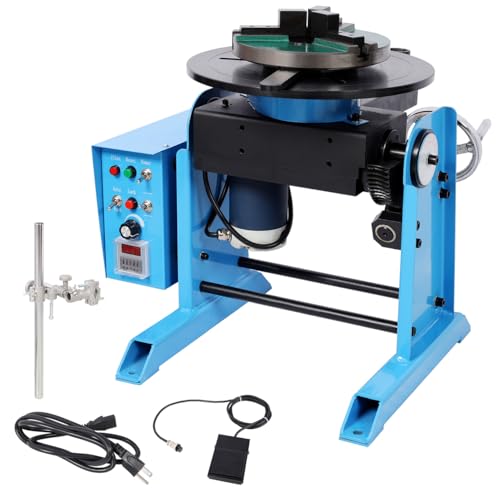
- 0-90° tilt with butterfly bolt locking
- 1-12 r/min rotation for steady work
- 3-jaw chuck and torch holder included
Best For: General fabrication with hands-free torch support
Best Feature-Rich Pick
30KG Tilting Welding Positioner with Foot Pedal
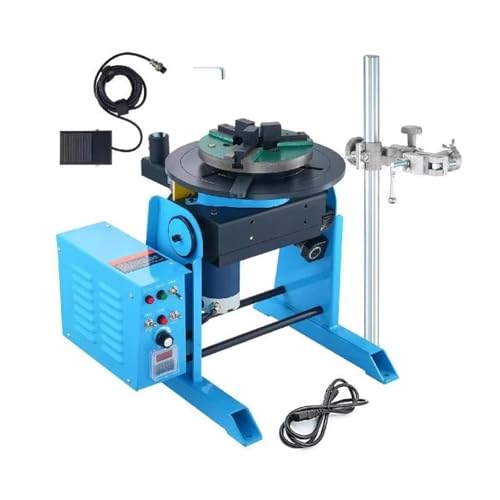
- 80W motor with 1-12 RPM variable speed
- 0-90° tilt lock with self-locking handwheel
- 315mm chuck, torch mount, and foot pedal control
Best For: Shop users who want a well-equipped 30kg positioner
Heavy-Duty 100kg Positioner

- 100 kg load rating for heavier fabrication work
- 0–90° tilt with lockable angle settings
- 120W DC motor and stepless speed control
Best For: Heavier pipe and seam welding with precise rotation control
Mini 20W Tilting Positioner

- 0–90° tilt for small-part angle control
- 20W DC motor with stepless speed regulation
- Foot switch operation for simple use
Best For: Light-duty small workpieces and compact welding setups
Compact Control Pick
VEVOR Rotary Welding Positioner 10KG

- 0-90° tilt with self-locking worm gear
- 1-12 RPM stepless speed adjustment
- 205mm 3-jaw chuck for small workpieces
Best For: Small bench jobs that need precise tilting and slow rotation
Complete Bench Setup
Welding Positioner 10KG with Chuck and Torch Holder

- 0-90° tilt with 360° rotation
- 2-20 RPM stepless speed control
- Includes chuck, foot pedal, and torch holder
Best For: Small pipe and flange welding in a compact bench-top setup
Heavy-Duty Capacity Pick
VEVOR Rotary Welding Positioner 50KG

- 50KG horizontal load capacity for larger parts
- 0.5-6 RPM stepless speed control
- 315mm 3-jaw chuck with torch stand included
Best For: Larger workshop pieces that need slow, stable tilting and rotation
Top All-Around Pick – VEVOR 66LBS Rotary Welding Positioner with 12.4" Chuck
If you want a tilting welding positioner that can handle a broad mix of shop tasks, this VEVOR unit is built for practical day-to-day use. Its 0-90° tilting table, 1-12 rpm stepless control, and 80W motor make it a flexible choice for welding, cutting, grinding, assembly, and testing.
Best For: Shops and makers who need a versatile 0-90° rotary positioner with a larger chuck and hands-free torch support.
Pros:
- 0-90° tilting table with self-locking worm gear for stable positioning
- 80W motor with 1-12 rpm stepless speed adjustment for smooth rotation
- 315mm KD200 3-jaw chuck with 10-210mm clamping range
- Includes a welding gun stand holder and foot pedal control
Cons:
- Heavy 85.4 lb unit may be best for a fixed workspace
- Requires 110V AC power
This is the strongest all-around option here if you want a tilting welding positioner with more chuck capacity and a feature set aimed at steady, repeatable work. The combination of tilt control, speed range, and included torch holder makes it especially practical for organized fabrication setups.
Best for Small Projects – 180mm Tilting Welding Positioner with 65mm Chuck
This tilting welding positioner is aimed at DIY users and smaller fabrication jobs that need simple angle control without a bulky setup. The 0-90° table, 2-16 rpm speed range, and foot switch make it a straightforward choice for light-duty welding and cutting work.
Best For: DIY welders and small-scale projects that benefit from compact size and easy rotation control.
Pros:
- 0-90° tilting table with locking wrench for fixed-angle work
- 2-16 r/min stepless speed control for precise adjustment
- Foot switch makes rotation control more convenient
- Lightweight, simple structure suited to bench use
Cons:
- Smaller 180mm table and 65mm chuck limit workpiece size
- Best suited to lightweight jobs rather than heavy fabrication
If you need a compact tilting welding positioner for occasional use, this model keeps the setup simple and manageable. It makes the most sense when workpiece size is modest and you value easier handling over maximum capacity.
Best Heavy-Duty Value – 30KG Rotary Welding Positioner with Torch Holder
For buyers who want a tilting welding positioner with strong core capabilities, this 30KG model covers the essentials well. It offers a 0-90° tilt range, 1-12 r/min rotation, a 3-jaw lathe chuck, and a torch stand holder for more controlled welding and fabrication.
Best For: Users who want a heavy-duty 30KG positioner with broad application support and hands-free torch placement.
Pros:
- 0-90° tilting worktable for flexible positioning
- 1-12 r/min rotation range for efficient workflow
- 3-jaw lathe chuck and welding torch stand holder included
- Suitable for cutting, grinding, assembly, testing, and seam welding
Cons:
- Manual tilt locking uses a butterfly bolt rather than powered adjustment
- Product details do not list as many speed-control specifics as some alternatives
This model is a solid pick if you want the familiar 30KG positioner format with useful extras and straightforward controls. It balances capacity and functionality in a way that fits general-purpose fabrication work.
Best Feature-Rich Pick – 30KG Tilting Welding Positioner with Foot Pedal
If you want a tilting welding positioner with a more complete feature set, this model brings together the essentials for efficient fabrication. Its 80W motor, 1-12 RPM control, 0-90° tilt lock system, and foot pedal rotation control are geared toward stable, repeatable work.
Best For: Fabricators who want a 30kg tilting positioner with a professional chuck, torch mount, and foot pedal control.
Pros:
- 80W motor with smooth 1-12 RPM variable-speed rotation
- 0-90° tilt lock system with self-locking handwheel
- 315mm KD200 3-jaw chuck plus 80-190mm support arms
- Integrated torch holder and foot pedal control for convenient operation
Cons:
- Bench-mounted style is better for dedicated workspaces
- Designed around 30kg horizontal / 15kg vertical loads, not oversized parts
This is the most feature-forward tilting welding positioner in the group, especially if you value controlled rotation and hands-free workflow. It is a strong fit for users who want more shop-oriented convenience without moving up to a much larger machine.
Compact 66 lb Tilting Positioner – 0–90° Manual Rotary Table
If you need a tilting welding positioner for small fabrication work, this 66 lb manual rotary table keeps setup simple while adding angle control. The 0–90° tilting bed, 360° rotation, and 1–12 RPM speed range make it easier to place round or awkward parts where you want them before striking an arc.
Best For: Small to medium MIG, TIG, MAG, and CO2 welding jobs that need hands-free rotation and adjustable tilt.
Pros:
- 0–90° tilt locks securely with a butterfly bolt for flexible welding angles.
- 360° continuous rotation with 1–12 RPM speed control for consistent positioning.
- Foot pedal control supports hands-free start/stop operation.
- 3-jaw chuck helps clamp round or irregular workpieces securely.
Cons:
- 66 lb load capacity limits it to lighter fabrication projects.
- Manual tilt setup is less convenient than powered tilt systems.
- Best suited to bench-mounted or integrated light-duty workflows.
This is a practical entry-level tilting welding positioner if you want better access and repeatability without moving into a heavy industrial machine. It’s especially useful when workpieces need secure clamping and frequent angle changes.
Heavy-Duty 100kg Positioner – 120W DC Motor Turntable
This tilting welding positioner is built for larger seam work, with a 100 kg load rating, 0–90° tilt, and smooth rotary control from a 120W DC motor. The 360 mm table and stepless speed adjustment make it a strong fit when you need stable, repeatable positioning for welding, cutting, grinding, or testing.
Best For: Pipe, flange, and seam-welding projects that benefit from higher load capacity and fine speed control.
Pros:
- 100 kg capacity handles substantially heavier workpieces.
- 0–90° tilting table can be fixed at any angle with tilt lock wrenches.
- 120W DC motor and stepless speed adjustment give precise rotation control.
- Foot switch operation and anti-electromagnetic design support TIG welding setups.
Cons:
- Larger footprint and 152 lb weight make it less portable.
- Manual table tilting may be slower than powered tilt mechanisms.
- More machine than needed for very small or occasional jobs.
For users who want a more capable tilting welding positioner, this model offers the capacity and control to keep heavier parts aligned through demanding tasks. It stands out when smooth rotation and stable positioning matter more than compact size.
Mini 20W Tilting Positioner – Small Part Rotary Table
When you need a compact tilting welding positioner for small workpieces, this miniature rotary table focuses on simple rotation and angle adjustment. Its 0–90° turning range, stepless speed regulation, and foot-switch control make it useful for positioning small parts at accessible welding angles.
Best For: Small workpieces and light-duty welding setups that need basic tilt and rotation control.
Pros:
- 0–90° tilting table supports welding at multiple angles.
- 20W DC motor offers stepless speed regulation for rotation control.
- Foot switch operation keeps use straightforward.
- Can accept a welding chuck and gun adjustment mechanism for improved setup.
Cons:
- Designed for small workpieces rather than larger fabrication tasks.
- Lower-power 20W motor suggests lighter-duty use.
- Product listing does not specify a load rating.
This miniature option makes sense if your priority is a simple, small-scale tilting welding positioner rather than maximum capacity. It is best viewed as a compact helper for light positioning tasks and small-part alignment.
Compact Control Pick – VEVOR Rotary Welding Positioner 10KG
If you need a tilting welding positioner for small parts, this VEVOR 10KG model focuses on stable, low-speed control and flexible angle setup. Its 0-90° tilt, stepless 1-12 RPM adjustment, and 3-jaw chuck make it a practical fit for careful welding, cutting, grinding, assembly, and testing on compact workpieces.
Best For: Light-duty bench work, small parts, and users who want simple tilt-and-rotate control for precise positioning.
Pros:
- 0-90° tilting worktable with self-locking worm gear for secure positioning
- Stepless 1-12 RPM speed control for stable, low-speed rotation
- 205mm 3-jaw chuck helps clamp and support small workpieces securely
- Foot pedal switch adds convenient 360-degree rotation control
Cons:
- 10KG capacity is limited to smaller projects
- Best suited to light-duty workshop tasks rather than heavy fabrication
This is a compact option when you want precision over raw capacity. For smaller welding jobs, its adjustable tilt and stable slow rotation are the key strengths.
Complete Bench Setup – Welding Positioner 10KG with Chuck and Torch Holder
This tilting welding positioner is built as a compact, practical setup for pipe, flange, and small-component welding. With 0-90° tilt, 360° rotation, 2-20 RPM stepless speed control, and included accessories like a chuck, foot pedal, torch holder, and optional tailstock, it offers a ready-to-use bench-top workflow for precise positioning.
Best For: Small workshop welding where you want a complete tilting and rotating setup in a compact footprint.
Pros:
- 0-90° tilting table supports flexible circular welding positions
- 2-20 RPM stepless speed control for smooth, adjustable rotation
- Includes chuck, foot pedal, welding torch holder, and optional tailstock
- Compact steel build is sized for bench-top use
Cons:
- 10KG load rating limits it to smaller workpieces
- Best suited to workshop bench tasks rather than larger fabrication jobs
If you want a straightforward, accessory-rich positioner for small welding projects, this model covers the basics well. The included torch holder and foot pedal make it especially convenient for controlled work.
Heavy-Duty Capacity Pick – VEVOR Rotary Welding Positioner 50KG
For users who need a more capable tilting welding positioner, this VEVOR 50KG model adds stronger load handling and slower, more controlled rotation. Its 0-90° tilt, 0.5-6 RPM speed range, 315mm 3-jaw chuck, and included torch stand make it better suited to heavier small-to-medium jobs that still need accurate positioning.
Best For: Workshops handling larger parts that still require precise tilt control and slow, stable rotation.
Pros:
- 50KG horizontal load capacity and 25KG vertical capacity support heavier work
- 0-90° tilting table with self-locking worm gear for secure angle control
- 0.5-6 RPM stepless speed adjustment for very slow, stable rotation
- 315mm 3-jaw chuck and included gun stand help secure and support workpieces
Cons:
- Much heavier and larger than 10KG class units
- May be more machine than small bench jobs require
This is the stronger pick if the smaller positioners feel underbuilt for your parts. Its slower speed range and higher capacity make it a better fit when stability matters more than compact size.
How We Picked the Best Tilting Welding Positioner
We compared each Tilting Welding Positioner by load capacity, tilt range, rotation speed, motor power, chuck size, and control method. We also looked for features that matter in real use, such as foot pedal operation, stable construction, and whether the table suits welding, grinding, or seam work.
Quick Comparison
As a rule, smaller 10KG units are better for light parts, hobby work, and occasional shop use, while 30KG to 66LB class machines offer a better balance of versatility and portability. The 50KG and 100KG options are stronger choices when you need more support for larger assemblies or repeated production tasks.
Key Buying Factors for a Tilting Welding Positioner
Load Capacity
Always buy with headroom. A Tilting Welding Positioner should comfortably exceed the weight of your workpiece, fixtures, and any off-center loading caused by clamps or irregular shapes.
Tilt Range and Table Size
A 0–90° tilt range is useful for setting up horizontal, vertical, and angled welds. Check table diameter or chuck size if you need to support awkward or long parts without excessive overhang.
Speed Control and Torque
Variable speed matters because different processes need different rotation rates. Slower speeds help with precise welding and seam tracking, while stronger torque helps keep heavier parts moving steadily without stalling.
Control Options and Workflow
Foot switches and hands-free control can improve positioning efficiency, especially when you need both hands on the torch and filler. For repeat work, simple speed dials and responsive controls reduce setup time.
Build Quality and Stability
Look for a rigid frame, stable base, and a chuck that holds parts securely. A Tilting Welding Positioner works best when it reduces vibration and keeps the workpiece aligned through the full angle range.
Who Should Buy Which Tilting Welding Positioner?
If you need a compact setup for light fabrication, model-making, or small repair jobs, a 10KG unit is usually enough. For general workshop use, the 30KG and 66LB options offer a strong mix of capacity and flexibility.
If your work involves larger fixtures, heavier assemblies, or more demanding production tasks, step up to the 50KG or 100KG class. Those buyers should prioritize torque, stable tilt action, and a chuck size that matches the parts they handle most often.
For the best overall fit, choose the smallest Tilting Welding Positioner that still gives you safe capacity margin and the speed control you need. That balance usually delivers the most value, the easiest setup, and the cleanest weld results.