Sewing statistics reveal a craft that sits at the intersection of DIY fashion, quilting, home décor, and clothing repair—supported by a multi-billion-dollar sewing machine market and a renewed focus on extending the life of garments.
sewing statistics
Sewing Statistics (Top Highlights)
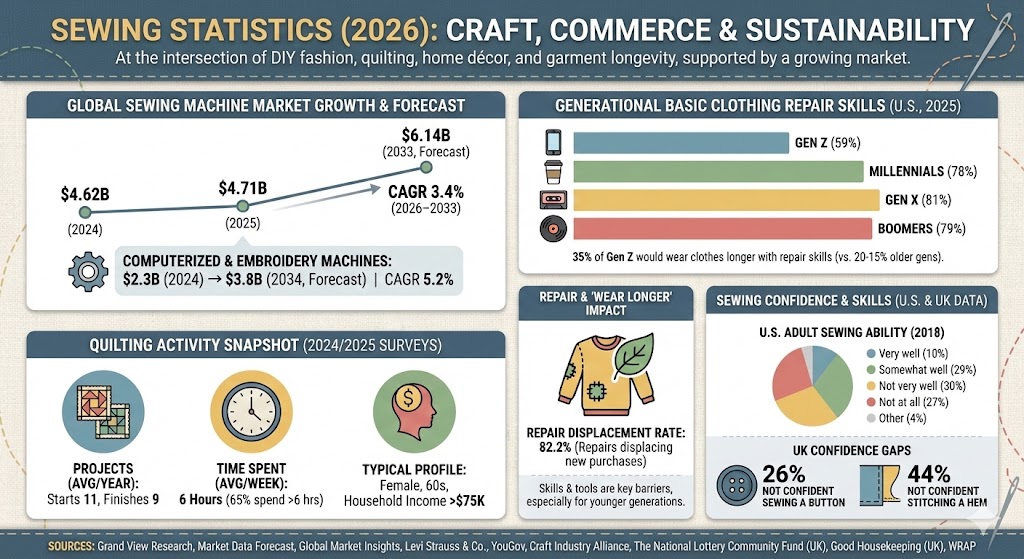
Grand View Research estimates the global sewing machine market at $4.71B in 2025, projected to reach $6.14B by 2033 (CAGR 3.4% from 2026–2033).
A separate 2024 estimate put the global sewing machines market at $4.62B (2024) with continued growth expected into the 2030s.
Global Market Insights values the computerized sewing & embroidery machine market at $2.3B in 2024, forecast to reach $3.8B by 2034 (CAGR 5.2% from 2025–2034).
In a Levi Strauss & Co. consumer survey (U.S., Aug–Sep 2025), basic clothing repair skills were reported by 59% of Gen Z vs 78% of Millennials, 81% of Gen X, and 79% of Boomers.
That same Levi’s survey reports 35% of Gen Z would wear clothes longer if they had repair skills (vs 20% Millennials, 15% Gen X, 15% Boomers).
In a YouGov survey of 6,377 U.S. adults (2018), 39% said they can sew very well or somewhat well (10% + 29%).
Craft Industry Alliance’s 2024 quilting survey reports the average quilter starts 11 projects per year, finishes 9, and spends about 6 hours/week quilting; 65% spend more than six hours/week.
The 2025 Quilting Trends Survey describes the “average quilter” as typically female, in her 60s, and in a household income band of >$75K.
A UK-based public survey write-up reported 27% can confidently operate a sewing machine (Good Housekeeping domestic skills survey).
A UK survey release reported 26% lacked confidence sewing on a button and 44% weren’t confident stitching a hem.
Sewing Machine Market Size Statistics
Most “sewing market size” reporting is actually tracking sewing machines (consumer + industrial) rather than the broader fabric/notions ecosystem. The market is consistently measured in the mid-single-digit billions of USD, with projections rising across the 2030s.
Global Sewing Machine Market Size (Selected Estimates & Forecast)
Label
Bar
Value
2024
$4.62B
2025
$4.71B
2033
$6.14B
Max = $6.14B. Widths: 2024 75.24%, 2025 76.71%, 2033 100.00%.
Another fast-growing slice of the category is computerized sewing and embroidery machines, which Global Market Insights sizes at $2.3B in 2024 with a forecast of $3.8B by 2034 (CAGR 5.2%).
Sewing Skills and Clothing Repair Statistics
“Sewing” in surveys often includes both making (garments, quilts, home projects) and repair (buttons, hems, small tears). Recent repair-focused polling shows meaningful generational gaps: younger adults express interest, but are less likely to report having the skills.
Basic Clothing Repair Skills by Generation (U.S. survey, 2025)
Label
Bar
Value
Gen Z
59%
Millennials
78%
Gen X
81%
Boomers
79%
Max = 81%. Widths: Gen Z 72.84%, Millennials 96.30%, Gen X 100.00%, Boomers 97.53%.
Skill and confidence gaps show up in other public surveys too. One UK survey release reported 26% lacked confidence sewing on a button and 44% weren’t confident stitching a hem. Another UK domestic skills survey write-up reported 27% can confidently operate a sewing machine.
How well do Americans say they can sew? (YouGov U.S., 2018)
Response
Share of U.S. adults
Very well
10%
Somewhat well
29%
Not very well
30%
Not at all
27%
Other / Not sure
4%
Quilting and Sewing Project Statistics
In consumer sewing, quilting surveys are some of the most data-rich sources available—capturing time spent, project volume, and machine ownership patterns.
Average quilter owns 4 different types of sewing machines
The 2025 Quilting Trends Survey also describes a typical respondent profile (for that survey’s sample): often female, in her 60s, retired, and in a household income band of >$75K, with a self-reported comfort with technology.
Repair and “Wear Longer” Impact Statistics
Sewing and repair skills increasingly show up in sustainability conversations. WRAP (a global environmental action NGO) reports high “displacement” effects—meaning repairs can replace some new purchases that would otherwise happen.
WRAP reports an average repair displacement rate of 82.2% (i.e., repair activity displacing new purchases at a high rate).
Levi Strauss & Co.’s U.S. repair survey (2025 fieldwork) suggests repair skills and access to tools/materials are practical barriers—especially for Gen Z respondents.
Sources
Grand View Research — Sewing machine market size estimate (2025) and forecast (2033), plus CAGR.
Market Data Forecast — Global sewing machines market value (2024) estimate.
Global Market Insights — Computerized sewing & embroidery machine market size (2024) and forecast (2034).
Levi Strauss & Co. — The Wear Longer Repair Survey (methodology and generational repair-skill figures; Aug–Sep 2025 fieldwork).
YouGov (U.S.) — “How well do you know how to sew?” results and sample size (Feb 1, 2018).