Soldering smoke can drift into your breathing zone before you notice it. A well-positioned extractor helps capture fumes near the joint, but airflow, filter design, and placement matter more than a long feature list.
These 10 picks cover compact desktop absorbers, adjustable fans, and larger filtered units. Use the buying guide below to match an extractor to your bench, workload, and ventilation setup.
Best 10 Soldering Fume Extractors Picks for 2026
High-Airflow Pick

- Stated 320 m³/h airflow
- Articulated arm and locking casters
- HEPA, carbon, and 10 pre-filters
Best For: Adjustable capture across a larger workstation
Compact Arm Pick

- Small 5.9-inch-square footprint
- Approximately 25.6-inch flexible arm
- Pre-filter plus HEPA/carbon filter
Best For: Space-limited hobby benches needing an adjustable inlet
Simple Fan Pick
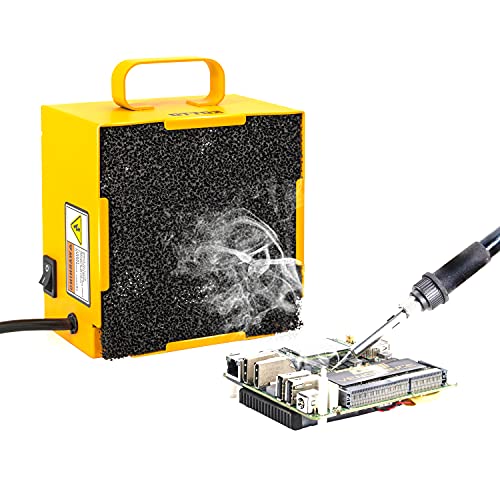
- Activated-carbon filter
- Stated 5–6-inch working distance
- Handle and non-slip feet
Best For: Occasional soldering with the fan close to the joint
Dual-Position Pick

- Upright or low-profile placement
- Replaceable carbon filter included
- Optional high-efficiency particle filter
Best For: Benches needing flexible fan orientation
Best Adjustable Pick
YIHUA 948DQ-I Tilting Fume Extractor

- 30° tiltable stand
- Front and rear adsorbers
- Eight adsorbers included
Best For: Close-range soldering and wood burning
Best Lightweight Pick
MUIN Three-Stage Fume Extractor

- Three-stage filtration
- Listed 115 cfm airflow
- Weighs 1.43 pounds
Best For: Portable soldering and craft stations
Best Magnetic-Wing Pick
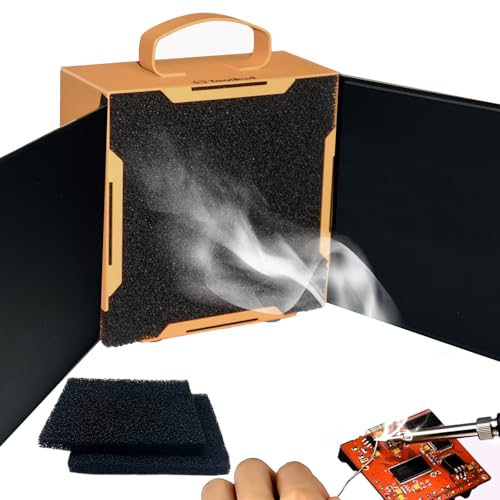
- Removable magnetic wings
- Two carbon filters included
- Detachable filter system
Best For: Small benches needing adjustable side panels
Compact Bench Helper

- Front and rear filtration
- Tilting fan with side fenders
- Helping hands and six adsorbers included
Best For: Compact soldering benches needing component support
Portable Fan Pick
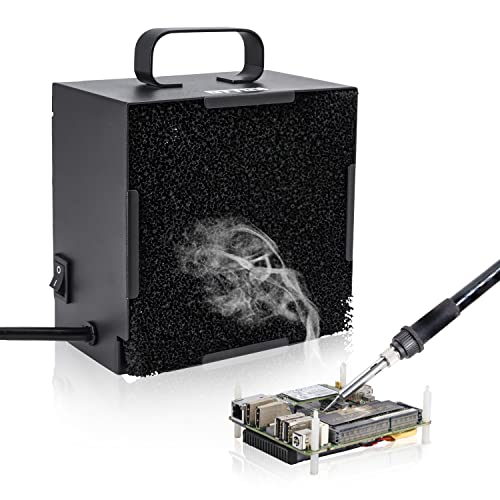
- 0.4-inch activated-carbon filter
- Specified 5–6-inch pickup range
- Handle and non-slip feet
Best For: Portable, stand-alone fume capture
Accessory-Rich Setup

- Eight filtration adsorbers included
- 30° tilting stand and side fenders
- Detachable helping hands
Best For: Close-range work needing adjustable positioning
High-Airflow Pick – Zericuf 180W Fume Extractor
For soldering fume extractors that need to serve a larger or changing work area, this Zericuf model pairs a stated 320 m³/h airflow with a movable capture arm and wheeled metal housing. Its three-stage setup combines a pre-filter, H13 HEPA filter, and activated carbon.
Best For: Workstations that need adjustable source capture and more airflow than a small desktop fan.
Pros:
- 180W brushless motor with a stated 320 m³/h airflow.
- Articulated arm, swivel casters, and front brakes help position the inlet.
- Includes 10 thick pre-filters and a clog-alert buzzer.
Cons:
- A 180W wheeled unit is more equipment than a compact bench setup may need.
- Replacement-filter availability should be checked before purchase; the notes list a planned release date rather than confirming stock.
Choose it for flexible placement and substantial stated airflow, but confirm the ongoing filter supply if you expect frequent use.
Compact Arm Pick – JJ-Z131 Fume Extractor
Among soldering fume extractors for crowded benches, the JJ-Z131 stands out for its 5.9-by-5.9-inch footprint and roughly 25.6-inch flexible suction arm. Its 30W brushless motor is rated at 50 CFM, with a pre-filter ahead of a combined H13 HEPA and activated-carbon filter.
Best For: Hobbyists who want source-positioned extraction without giving up much bench space.
Pros:
- Compact 5.9 x 5.9 x 7.3-inch unit.
- Flexible arm lets you place the inlet near the task.
- Includes five pre-filters and a combined HEPA/carbon filter.
Cons:
- Its stated 50 CFM airflow may be less suitable for demanding, high-smoke work.
- The notes do not specify replacement-filter availability.
This is a practical fit when adjustable capture matters more than maximum airflow; check replacement-filter options before relying on it long term.
Simple Fan Pick – Solder Smoke Absorber
If you’re comparing straightforward soldering fume extractors for occasional bench work, this fan-style absorber uses a 0.4-inch activated-carbon filter and is intended to sit close to the soldering point. The stated working distance is 5–6 inches, so placement is especially important.
Best For: Occasional soldering at a fixed bench where the fan can sit close to the work.
Pros:
- Simple, replaceable activated-carbon filter; one replacement filter is included.
- Carrying handle and four non-slip rubber feet.
- Compact listed dimensions of 5 x 3 x 5 inches.
Cons:
- Short stated capture distance requires close positioning.
- No HEPA stage or flexible capture arm is listed.
- The notes conflict on voltage, listing both 120V and 220V; verify the version before ordering.
It suits a nearby, stationary soldering spot, but buyers needing reach or particle filtration should consider a filtered arm-style unit instead.
Dual-Position Pick – Hakko FA400-04 Smoke Absorber
The Hakko FA400-04 is one of the simpler soldering fume extractors here: it can stand upright or lie in a low-profile position to suit the bench layout. It ships with an activated-carbon filter, and Hakko lists a separate optional high-efficiency particle filter.
Best For: Soldering benches that benefit from switching between upright and low-profile fan placement.
Pros:
- Two placement orientations.
- Filters are designed for easy replacement.
- Optional high-efficiency filter is listed for airborne-particle removal.
Cons:
- The included standard carbon filter is specified for odor absorption; the particle filter is optional.
- No adjustable suction arm is listed.
Its appeal is straightforward placement and filter changes. If particle filtration is your priority, account for the optional filter rather than assuming it comes installed.
Best Adjustable Pick – YIHUA 948DQ-I Tilting Fume Extractor
Among soldering fume extractors for compact benches, the YIHUA 948DQ-I stands out for its 30° tiltable stand and side fenders, which help position the intake around your work.
Best For: Soldering or wood-burning setups where you can place the extractor close to the source.
Pros:
- Front and rear filtration adsorbers provide dual filtering.
- Includes eight adsorbers, two fenders, and a tiltable stand.
- Compact 3.54 x 5.71 x 6.46-inch body.
Cons:
- Specified effective capture distance is only 10 cm in a straight line.
- Designed for 110–127V outlets with a US-standard plug.
This is a practical choice if you want to adjust the intake angle, but its stated capture distance makes close placement important.
Best Lightweight Pick – MUIN Three-Stage Fume Extractor
The MUIN is one of the lighter soldering fume extractors in this lineup at 1.43 pounds. Its three-stage filter and compact ABS housing suit a bench that needs to stay easy to rearrange.
Best For: Small soldering or craft workstations where portability matters.
Pros:
- Three-stage filtration is intended to capture fumes and reduce odors.
- Listed airflow capacity is 115 cfm.
- Measures 5 x 2.8 x 5.5 inches and weighs 1.43 pounds.
Cons:
- Manufacturer-stated working distance is about 4–5 inches, so placement still matters.
- Listed sound level is 45 dB, not silent operation.
Choose it for a portable desktop setup, while keeping the intake near the work rather than relying on it from across the bench.
Best Magnetic-Wing Pick – ToolBud Fume Extractor
The ToolBud takes a different approach from basic soldering fume extractors: two removable magnetic wings are designed to widen its smoke-capture area. Its compact build also makes it straightforward to move around a small workspace.
Best For: Benches where removable side panels and simple filter access are priorities.
Pros:
- Two detachable magnetic wings expand the intake area.
- Includes two carbon filters.
- Detachable filter system simplifies cleaning or replacement.
Cons:
- No airflow rating or effective capture distance is provided in the supplied specifications.
- Only two filters are listed as included.
The magnetic wings offer a useful positioning option, but without a stated capture distance, plan to keep the unit close to the work.
Compact Bench Helper – WEP 948DQ-I Fume Extractor
Among soldering fume extractors for a compact workbench, the WEP 948DQ-I stands out for pairing a tilting fan with attachable helping hands. Front and rear filtration adsorbers and side fenders are designed to help capture fumes near the work area.
Best For: Small soldering setups where you want component support and close-range fume capture in one unit.
Pros:
- Front and rear filtration, with six adsorbers included.
- Adjustable tilt and side fenders help position the fan and limit disruptive airflow.
- Includes 11.8-inch helping hands for holding boards, wires, or components.
Cons:
- Specified effective suction distance is about 10 cm, so placement close to the work matters.
- Designed for 110–127V outlets, not 220V sockets.
This is a practical choice when bench space is limited and the included helping hands will see regular use. Keep the fan close to the solder joint to work within its stated suction range.
If you prefer straightforward soldering fume extractors without extra bench accessories, this 120V fan offers an activated-carbon filter in a 3-by-5-by-5-inch housing. Its carrying handle and rubber feet make it easy to move between work spots and set down securely.
Best For: Soldering stations that need a portable, stand-alone fan with a replaceable carbon filter.
Pros:
- Includes a 0.4-inch-thick activated-carbon filter and one replacement filter.
- 3000 RPM fan is specified for fume pickup from roughly 5–6 inches away.
- Carrying handle and four non-slip rubber feet support portable use.
Cons:
- No helping hands or adjustable-tilt stand are listed.
- Rated for 120V power.
This model makes sense when you want a movable filter fan rather than an all-in-one soldering aid. Position it within its stated 5–6-inch pickup range for the intended effect.
The YIHUA 948DQ-I is one of the more accessory-focused soldering fume extractors here, combining front and rear filtration with a 30° tilting stand. It also includes two side fenders and detachable helping hands for managing workpieces near the fan.
Best For: Soldering or wood-burning work where adjustable positioning and included spare adsorbers are priorities.
Pros:
- Eight filtration adsorbers included for the front-and-rear filtering setup.
- 30° tilting stand and side fenders help aim the fan and reduce disruptive airflow.
- Detachable helping hands can hold boards or wires while you work.
Cons:
- Stated effective fume-capture distance is 10 cm, requiring close placement.
- Designed for 110–127V power with a US-standard plug.
Choose this version if the extra adsorbers and adjustable workholding fit your bench routine. Its close-range specification is a reminder to position the extractor near the source of fumes.
How We Picked These Soldering Fume Extractors
We focused on practical differences across the selected models: fan and intake design, filtration claims, adjustability, footprint, and access to replacement filters. The list spans simple desktop absorbers and larger units with more substantial filter assemblies. Manufacturer airflow and filter claims are useful starting points, but they do not establish how much exposure a unit will reduce at your bench. Positioning and the way you work are just as important.
Quick Comparison
For occasional work at a small desk, a compact absorber such as the Hakko FA400-04 or JJ-Z131 is a straightforward place to start. Adjustable desktop options, including the YIHUA and WEP 948DQ-I variants, suit buyers who need to aim the intake toward changing work positions; some configurations also offer helping hands. The larger 180W unit is worth considering when you have room for a more substantial extractor and want to evaluate its stated airflow and multistage filtration. Check the exact listing before purchase: similarly named models and bundles may differ in included filters and accessories.
Key Buying Factors for Soldering Fume Extractors
Capture at the Source
Choose an intake you can place close to the solder joint without blocking your hands, iron, or view. A fan that is powerful on paper may capture little smoke if it sits too far away. Tilting heads, adjustable arms, and side flaps can make placement easier, but verify that they fit your bench layout.
Filtration and Replacement Costs
Basic carbon filter pads and units claiming HEPA plus activated-carbon filtration are not interchangeable. Particle filters address airborne particles; activated carbon is used for some gases and odors, with performance dependent on the filter and conditions. Look for clear replacement-filter information, then factor ongoing costs into the price. Do not assume that an H13 label alone describes whole-unit performance.
Noise, Space, and Ventilation
Consider whether the extractor’s footprint, exhaust direction, and noise level will work for long sessions. Confirm that exhaust air will not blow smoke back across your face. An extractor is a source-capture aid, not a substitute for suitable room ventilation or any controls required by your workplace or materials.
Who Should Buy Which Soldering Fume Extractors?
Choose a small desktop absorber if you solder occasionally and can keep the intake near the work. Pick an adjustable model if your projects vary in size or you need to reposition the fan frequently. If you solder for longer periods or prioritize a larger filter assembly, compare the bigger filtered units, their replacement filters, and your available space. Whichever style you choose, watch the smoke path during use and adjust the intake until it draws fumes away from your breathing zone.