Choosing your first table saw can feel complicated when compact craft tools, portable jobsite models, and precision benchtop machines all look similar at a glance. The right choice depends on your materials, workspace, desired cut accuracy, and comfort with setup and safety features.
We selected 10 beginner-friendly hobby table saws spanning versatile portable saws and small precision machines, so you can compare cutting capacity, adjustability, portability, and overall usefulness for DIY work.
Best 10 Beginner-Friendly Hobby Table Saws Picks for 2026
Best Overall
DEWALT DWE7485 Compact Jobsite Table Saw

- 24.5-inch rip capacity for sheet goods
- Rack-and-pinion fence adjustments
- Portable metal roll-cage design
Best For: DIYers needing portable capacity for general woodworking
Best for Precision Crafts
PROXXON FET Precision Table Saw

- Adjustable blade height and angle
- Cuts wood, plastics, and non-ferrous metals
- Extendable table with vacuum adaptor
Best For: Model building and intricate bench-top projects
Best Lightweight Pick

- weighs 14.7 pounds for easy transport
- Includes five blades for varied materials
- Miter gauge adjusts from 0 to 60 degrees
Best For: Small projects and portable workshop use
Best for Miniature Crafts
Mini Multifunctional Table Saw

- Adjustable height and 0–90° cutting angle
- Supports cutting, grinding, engraving, and drilling
- Includes four blade types and 100+ small parts
Best For: Miniature craft and hobby projects
Best Pocket-Size Pick

- Palm-sized design for compact workspaces
- 0-0.59-inch adjustable cutting depth
- Seven-speed power supply and multiple accessories
Best For: Miniature crafts, models, and thin materials
Best Accessory Bundle

- Four blade types plus 160+ accessories
- Five speeds and 0°-90° angle adjustment
- Marked table, shield, and anti-slip feet
Best For: Beginners wanting versatile model-making tools
Best Stability Features

- Cast-iron table with laser-etched scales
- Seven-speed control and 100W motor
- Transparent shield and shock-absorbing feet
Best For: Precise desktop crafts using thin materials
Best Compact Pick

- Seven adjustable power settings up to 5,000 RPM
- 0–0.59-inch adjustable cut depth
- Four blades plus a storage pouch included
Best For: Miniature woodworking, model making, and light craft materials
Best Multifunction Option
Adjustable-Speed Desktop Craft Saw
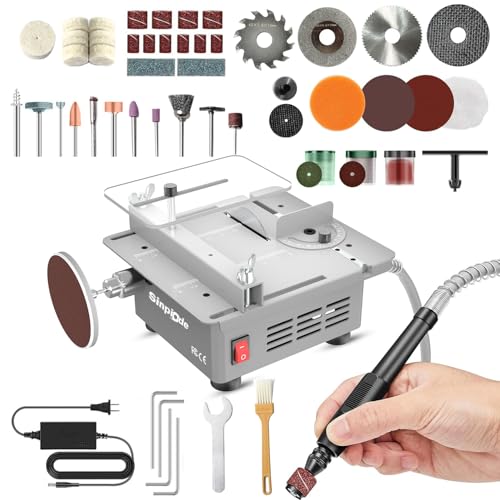
- 100W motor with seven speed levels
- Four specialized blades included
- Combines cutting, sanding, engraving, and drilling
Best For: Delicate DIY crafts using thin wood, plastics, PCBs, and soft metals
Best Low-Noise Pick

- Aluminum-alloy body with engraved scale
- Designed for low-noise operation
- Works with wood, acrylic, PVC, plastic, and PCBs
Best For: Quiet home DIY and miniature craft cutting
Best Overall – DEWALT DWE7485 Compact Jobsite Table Saw
For shoppers seeking beginner-friendly hobby table saws with room to grow, the DEWALT DWE7485 combines a compact footprint with a useful 24.5-inch rip capacity. Its rack-and-pinion fence and tool-free guard adjustments make common setup tasks more approachable.
Best For: DIYers and hobbyists who need a portable saw for plywood, OSB, and general woodworking projects.
Pros:
- 24.5-inch rip capacity supports ripping 4×8 plywood or OSB sheets.
- Rack-and-pinion telescoping rails make fence adjustments fast and precise.
- Metal roll cage, onboard storage, and compact dimensions suit transport and storage.
- Power-loss reset helps prevent accidental restarts after an interruption.
Cons:
- At 54 pounds, it is less convenient to carry than lighter tabletop models.
- Its 8-1/4-inch blade and compact format may be limiting for larger stock.
The DWE7485 is a strong all-around choice when beginner-friendly operation matters but you still want jobsite-ready capacity and durability.
Best for Precision Crafts – PROXXON FET Precision Table Saw
The PROXXON FET is a specialized option among beginner-friendly hobby table saws, emphasizing controlled cuts for model building and intricate projects. Its adjustable blade, extendable table, and low-noise motor are suited to small-scale work rather than heavy construction.
Best For: Model builders and hobbyists cutting wood, non-ferrous metals, and plastics in a compact workspace.
Pros:
- Adjustable blade height and angle support precise project work.
- Extendable table accommodates larger workpieces than its compact body suggests.
- Low-noise motor and vacuum adaptor support cleaner, more comfortable operation.
- Non-slip rubber feet and a safety switch add convenience during use.
Cons:
- The 200-watt motor is intended for hobby applications, not demanding construction cuts.
- Its 13-by-14-by-8-inch format provides less working area than a jobsite saw.
Choose the FET when accuracy, material versatility, and a compact bench setup are more important than high-capacity ripping.
Best Lightweight Pick – WORX BladeRunner WX572L
Weighing less than 15 pounds, the WORX BladeRunner is one of the more approachable beginner-friendly hobby table saws for portable, small-project work. It includes a rip fence, miter gauge, and five blades for cutting several materials.
Best For: Beginners who want an easy-to-move tabletop saw for wood, plastic, metal, aluminum, or ceramic tile projects.
Pros:
- Lightweight 14.7-pound design is easy to move around a workshop.
- Steel rip fence and riving knife support crosscuts and rip cuts.
- Adjustable miter gauge handles angles from 0 to 60 degrees in either direction.
- Includes five material-specific blades and tool-free blade changes.
Cons:
- Its compact tabletop format is better suited to smaller workpieces than full-size sheet goods.
- The 5.5-amp saw has less capacity than a heavier jobsite table saw.
The BladeRunner is a practical starter for users who value portability, included accessories, and the ability to work with more than just wood.
Best for Miniature Crafts – Mini Multifunctional Table Saw
This mini multifunctional saw is aimed at craftspeople who need more than basic cutting. As one of the most compact beginner-friendly hobby table saws in this roundup, it offers adjustable height and angle controls plus accessories for grinding, engraving, and drilling.
Best For: Small craft projects involving thin wood, PCB boards, acrylic, plastic, tubing, and other miniature materials.
Pros:
- Independent motor switches separate cutting from grinding or polishing functions.
- Blade height adjusts through a 0-to-16 mm range for controlled cutting depth.
- Cutting plate rotates from 0 to 90 degrees with marked angle settings.
- Includes four blade types, a drill chuck, sanding disc, and more than 100 small parts.
Cons:
- The 8-by-4-by-3-inch size is intended for miniature materials, not full-size lumber.
- The supplied details do not specify motor power, speed, or complete cutting capacity.
- Its multifunction design may require more setup familiarity than a dedicated saw.
This is best viewed as a compact craft workstation rather than a conventional woodworking table saw, especially if drilling and engraving are useful to you.
Best Pocket-Size Pick – MXBAOHENG Mini Table Saw S3
For beginners seeking hobby table saws that fit a compact workspace, the MXBAOHENG S3 offers straightforward control in a palm-sized design. Its adjustable blade height, seven-speed power supply, and included accessories make it suitable for small, detail-oriented craft projects rather than full-size woodworking.
Best For: Miniature wood crafts, model making, balsa wood, thin wood, acrylic, plastic, and PCB projects.
Pros:
- Compact 7 x 5.5 x 3-inch, 4.2-pound design for space-constrained workshops.
- Adjustable cutting depth from 0 to 0.59 inches for small materials.
- Seven voltage settings and included miter gauge support controlled cutting.
- Supports 0°-90° cuts, including 45° bevel work.
Cons:
- Its 0.59-inch maximum depth limits it to thin and miniature materials.
- The small work area is not intended for large woodworking projects.
Choose this model if portability and fine control matter more than capacity. The included blades and accessories broaden its usefulness, while the adjustable power supply can help beginners match speed to delicate materials.
Best Accessory Bundle – Saker Mini Table Saw
The Saker is a beginner-friendly hobby table saw for makers who want one compact machine for cutting and light workshop tasks. Clear panel markings, anti-slip feet, a transparent baffle, adjustable speed, and more than 160 accessories help make its broad feature set approachable for first-time users.
Best For: DIY models, small woodworking projects, PCB boards, plastic sheets, thin wood, aluminum tubes, and copper tubes.
Pros:
- Includes four blade types for wood, PCB, metal-related, and resin cutting tasks.
- Five adjustable speed settings and a 90W copper motor reach up to 5,000 rpm.
- 0°-90° angle adjustment and 16mm cutting depth support varied small projects.
- Transparent debris protection, rubber feet, and marked panels support steadier work.
Cons:
- Its compact format is designed for small items, not full-size stock.
- The extensive accessory set may take time for beginners to organize and learn.
This is a strong choice when versatility is the priority. Its compact cast-iron body and stability features provide a reassuring foundation, while the included soft shaft adds drilling and detail-work capability.
Best Stability Features – M-T 7-Speed Mini Table Saw
The M-T mini saw is among the more beginner-friendly hobby table saws for precise desktop crafting. Its cast-iron worktable, laser-etched scales, shock-absorbing feet, transparent shield, and seven-speed control are aimed at helping new users make cleaner cuts on thin materials.
Best For: DIY models, miniature crafts, thin wood, acrylic, plastic, and PCB cutting, plus light grinding and drilling work.
Pros:
- Four specialized blades cover PCB, HSS, alloy, and resin cutting applications.
- Seven-speed control and a 100W motor rated up to 6,000 rpm help match output to materials.
- Laser-etched scales and a cast-iron table are designed for stable, accurate cuts.
- Transparent protection and rubber feet support a cleaner, steadier workspace.
Cons:
- The 0.59-inch maximum cutting thickness restricts projects to thin stock.
- It is a desktop craft tool rather than a general-purpose woodworking saw.
For beginners who value visible measurements and reduced vibration, this model has a practical feature mix. Its compact footprint and material-specific blades make it well suited to controlled craft work, provided your projects stay within its small capacity.
Best Compact Pick – 7-Speed Portable Craft Saw
For beginners seeking beginner-friendly hobby table saws for small projects, this compact 96W model offers adjustable power, depth control, and a useful selection of cutting accessories. Its small footprint suits model making, miniature woodworking, and other light-duty crafts rather than full-size woodworking.
Best For: Beginners working on balsa wood, basswood, craft sticks, acrylic, plastic, PCB, and other small materials.
Pros:
- Seven power settings, from 12V to 24V, with speeds up to 5,000 RPM.
- Adjustable cutting depth from 0 to 0.59 inches for better control.
- Includes four cutting accessories, a miter gauge, transparent guard, and storage pouch.
- Compact 7 × 5.5 × 3-inch design weighs about 4.1 pounds.
Cons:
- Limited to light-duty materials and a maximum depth of 0.59 inches.
- The very small work surface may not suit larger pieces.
This is a practical entry point for hobbyists who value portability and adjustable control. Its accessory bundle expands its usefulness, but users should keep projects within its miniature-craft capacity.
Best Multifunction Option – Adjustable-Speed Desktop Craft Saw
This multifunction desktop saw is aimed at beginners who want beginner-friendly hobby table saws for delicate craft work. Its 100W motor, seven-speed control, and compact cast-alloy tabletop support cutting, sanding, engraving, and drilling tasks, but its 0.59-inch capacity makes it unsuitable for heavy-duty woodworking.
Best For: DIY hobbyists cutting thin wood, plastic, acrylic, PCBs, and soft metals such as aluminum up to 3mm.
Pros:
- Seven speed levels and a motor rated up to 6,000 RPM.
- Includes PCB, HSS, alloy, and resin blades for different light materials.
- Compact design with a cast-alloy tabletop, laser-etched scale, guard, and shock-absorbing pads.
- Supports multiple craft functions, including cutting, sanding, engraving, and drilling.
Cons:
- Maximum cutting thickness is 0.59 inches.
- Not intended for professional, large-scale, or heavy-duty woodworking.
- The saw and sanding functions activate simultaneously, requiring careful setup.
This model stands out when one compact tool needs to handle several craft tasks. Beginners should follow the stated safety limits closely and use it only on a stable, flat surface with suitable light materials.
Best Low-Noise Pick – Precision Mini DIY Table Saw
Beginners comparing beginner-friendly hobby table saws may appreciate this compact corded model for its aluminum-alloy body, engraved scale, and low-noise operation. It is designed for portable DIY and miniature projects involving materials such as wood, acrylic, PVC, plastic, and circuit boards.
Best For: Hobbyists who want a lightweight desktop saw for small straight or curved cuts in craft materials.
Pros:
- Compact, lightweight design is easy to move around a home workshop.
- Aluminum-alloy body and high-precision scale markings support repeatable positioning.
- Designed for relatively low-noise, energy-conscious operation.
- Broad stated material compatibility, including wood, balsa, acrylic, PVC, plastic, and circuit boards.
Cons:
- No included components are listed, so accessories may need to be sourced separately.
- Its 18 × 14 × 8-inch listed dimensions are less compact than the other mini saws here.
- The notes do not specify an adjustable cutting depth or included safety accessories.
This saw is a reasonable choice for beginners prioritizing a sturdy alloy platform and quieter operation. Before buying, confirm the included blade and accessory setup, especially if you need depth adjustment or guided angled cuts.
How We Picked These Beginner-Friendly Hobby Table Saws
We focused on saws that suit beginners working on crafts, models, small woodworking projects, repairs, and occasional DIY tasks. Selection criteria included ease of setup, speed or blade adjustment, cutting control, portability, workspace requirements, included accessories, and the types of materials each saw is designed to handle. We also included a range of sizes, from compact craft machines to a more capable portable jobsite saw, because “beginner” does not always mean the same project scale.
Before buying, verify the current specifications, included blades, maximum cutting depth, and manufacturer guidance for compatible materials. Small hobby saws are not substitutes for full-size woodworking equipment, while larger portable saws require more space and stricter attention to safe operation.
Quick Comparison
| Type | Best suited to | Main advantage | Potential limitation |
|---|---|---|---|
| Portable jobsite saw | Boards, shelving, and general DIY | Greater power and cutting capacity | Larger footprint and more demanding setup |
| Compact tabletop saw | Light woodworking and mixed DIY | Portable, versatile format | Less capacity than a jobsite model |
| Precision mini saw | Models, crafts, thin wood, and small parts | Compact control and adjustable settings | Limited depth and material size |
| Multi-function craft saw | Cutting, sanding, grinding, or engraving | Broad hobby usefulness | Accessory quality and capability may vary |
Key Buying Factors for Beginner-Friendly Hobby Table Saws
Material and Cutting Capacity
Start with the materials you expect to cut most often. Thin craft wood, plastic, foam board, and small model parts generally suit mini saws. Larger boards and repeated straight cuts call for a more powerful portable table saw. Check both maximum cut depth and the available table or fence support.
Control and Adjustability
Variable speed can help beginners match the tool to different materials, while an adjustable blade angle supports bevel cuts. A stable fence, clear measurement markings, and a controllable feed rate are often more valuable than a long list of accessories.
Safety and Workspace
Look for a dependable blade guard, a usable push stick, a secure work surface, and an accessible power switch. Keep the saw stable, wear suitable eye protection, and follow the manual. Compact machines still require careful handling, especially when cutting very small pieces.
Portability and Accessories
Consider whether the saw will stay on a bench or be stored after every use. Included blades and attachments can improve value, but confirm that replacement parts are available and that accessories are appropriate for your intended materials.
Who Should Buy Which Beginner-Friendly Hobby Table Saws?
Choose a portable jobsite model if you need to cut ordinary lumber, panels, or shelving and have room for a sturdier machine. Choose a compact tabletop saw for occasional DIY work when portability matters but you still want more capacity than a miniature craft tool.
Choose a precision mini saw if your projects involve model making, thin wood, small plastic pieces, electronics enclosures, or detailed craft work. A multi-function model may be worthwhile if sanding, grinding, or engraving are as important as sawing. For most first-time buyers, prioritize stable guidance, straightforward adjustments, and a suitable cutting range over maximum speed or the largest accessory bundle.