The right anvil gives jewelry artists a stable, dependable surface for shaping wire, flattening components, stamping metal, and refining small formed pieces. For a compact studio or mobile bench, size, weight, horn shape, and surface quality matter more than a large blacksmith-style footprint.
We compared 10 small jewelry anvils and related bench tools across steel and cast-iron construction, dual-ended and single-horn designs, flat work surfaces, included accessories, and space-saving formats. Use the guide below to match the tool to your techniques, materials, and available bench space.
Best 10 Small Jewelry Anvils for Professional Artists Picks for 2026
Best Dual-Ended Pick

- Flat and rounded horns
- Solid polished stainless steel
- Workbench attachment holes
Best For: Wire shaping, riveting, and compact metalsmithing
Best Stamping Block
OWDEN Professional Steel Bench Block

- Three-inch round steel surface
- Mirror-finished chrome plating
- Soft base reduces rebound
Best For: Jewelry stamping and controlled flattening
Best Forming Layout
SFC Tools Hexagon Jewelry Anvil

- 15 holes from 0.5–6 mm
- Five tapered milled slots
- Compact jewelry-focused design
Best For: Riveting and forming small components
Best Complete Workstation
Steel Bench Block and Hammer Set

- Includes block, base, and hammer
- Four-inch square steel surface
- Rubber base absorbs vibration
Best For: Jewelry repair, stamping, and starter setups
Compact Cast-Iron Pick

- Cast-iron body with 45–58 HRC hardness
- Polished face and rounded horn
- Compact 2.57-pound listed weight
Best For: Precision jewelry shaping and stamping in small workspaces
Ready-to-Use Set
Mini Horn Anvil with Rubber Hammer
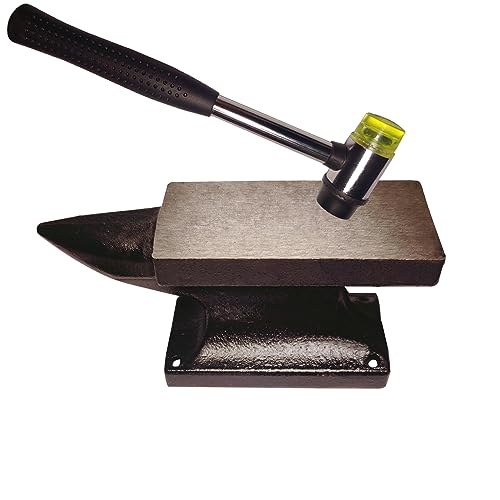
- Includes cast-iron anvil and rubber hammer
- Four holes support secure bench placement
- 4 x 2-inch flat work surface
Best For: Jewelry artists wanting a compact bundled setup
Lightweight Steel Choice

- Heat-treated steel construction
- Dual rounded horns for forming
- Lightweight 1.07-pound design
Best For: Portable wire forming, embossing, and detailed jewelry work
Versatile Horn Set
3-Lb Jewelry Stamping Anvil Kit

- Includes an anvil and stamping hammer
- 4 x 2-inch flat work surface
- Cast iron construction for durable bench work
Best For: Artists needing a stable, ready-to-use stamping kit
Bench-Mount Pick

- Compact 1-pound cast iron design
- Four slots for secure bench mounting
- 2.5 x 1.38-inch polished flat top
Best For: Light-duty jewelry and model work in compact studios
Gentle Stamping Set
Mini Iron Horn Anvil and Hammer

- Includes 1.1-pound anvil and rubber hammer
- Polished 2.4 x 1.4-inch work surface
- Four mounting holes improve stability
Best For: Delicate jewelry stamping and small-scale metal shaping
Best Dual-Ended Pick – The Beadsmith Mini Horn Anvil
For professional artists seeking small jewelry anvils, The Beadsmith Dual-Ended Horn Anvil offers two shaping profiles in a compact stainless-steel format. Its flat and rounded horns support wire hardening, bending, riveting, stamping, and other precision metalsmithing tasks.
Best For: Jewelry artists who need a compact, versatile horn anvil for wire designs and small metalwork.
Pros:
- Dual-ended design includes flat and rounded horns.
- Solid stainless-steel construction with a polished finish.
- Base holes allow attachment to a workbench for added stability.
- Includes a Pritchel hole for riveting and bending.
Cons:
- The miniature working area may limit larger projects.
- At about 0.82 pounds, it may need bench attachment during forceful work.
This is a strong choice when versatility matters more than a broad flat surface. The two horn shapes and attachment holes make it especially practical for detailed jewelry work in a small studio.
Best Stamping Block – OWDEN Professional Steel Bench Block
For professional artists comparing small jewelry anvils, the OWDEN Professional Steel Bench Block emphasizes a stable, low-rebound surface for stamping and flattening. Its round, chrome-plated steel top and soft plastic base are suited to controlled bench work.
Best For: Jewelry makers focused on stamping blanks, tags, letters, and small metal components.
Pros:
- Three-inch round steel surface provides a solid working area.
- Mirror finish with chrome plating offers a smooth surface.
- Soft plastic base improves stability and reduces rebound.
- Supports flattening, chasing, shaping, laying out, and stamping.
Cons:
- Its round, flat-block design does not provide horn profiles or forming holes.
- The plastic base may be less suitable for users wanting a permanently mounted anvil.
This bench block is best viewed as a precision stamping and flattening tool rather than a traditional horn anvil. The reduced rebound design can help artists make cleaner, more controlled impressions.
Best Forming Layout – SFC Tools Hexagon Jewelry Anvil
Small jewelry anvils for professional artists do not all need to be large or traditional. The SFC Tools Hexagon Anvil packs 15 holes and five milled slots into a compact block, giving jewelry makers dedicated options for riveting, forming, and working small parts.
Best For: Artists who need varied holes and slots for small-part forming and riveting.
Pros:
- Includes 15 holes ranging from 0.5 to 6 mm in diameter.
- Five milled slots measure 1.2–1.6 mm wide.
- Compact 2.13 x 1.88 x 0.69-inch working form suits small projects.
- Slots are tapered on one side for varied forming applications.
Cons:
- The small block offers less flat surface than a larger bench block.
- Supplied notes do not specify the construction material or finish.
This is a specialized choice for artists who value built-in forming features over a broad hammering face. Its range of hole sizes and tapered slots makes it particularly useful for detailed small-part work.
Best Complete Workstation – Steel Bench Block and Hammer Set
For professional artists looking for small jewelry anvils with immediate usability, this set combines a flat steel bench block, shock-absorbing rubber base, and a six-inch jewelry-making hammer. It is designed for stamping, repairing, and general jewelry hammering.
Best For: Jewelry repairers, metal stampers, and DIY users who want a bench block and hammer together.
Pros:
- Includes a steel bench block, rubber base, and six-inch hammer.
- Four-inch square steel block provides a flat working surface.
- Rubber base absorbs shock and reduces vibration.
- Suitable for jewelry making, repairs, stamping, and hammering.
Cons:
- Its flat design does not offer horns, holes, or forming slots.
- The complete set is heavier than the smaller standalone blocks listed here.
This set offers practical value for artists building a basic jewelry work surface. The included hammer and shock-absorbing base make it a convenient starting point for flat stamping and repair tasks.
Compact Cast-Iron Pick – HimaPro Single Horn Anvil
For artists comparing small jewelry anvils for professional artists, the HimaPro offers a compact cast-iron platform with a polished flat face and a rounded horn. Its 2.2-pound-class size suits detailed forming, stamping, and bench work where portability matters.
Best For: Jewelers who need a compact, sturdy anvil for bending, shaping, flat hammering, and punching.
Pros:
- Cast-iron construction with a stated hardness of 45–58 HRC.
- Rounded horn supports curved forming and bending.
- Polished flat surface works for hammering and punching.
- Compact dimensions make it practical for small workspaces.
Cons:
- Its small 2.57-pound listed weight may limit heavier forging tasks.
- Single-horn design offers less shape variety than dual-ended models.
The HimaPro is a focused bench tool for precision jewelry work rather than large-scale forging. It is a sensible choice when a durable cast-iron body and compact footprint are priorities.
Ready-to-Use Set – Mini Horn Anvil with Rubber Hammer
This set stands out among small jewelry anvils for professional artists because it combines a compact cast-iron anvil with a rubber hammer. The flat work surface, horn, and securing holes make it a practical starter setup for controlled jewelry forming and wire work.
Best For: Artists who want an anvil-and-hammer combination for jewelry design, hardened wire work, and light metal forming.
Pros:
- Includes both a 3-pound anvil and a rubber hammer.
- Four base holes help secure the anvil at the work area.
- Flat 4 x 2-inch surface supports hammering.
- Rubber hammer is designed to reduce surface damage to jewelry.
Cons:
- The rubber hammer may be less suitable for demanding metal-forging blows.
- There is no manufacturer warranty listed in the supplied details.
- Its compact work surface may feel limited for larger pieces.
For buyers who value convenience, this package provides the essential anvil and hammer together. Its securing features and softer hammer make it especially appealing for careful bench work where protecting finished surfaces is important.
Lightweight Steel Choice – Splenor Dual-Ended Horn Anvil
The Splenor is a lightweight option for artists seeking small jewelry anvils for professional artists, with a heat-treated steel body and dual-ended rounded horns. Its smooth, chamfered surfaces are designed for shaping, embossing, flattening, riveting, stamping, and wire forming.
Best For: Jewelry makers who prioritize a lightweight steel bench tool with multiple rounded forming areas.
Pros:
- Heat-treated steel construction is designed for durability.
- Dual-ended horn design supports rounded forming work.
- Smooth surface and thick chamfers help reduce metal damage.
- At 1.07 pounds, it is easy to move between work areas.
Cons:
- Its 4 x 1.5-inch dimensions provide a relatively small work surface.
- The lightweight design may be less stable for forceful hammering.
- No included hammer or mounting hardware is specified.
Splenor’s main advantage is flexibility in a small, portable format. It fits detail-focused forming and wire work particularly well, though artists doing heavier hammering may prefer a more substantial anvil.
Versatile Horn Set – 3-Lb Jewelry Stamping Anvil Kit
For professional artists seeking small jewelry anvils for professional artists, this 3-pound horn anvil set offers a practical combination of a compact work surface and included stamping hammer. Its cast iron construction is suited to jewelry making, metal stamping, wirework, and light metal forming.
Best For: Artists who want a heavier compact anvil with a dedicated metal stamping hammer for jewelry tags, blanks, and general bench work.
Pros:
- Includes both a mini horn anvil and metal stamping hammer.
- Provides a 4 x 2-inch flat work surface and a stable 2 x 3.7-inch base.
- Cast iron construction with alloy steel investment casting and heat treatment is designed for durability.
- Suitable for jewelry making, stamping, wirework, and metal forming.
Cons:
- The compact 4 x 2-inch work surface may limit larger projects.
- Its 3-pound size is less portable than lighter bench blocks.
Among small jewelry anvils for professional artists, this is a strong choice when stability and a complete stamping setup matter more than minimum size. The horn also adds flexibility for curved and formed work.
Bench-Mount Pick – 1-Lb Compact Horn Anvil
QWORK Mini Cast Iron Horn Anvil 1lb Bench Block – Compact Tool for Jewelry, Metal Craft & Model Work
Check Price On AmazonFor artists comparing small jewelry anvils for professional artists, the QWORK Mini Cast Iron Horn Anvil emphasizes a compact footprint and easy bench mounting. Its polished, hardened surface is intended for light-duty jewelry, model work, and small metal-craft tasks.
Best For: Jewelers and model makers who need a small, mountable anvil for light-duty work and have their own hammer.
Pros:
- Light 1-pound design is convenient for compact workspaces.
- Four base slots allow secure fixing to a workbench.
- Polished and hardened surface supports steady light-duty use.
- Its 2.5 x 1.38-inch flat top suits small craft projects.
Cons:
- The small flat top is not intended for larger workpieces.
- No hammer or other accessories are listed in the supplied notes.
- The product is positioned for hobby and light-duty use rather than demanding forging.
This QWORK model is a focused option when saving space and anchoring the tool securely are priorities. Its compact dimensions make it especially appropriate for detailed bench work, provided the project stays within its light-duty scope.
Gentle Stamping Set – Mini Iron Horn Anvil and Hammer
For professional artists evaluating small jewelry anvils for professional artists, the NewFe Mini Iron Horn Anvil set combines a 1.1-pound horn anvil with an 8.2-inch rubber hammer. The compact polished surface and softer hammer are designed for jewelry stamping, silversmithing, shaping, and other small metalworking tasks.
Best For: Jewelry artists who want a compact starter set with a rubber hammer intended to minimize damage to delicate metal surfaces.
Pros:
- Includes the anvil, rubber metal stamping hammer, and a small piece of sandpaper.
- Polished 2.4 x 1.4-inch surface supports small-scale hammering and shaping.
- Four mounting holes help secure the anvil and reduce unwanted movement.
- Horn profile assists with bending, curving, and forming intricate metalwork.
Cons:
- The small work surface limits the size of projects it can accommodate.
- At 1.1 pounds, it offers less mass than heavier bench anvils.
- The rubber hammer may be less suitable when a harder striking surface is required.
This set stands out for delicate bench work because it pairs a compact horn anvil with a rubber hammer. It is a convenient choice for artists prioritizing surface protection and included accessories over maximum anvil weight.
How We Picked These Small Jewelry Anvils for Professional Artists
We focused on compact anvils suited to jewelry-scale work rather than general forging. The selection includes horn anvils for curved forming, flat bench blocks for stamping and texturing, combination kits with hammers, and versatile designs that can support several bench tasks. We considered material, working-surface shape, portability, stability, stated dimensions and weight, and whether included accessories add useful value.
Because product specifications and finishing can vary, inspect the working faces and edges when an anvil arrives. A clean, reasonably smooth surface is important for avoiding unwanted marks on soft metals.
Quick Comparison
| Type | Best suited to | Main advantage | Potential limitation |
|---|---|---|---|
| Dual-ended horn | Curves, rings, and forming | Multiple radii in one tool | Less flat area than a bench block |
| Single-horn anvil | General jewelry forming | Focused curved support | Fewer shaping options |
| Flat bench block | Stamping, flattening, and texturing | Stable, uniform surface | Limited curved forming |
| Anvil and hammer set | New or mobile benches | Ready-to-use basic setup | Included hammer may not suit every technique |
Key Buying Factors for Small Jewelry Anvils for Professional Artists
Working Surface and Shape
Choose a horn when you regularly form curves, bezels, loops, bangles, or rings. A flat block is usually better for stamping, planishing, straightening, and texturing sheet or wire. Dual-ended horns offer flexibility, while a dedicated flat block can provide more predictable support for impression work.
Material, Hardness, and Finish
Steel generally provides a durable, crisp surface for repeated bench work. Cast or forged iron can also be effective, especially when weight and value are priorities. Look for a surface free from deep pits, sharp unintended burrs, and rough casting marks. The finish should complement the metal you work with rather than transfer distracting texture.
Weight and Stability
A heavier anvil tends to move less during hammering, but a lighter model is easier to store, transport, or use in a small workspace. If choosing a compact model, place it on a solid bench and consider a non-slip or rubber base. Included rubber blocks can help reduce movement and noise, though they may not replace a firmly mounted setup for frequent heavy work.
Size and Technique
Check the actual dimensions before buying. Small anvils are excellent for precision tasks, but a very short horn or narrow face may feel restrictive when working on larger components. Match the tool to your largest regular project, not only the smallest piece you make.
Who Should Buy Which Small Jewelry Anvils for Professional Artists?
Choose a dual-ended horn if you want one compact tool for varied curved-forming tasks. Choose a flat bench block if stamping, flattening, and texturing are your main priorities. Choose a heavier cast- or forged-iron model when stability matters more than portability. Choose a hammer-and-anvil set if you are building a starter bench or need a convenient secondary setup. Professional artists with specialized workflows may benefit from pairing a flat block with a horn rather than expecting one small anvil to handle every operation.