Fine airborne particles can settle on precision tools, obscure detailed work, and affect shop air quality long after a cutting or sanding task ends. The right filtration system helps capture suspended dust and fumes that ordinary source collection may miss.
This roundup compares 10 options across compact extraction, remote-controlled filtration, multi-stage designs, and high-CFM systems so you can match airflow, filtration, and shop size to your workflow.
Best 10 Workshop Air Filtration Systems for Precision Work Picks for 2026
Best HEPA Ceiling Unit
DEWALT DWXAF101 Air Filtration System
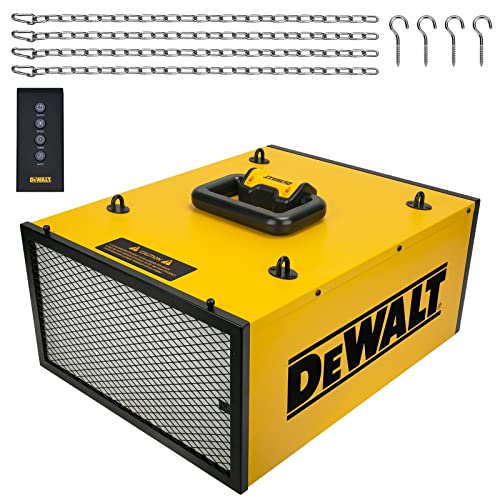
- H11 HEPA plus washable pre-filter
- Four modes with remote and timer
- Ceiling-mount design saves floor space
Best For: Woodworking shops needing convenient overhead HEPA filtration
Best for Soldering Fumes

- Three-stage HEPA and carbon filtration
- Designed for soldering and PCB repair
- Around 50 dB on low speed
Best For: Light-duty benchtop soldering and electronics work
Best Budget Workshop Circulation
WEN 3410 Air Filtration System
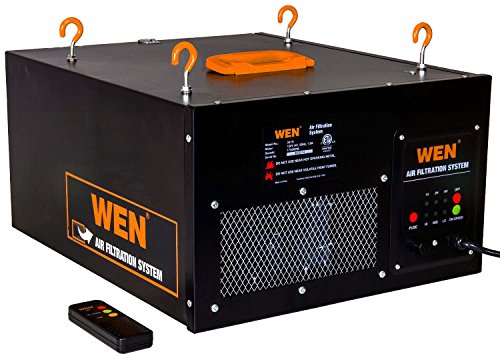
- 300/350/400 CFM airflow settings
- 1-micron filter with 5-micron pre-filter
- RF remote and programmable timer
Best For: Affordable general-purpose workshop dust circulation
Best High-Airflow Woodworking Unit

- 580/780 CFM airflow options
- 270-degree intake with vortex fan
- Ceiling or workbench placement
Best For: Larger woodworking shops needing strong air circulation
Balanced Workshop Coverage
WEN 3417 Air Filtration System
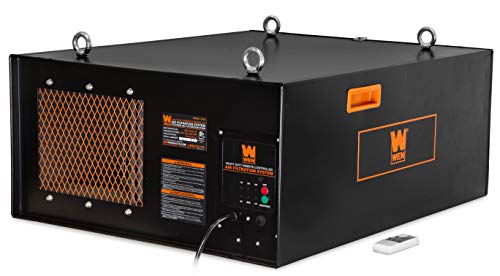
- Three speeds up to 1,044 CFM
- 1-micron filter with 5-micron pre-filter
- RF remote and programmable timer
Best For: Workshops up to 1,000 square feet
High-Volume Intake Filtration

- Airflow reaches 1,350 CFM
- MERV-11 filter with stated particle-capture rates
- Ceiling or workbench placement with IR remote
Best For: Large woodworking shops and garages
Maximum WEN Airflow
- Three speeds up to 1,270 CFM
- 1-micron filter and 5-micron pre-filter
- Remote control with programmable timer
Best For: 1,000-square-foot shops needing stronger airflow
Large-Shop Circulation Pick

- 360-degree intake for broad air circulation
- MERV-11 filter with two fan speeds
- Remote, timer, ionizer, and ceiling-mount hardware
Best For: Larger woodworking shops and garages
Compact Quiet Pick

- Compact 17.4-pound portable design
- MERV-13 filter and two airflow settings
- Under 58 dBA with timer and extra socket
Best For: Smaller shops and portable workstations
Hanging Workshop Pick

- 270-degree intake for flexible air circulation
- MERV-11 filtration with two fan speeds
- Remote, timer, ionizer, and hook-and-chain mount
Best For: Medium home workshops and garages
Best HEPA Ceiling Unit – DEWALT DWXAF101 Air Filtration System
For workshop air filtration systems for precision work, the DEWALT DWXAF101 is a practical choice when you want two-stage filtration, remote control, and ceiling-mounted installation. Its washable pre-filter and H11 HEPA filter target particles down to 0.3 micron, while the automatic mode can adjust operation based on detected air quality.
Best For: Woodworking shops that need space-saving, remote-controlled air cleaning with HEPA filtration.
Pros:
- Two-stage filtration includes a washable cotton pre-filter and H11 HEPA filter.
- Four operating modes, including automatic air-quality sensing.
- Ceiling hooks and chains preserve floor space; timer settings run from 1 to 8 hours.
- Filter replacement indicator and a three-year warranty simplify ownership.
Cons:
- Its 64 dB noise rating may be noticeable in a quiet precision-work area.
- Designed for dust rather than dedicated fume or odor control.
The DWXAF101 stands out for general workshop dust management where overhead mounting and HEPA filtration matter. It is less specialized for soldering, laser smoke, or strong odors.
Best for Soldering Fumes – KNOKOO FES150S Fume Extractor
The KNOKOO FES150S is a source-capture option among workshop air filtration systems for precision work. Its three-stage design combines a pre-filter, H13 HEPA filter, and activated carbon filter to address solder smoke, fine particles, VOCs, and odors near a desktop work area.
Best For: Light-duty soldering, PCB repair, 5W laser engraving, and similar benchtop tasks.
Pros:
- Three replaceable filtration stages provide particle and odor treatment.
- H13 HEPA filtration is rated up to 99.97% purification efficiency.
- 200 m³/h airflow and a brushless motor support continuous operation.
- Low-speed operation is rated around 50 dB, with a filter-clog alert.
Cons:
- The manufacturer identifies it as a light-duty model.
- Odor adsorption performance can vary with contaminant concentration, especially on higher-power laser systems.
For precision electronics work, the FES150S is more targeted than a general room air cleaner because it is designed to capture fumes at the source. Consider a higher-capacity model for thick smoke or heavier industrial use.
Best Budget Workshop Circulation – WEN 3410 Air Filtration System
The WEN 3410 offers straightforward workshop air filtration systems for precision work when adjustable airflow and remote operation are priorities. It uses a 5-micron pre-filter and 1-micron filter, moves 300, 350, or 400 CFM, and is rated for rooms up to 400 square feet.
Best For: Budget-conscious woodworking or garage users who want programmable, remote-controlled air circulation.
Pros:
- Three airflow settings provide up to 400 CFM.
- Includes replaceable 1-micron and 5-micron filters.
- RF remote works from up to 26 feet and does not require direct line of sight.
- Programmable timer automatically shuts the unit off.
Cons:
- Its 1-micron filtration is less fine than the HEPA-equipped options in this roundup.
- Noise is rated from 50 to 60 dB.
- At 31 pounds, it is heavier than some comparable units.
The WEN 3410 is a sensible general-purpose choice for airborne workshop dust and routine circulation. It is not the strongest match for ultrafine fume control or odor removal.
Best High-Airflow Woodworking Unit – ALORAIR Purecare 780IG
The ALORAIR Purecare 780IG suits larger woodworking areas where strong circulation is important. Among workshop air filtration systems for precision work, it combines a 270-degree intake, vortex fan, two-stage operation, and a built-in ionizer, with airflow settings of 580 and 780 CFM.
Best For: Wood carving, sanding, turning, scroll-saw work, and other dust-producing shop tasks in spaces up to about 800 square feet.
Pros:
- High airflow settings of 580 and 780 CFM support broad circulation.
- 270-degree intake design and vortex fan help maintain airflow.
- Can be hung from the ceiling or placed on a workbench.
- Remote control and 1-to-9-hour timer add convenience; noise is rated below 50 dBA.
Cons:
- MEVR 11 filtration is not HEPA filtration.
- The built-in ionizer may not suit users who prefer filtration without ionization.
- Not available for shipment to California according to the supplied notes.
The Purecare 780IG is compelling when shop coverage and airflow take priority over ultra-fine HEPA filtration. Its flexible mounting and quiet rating make it useful for active woodworking spaces.
Balanced Workshop Coverage – WEN 3417 Air Filtration System
WEN 3417 3-Speed Remote-Controlled Industrial-Strength Air Filtration System (556/702/1044 CFM)
Check Price On AmazonFor workshop air filtration systems for precision work, the WEN 3417 offers adjustable airflow and fine-particle filtration for rooms up to 1,000 square feet. Its three speeds, programmable timer, and radio-frequency remote make it practical for routine dust control without needing to reach the unit.
Best For: Woodworkers and makers who want remote-controlled filtration for a workshop of up to 1,000 square feet.
Pros:
- Three airflow settings: 556, 702, and 1,044 CFM.
- Includes a 1-micron filter and replaceable 5-micron pre-filter.
- RF remote works from up to 26 feet and does not require direct line of sight.
- Programmable timer can shut the unit off automatically.
Cons:
- At 55 pounds, it is relatively heavy for installation or repositioning.
- Noise is rated from 63 to 68 dB.
- Its maximum coverage is listed at 1,000 square feet.
The WEN 3417 is a balanced choice when convenient controls and replaceable dual-stage filtration matter as much as airflow. Its moderate coverage and higher weight are worth considering before mounting it in a compact workspace.
High-Volume Intake Filtration – ABESTORM DecDust 1350
The ABESTORM DecDust 1350 is a high-airflow option among workshop air filtration systems for precision work. Its 360-degree intake, MERV-11 filter, and two speed settings are designed for woodworking, sanding, carving, and other dust-producing shop tasks.
Best For: Larger workshops, garages, and woodworking areas that need up to 1,350 CFM of overhead or workbench filtration.
Pros:
- Delivers 1,050 or 1,350 CFM and lists coverage up to 1,700 square feet.
- MERV-11 filter captures 90% of 3–10 micron particles and 85% of 1-micron particles, according to the supplied specifications.
- 360-degree intake is suited to dust-heavy woodworking applications.
- Can be hung from the ceiling or placed on a workbench, with panel and IR remote controls.
Cons:
- Noise is rated from 60 to 69 dBA.
- Only two speed settings are listed.
- The supplied filter dimensions may require checking replacement availability before purchase.
Choose the DecDust 1350 when coverage and airflow take priority. Its flexible placement and dual controls are useful in busy shops, while the two-speed design gives less adjustment than a three-speed unit.
Maximum WEN Airflow – WEN AF1270 Filtration System
The WEN AF1270 combines three speed settings with airflow up to 1,270 CFM, making it a strong fit for workshop air filtration systems for precision work in a 1,000-square-foot room. Its included 1-micron filter, 5-micron pre-filter, timer, and remote support flexible dust-management routines.
Best For: Users who want higher airflow and three-speed control in a workshop of up to 1,000 square feet.
Pros:
- Three speeds provide 750, 950, or 1,270 CFM.
- Can circulate air in a 1,000-square-foot room up to 9.5 times per hour.
- Includes replaceable 1-micron and 5-micron filtration stages.
- Remote control works up to 26 feet and operates the timer, speed, and power.
Cons:
- Its listed noise level is 68 dB.
- At 65.9 pounds, it is the heaviest product in this comparison.
- It draws 4.2 amps, or 504 watts according to the supplied details.
The AF1270 is the more powerful WEN option here, offering greater maximum airflow than the WEN 3417 while retaining similar remote and timer features. Its weight and noise rating make installation and placement important considerations.
Large-Shop Circulation Pick – ALORAIR PureCare 1350IG
For larger woodworking areas, this ALORAIR unit is a strong option among workshop air filtration systems for precision work. Its 360-degree intake, two-stage vortex fan, and MERV-11 filter are designed to circulate air through rooms up to 1,700 square feet while capturing workshop dust.
Best For: Larger woodworking shops, garages, and workspaces using sanding, carving, turning, or rotary tools.
Pros:
- 360-degree intake helps circulate air across a broad area.
- Two-stage vortex fan maintains airflow as the filter loads with dust.
- MERV-11 filtration is rated to stop 90% of 3–10-micron particles and 85% of 1-micron particles.
- Includes a remote, 1–9-hour timer, ionizer, and hanging hook and chain.
Cons:
- At 60–69 dB, it may be noticeable during quiet precision work.
- The product notes say it cannot be shipped to California because it does not meet that state’s regular requirements.
- At 27 pounds, it is less portable than smaller shop units.
Choose this model when coverage and flexible mounting matter more than compact size. The built-in ionizer may also help address odors and airborne pollutants, while the replaceable filter supports ongoing workshop maintenance.
Compact Quiet Pick – ALORAIR PureCare 780S
If you need a space-saving choice for workshop air filtration systems for precision work, the ALORAIR PureCare 780S combines a compact footprint with two-stage airflow. Its MERV-13 filter and sub-58 dBA operating level suit smaller woodworking areas where equipment noise and available floor space are concerns.
Best For: Small woodworking shops, garages, and portable setups covering up to about 800 square feet.
Pros:
- Compact 14.57-by-9.45-by-11.81-inch design and 17.4-pound weight make it easy to move.
- Two airflow settings provide 850 or 1,050 CFM circulation.
- MERV-13 filtration is rated to stop 90% of 3–10-micron particles.
- Runs under 58 dBA and includes a 1–2-hour timer and extra socket.
Cons:
- Its stated coverage is limited to spaces up to approximately 800 square feet.
- The timer only supports 1–2 hours, offering less scheduling flexibility than some larger models.
- The supplied notes do not specify filtration performance for 1-micron particles.
This is the most convenient fit when portability, compact storage, and comparatively quiet operation are priorities. The extra socket can also help coordinate the filtration unit with another electric tool.
Hanging Workshop Pick – ALORAIR PureCare 1080IG
The ALORAIR PureCare 1080IG is a practical middle-ground option for workshop air filtration systems for precision work. Its 270-degree intake, two-stage vortex fan, and ceiling-mount hardware are intended to improve air circulation in spaces up to 1,100 square feet without taking up much bench or floor area.
Best For: Home workshops and garages that need ceiling-mounted or flexible air filtration for woodworking and grinding tasks.
Pros:
- 270-degree intake supports high-circulation airflow around the unit.
- Two-stage vortex fan offers adjustable airflow for woodworking and garage use.
- MERV-11 filter is rated to stop 90% of 3–10-micron particles and 85% of 1-micron particles.
- Includes an ionizer, IR remote, 1–9-hour timer, and hook-and-chain mounting option.
Cons:
- Coverage is lower than the 1350IG, at up to approximately 1,100 square feet.
- The product notes say it cannot be shipped to California because it does not meet that state’s regular requirements.
- Its noise rating is below 60 dBA, but it is not specified as silent.
For a medium-sized shop, this model offers useful placement flexibility: hang it overhead to preserve workspace or set it on a bench. Its timer and remote are particularly convenient when the unit is mounted above the work area.
How We Picked These Workshop Air Filtration Systems for Precision Work
We focused on systems suited to detail-oriented workshops, including woodworking spaces, electronics benches, garages, and mixed-use shops. The selection covers compact solder-fume extraction as well as suspended-dust filtration for larger areas. We compared published airflow ratings, intake designs, filtration stages, controls, remote operation, and practical fit for ceiling- or bench-mounted use.
Because CFM ratings are typically measured under specific test conditions, they are best used as a comparison point rather than a guarantee of room-level performance. A filtration unit should complement, not replace, source capture at the tool, appropriate ventilation, and respiratory protection when required.
Quick Comparison
- For soldering and electronics: The FES150S is the most targeted choice because its compact, three-stage design is intended for fumes rather than general shop dust.
- For small woodworking shops: The WEN 3410 and DEWALT DWXAF101 offer lower-airflow approaches that suit limited spaces and occasional use.
- For medium shops: The WEN 3417 and ALORAIR 580/780 CFM models provide more capacity without moving into the largest systems.
- For large or dusty work areas: The WEN AF1270, ABESTORM 1350 CFM, and ALORAIR 1050/1350 CFM models are better suited to higher air-volume demands.
Key Buying Factors
Airflow and Room Size
Higher CFM can circulate more air, but the best choice depends on room volume, ceiling height, layout, and how much dust your tools generate. Avoid choosing solely by the largest advertised number; excessive airflow can add noise and energy use without improving capture at the source.
Filtration and Maintenance
Look for clearly identified stages, including a coarse prefilter and finer secondary filter where applicable. Check replacement-filter availability, cleaning requirements, and access before buying. A clogged filter reduces airflow and can undermine precision work quickly.
Intake Design and Coverage
Wide-angle or 360-degree intake designs can help draw suspended particles from more directions, while a focused intake may work better when the unit is positioned near a recurring dust plume. Placement is as important as the intake pattern.
Controls, Noise, and Installation
Remote controls and multiple speeds make it easier to run filtration before, during, and after a task. Confirm hanging or mounting requirements, clearance, power needs, and operating noise—especially in small rooms where a high-speed unit may become distracting.
Who Should Buy Which Workshop Air Filtration Systems for Precision Work?
Choose the FES150S if your primary concern is solder smoke or bench-level electronics work. Choose a compact WEN or DEWALT option for a smaller woodworking area, light-duty use, or limited installation space. Choose a midrange ALORAIR or WEN 3417 for regular workshop use where balanced airflow and flexible speed control matter. Choose a 1050- to 1350-CFM system for larger shops, frequent sanding, or multiple airborne-dust sources—but pair it with effective tool-level dust collection and verify that your electrical circuit can support the unit.