Production woodworking and fabrication create fine airborne dust that can linger long after a machine stops. The right air filtration system helps capture suspended particles and supports a cleaner, more comfortable shop.
These 10 picks range from compact remote-controlled units to high-CFM hanging filters and portable air scrubbers, giving you options for different shop sizes, layouts, and workloads.
Best 10 Workshop Air Filtration Systems for Production Work Picks for 2026
Compact Remote-Controlled Pick
WEN 3410 Air Filtration System
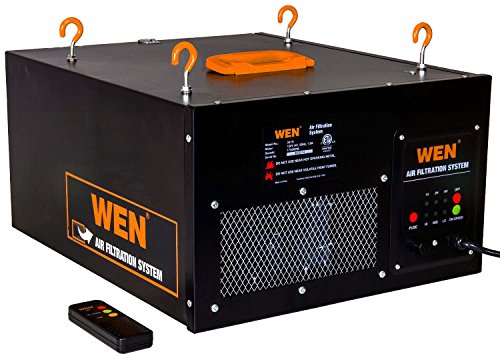
- 300/350/400 CFM airflow
- 1-micron filter plus pre-filter
- RF remote and programmable timer
Best For: Small workshops up to 400 square feet
Automated HEPA Upgrade
DEWALT DWXAF101 Air Filtration System
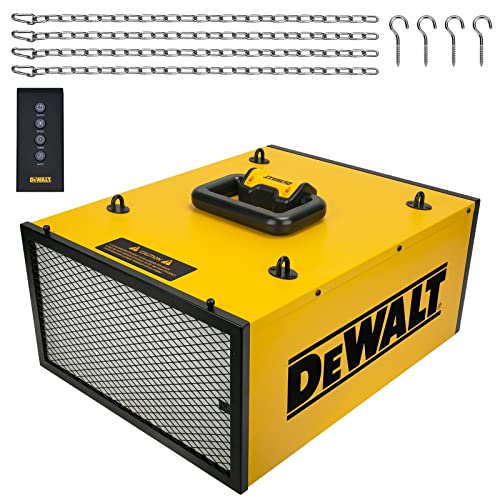
- Two-stage filtration with H11 HEPA
- Four modes, including automatic sensing
- Ceiling hooks, timer, and filter indicator
Best For: Woodworking shops seeking automated overhead filtration
Heavy-Duty Restoration Option

- MERV-10, carbon, and H13 HEPA stages
- Adjustable airflow up to 550 CFM
- Stack up to three units via auxiliary sockets
Best For: Portable production, repair, and restoration work
High-Capacity Hanging Filter

- Up to 1,350 CFM airflow
- 360-degree intake for larger workshops
- MERV-11 filters with touch and remote control
Best For: Large woodworking shops up to 1,700 square feet
Best Remote-Controlled Coverage
WEN 3417 Air Filtration System
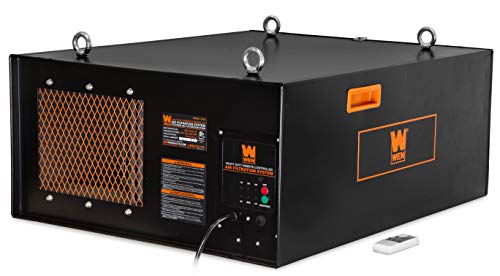
- Three speeds up to 1,044 CFM
- 1-micron filter plus 5-micron pre-filter
- Remote operation and programmable timer
Best For: Large workshop areas needing convenient remote control
Best Portable Benchtop Option
Portable 2 Stage Intake Air Filtration System

- Portable handle for flexible placement
- 850 or 1,050 CFM airflow settings
- HEPA and carbon deodorization filtration
Best For: Localized benchtop woodworking and production tasks
Best High-Airflow Choice
WEN AF1270 Air Filtration System
- Three speeds up to 1,270 CFM
- Circulates a 1,000-square-foot room up to 9.5 times hourly
- Remote control, timer, and two replaceable filters
Best For: Large production workshops prioritizing maximum airflow
Best Quiet Coverage

- 270° intake supports multidirectional dust capture
- 580–780 CFM airflow for workshops up to 800 sq. ft.
- Below-50-dBA operation with remote control
Best For: Quiet, compact air cleaning in smaller woodworking shops
Best Filter Bundle

- 300–400 CFM across three speed settings
- Includes extra inner and outer filters
- Remote offers 1-, 2-, and 4-hour timers
Best For: Smaller shops prioritizing included replacement filters
Best Simple Pick

- 780–1,080 CFM two-speed airflow
- Rated for spaces up to 1,100 sq. ft.
- MERV-11 filters with slide-out maintenance
Best For: Larger workshops needing maximum circulation
Compact Remote-Controlled Pick – WEN 3410 Air Filtration System
For workshop air filtration systems for production work, the WEN 3410 is a compact option for controlling airborne dust in rooms up to 400 square feet. Its three speed settings, replaceable filters, and RF remote make it practical when the unit is mounted or positioned across the shop.
Best For: Small workshops and production areas needing straightforward, remote-controlled air circulation and filtration.
Pros:
- Three airflow settings from 300 to 400 CFM.
- Includes a 1-micron filter and a 5-micron pre-filter.
- RF remote works from up to 26 feet and does not require direct line of sight.
- Programmable timer supports automatic shutoff.
Cons:
- Rated coverage is limited to rooms up to 400 square feet.
- Noise is listed at 50 to 60 dB.
- It has lower maximum airflow than the larger systems in this roundup.
The WEN 3410 is a sensible choice when compact size and convenient controls matter more than high-volume filtration. Check the stated coverage and filter replacement needs against your production area before buying.
Automated HEPA Upgrade – DEWALT DWXAF101 Air Filtration System
For workshop air filtration systems for production work, the DEWALT DWXAF101 adds two-stage filtration, automatic sensing, and ceiling-mounted installation. Its H11 HEPA filter is designed to capture over 95% of 0.3-micron particles, while multiple operating modes simplify day-to-day shop use.
Best For: Woodworking shops that want ceiling-mounted filtration with HEPA filtration, automatic mode, and remote operation.
Pros:
- Two-stage system combines a washable cotton pre-filter with an H11 HEPA filter.
- Offers low, medium, high, and automatic operating modes.
- Includes 1-, 2-, 4-, and 8-hour timer settings plus a remote.
- Filter replacement indicator and included hanging hardware support maintenance and installation.
Cons:
- Listed noise level is 64 dB.
- Ceiling installation may require more setup than a portable floor unit.
- Its filtration system is specified for dust rather than a broader range of contaminants.
The DWXAF101 stands out for shops that value automated operation and easier overhead installation. The washable pre-filter and replacement indicator can also make routine upkeep more predictable.
Heavy-Duty Restoration Option – VEVOR 550 CFM Air Scrubber
For workshop air filtration systems for production work involving dust, smoke, or odors, the VEVOR 550 CFM air scrubber uses three filtration stages and adjustable airflow. Its portable design, stackable format, and auxiliary sockets make it suited to demanding work areas and multi-unit setups.
Best For: Production, repair, renovation, and restoration environments needing portable filtration for dust, pollen, smoke, and odors.
Pros:
- Three-stage filtration combines MERV-10, carbon, and H13 HEPA filters.
- Captures 99.97% of particles as small as 0.3 microns, according to the supplied specifications.
- Adjustable airflow reaches 550 CFM and covers a listed 5,500-cubic-foot filtration area.
- Two auxiliary sockets support daisy-chaining up to three units.
Cons:
- Listed noise level is 68 dB.
- At 35 pounds, it is heavier than compact hanging shop filters.
- Operation uses a manual control panel rather than a remote.
The VEVOR is the most versatile choice here for mobile cleanup and odor control, especially where multiple units may be needed. Its larger footprint and higher noise rating should be considered when space or quiet operation is important.
High-Capacity Hanging Filter – Abestorm DecDust 1350IG
For workshop air filtration systems for production work, the Abestorm DecDust 1350IG delivers up to 1,350 CFM with 360-degree intake coverage. It supports ceiling, workbench, or direct ceiling-screw installation and combines MERV-11 filtration with touch and remote controls.
Best For: Larger woodworking workshops needing high airflow and flexible mounting options.
Pros:
- Airflow ranges from 1,050 to 1,350 CFM for listed coverage up to 1,700 square feet.
- 360-degree intake design supports broad room coverage.
- Can be hung, placed on a workbench, or screwed directly into the ceiling.
- Includes four replaceable MERV-11 filters and both touch and remote controls.
Cons:
- Noise is listed at 60 to 69 dBA.
- Filters may need replacement every two to four months, depending on use.
- It cannot be shipped to California because it does not meet that state’s air-cleaner regulation requirements.
The DecDust 1350IG is a strong fit for larger shops where airflow and installation flexibility are priorities. Confirm local shipping and regulatory availability before purchasing, especially if the unit will be used in California.
Best Remote-Controlled Coverage – WEN 3417 Air Filtration System
WEN 3417 3-Speed Remote-Controlled Industrial-Strength Air Filtration System (556/702/1044 CFM)
Check Price On AmazonFor workshop air filtration systems for production work, the WEN 3417 offers adjustable airflow, replaceable two-stage filtration, and remote operation. Its three settings produce 556, 702, or 1,044 CFM and are intended for rooms up to 1,000 square feet.
Best For: Production workshops needing broad room coverage and convenient remote-controlled operation.
Pros:
- Three airflow settings reach up to 1,044 CFM.
- Includes replaceable 1-micron filter and 5-micron pre-filter.
- RF remote works from up to 26 feet and does not require direct line of sight.
- Programmable timer can shut the unit off automatically.
Cons:
- At 55 pounds, it is less convenient to reposition than a benchtop unit.
- Noise is rated at 63 to 68 dB.
The WEN 3417 is a practical choice when room-wide circulation matters more than portability. Its remote and timer add useful convenience for production environments, while the replaceable filters support ongoing maintenance.
Best Portable Benchtop Option – Portable 2 Stage Intake Air Filtration System
Among workshop air filtration systems for production work, this portable benchtop model stands out for flexible placement. Its two airflow settings deliver 850 or 1,050 CFM, while the HEPA and carbon deodorization filter is designed to stop 99.5% of 0.3-micron particles.
Best For: Benchtop woodworking, carving, powder mixing, and other tasks where the filter needs to move around the workspace.
Pros:
- Portable leather-handle design allows flexible positioning.
- Two airflow settings provide up to 1,050 CFM.
- HEPA filtration is rated to stop 99.5% of 0.3-micron particles.
- Noise is listed below 55 dB.
Cons:
- Filter replacement is recommended approximately every four months.
- Button controls provide fewer operating options than a remote-controlled system.
- Its benchtop form is intended for localized placement rather than stated 1,000-square-foot room coverage.
This model is a strong fit when portability and lower listed noise are priorities. It offers substantial airflow in a compact format, but users should plan for regular filter replacement and position it near the active work area.
Best High-Airflow Choice – WEN AF1270 Air Filtration System
The WEN AF1270 is built for production spaces that need higher circulation rates. This workshop air filtration system provides three settings from 750 to 1,270 CFM and is specified to circulate air in a 1,000-square-foot room up to 9.5 times per hour.
Best For: Larger production workshops seeking maximum airflow from a three-speed, remote-controlled ceiling or overhead filtration unit.
Pros:
- Highest stated airflow of the three settings, reaching 1,270 CFM.
- Three speeds support adjustable circulation.
- Includes replaceable 1-micron filter and 5-micron pre-filter.
- Remote control and programmable timer simplify operation.
Cons:
- Its 68 dB noise rating is higher than the portable model’s listed rating.
- At 65.9 pounds, it is relatively heavy to move.
- The higher 504-watt rating may use more power than the lower-output WEN 3417.
Choose the AF1270 when airflow capacity is the main consideration. It combines the strongest listed circulation with remote control and two-stage filtration, making it well suited to demanding workshop environments where portability is less important.
Best Quiet Coverage – Abestorm DecDust 780
The Abestorm DecDust 780 is a practical choice for workshop air filtration systems for production work when you need broad intake coverage without excessive noise. Its three-sided intake and adjustable 580–780 CFM airflow help circulate air in workshops, garages, and spaces up to 800 square feet.
Best For: Woodworking shops and production areas that need quiet, ceiling-mounted air cleaning with remote or touch control.
Pros:
- 270° intake design captures airborne dust from multiple directions.
- Up to 780 CFM airflow supports sanding, sawing, and grinding work.
- Operates below 50 dBA and includes remote control operation.
- Compact design is suited to ceiling installation in spaces up to 800 square feet.
Cons:
- Its 800-square-foot coverage is lower than the larger Abestorm model.
- The supplied specifications list a 1-micron retention size but do not provide a detailed filter replacement schedule.
Choose this model when low noise, compact mounting, and multidirectional intake matter more than maximum airflow. It offers a balanced fit for smaller production workshops.
Best Filter Bundle – POWERTEC AF4001C
The POWERTEC AF4001C is a useful option among workshop air filtration systems for production work, especially if you want replacement filters included with the unit. Its three-speed airflow, wireless timer, and two-stage filtration are designed for woodworking shops, garages, and similar work areas.
Best For: Shops seeking a lower-airflow hanging system with convenient remote scheduling and an extra inner-and-outer filter set.
Pros:
- Three airflow settings provide 300, 350, or 400 CFM.
- Includes two outer filters and two inner filters with the system.
- Five-micron outer and one-micron inner filtration targets progressively smaller particles.
- Remote includes 1-, 2-, and 4-hour timer settings.
Cons:
- Maximum airflow is lower than both Abestorm models.
- Filter compatibility should be checked against the system’s specified dimensions.
- The notes do not state a coverage area or operating noise level.
The included filter supply adds value for production environments where ongoing maintenance is important. It is best suited to smaller or moderately sized shops that can work within its 400 CFM ceiling.
Best Simple Pick – Abestorm DecDust 1080
For larger production areas, the Abestorm DecDust 1080 is one of the stronger workshop air filtration systems for production work in this lineup. It combines a 270° intake with two-speed airflow up to 1,080 CFM and is rated for spaces up to 1,100 square feet.
Best For: Larger woodworking shops and industrial-style workspaces that need higher circulation and ceiling or wall mounting.
Pros:
- High-speed setting delivers up to 1,080 CFM; low speed provides 780 CFM.
- 270° three-sided intake helps capture airborne dust from multiple directions.
- Three MERV-11 filters are designed to trap 90% of 3–10 micron particles.
- Remote control reaches up to 26 feet, and slide-out filters simplify maintenance.
Cons:
- Operation is rated below 60 dBA, so it may be louder than the DecDust 780.
- It offers two speeds rather than the POWERTEC system’s three settings.
- Filters are expected to be replaced every 4–6 months.
This is the better fit when workspace size and airflow capacity take priority. Its larger coverage rating, high-speed setting, and accessible filters make it well suited to demanding production environments.
How We Picked the Best Workshop Air Filtration Systems for Production Work
We compared these systems by airflow, filtration design, control options, installation flexibility, and suitability for repeated use. Higher-CFM models can move more air across larger production areas, while compact units may be easier to place in smaller shops or near specific work zones.
We also considered practical ownership details, including filter access, remote controls, noise-related convenience, portability, and whether a unit is designed to hang overhead or operate as a freestanding air scrubber. Air filtration should supplement—not replace—source capture, dust collection, ventilation, and appropriate respiratory protection.
Quick Comparison
| Shop Need | Best-Fit Type | What to Prioritize |
|---|---|---|
| Small workshop or occasional projects | Compact hanging filter | Simple controls, low profile, affordable replacement filters |
| Medium production area | Midrange 550–850 CFM unit | Balanced airflow, timer or remote, easy maintenance |
| Large or busy workshop | High-CFM industrial-strength filter | Strong circulation, durable construction, multiple fan speeds |
| Localized cleanup or renovation | Portable air scrubber | Stackable design, staged filtration, flexible placement |
Key Buying Factors for Workshop Air Filtration Systems for Production Work
Airflow and Room Coverage
CFM indicates how much air a unit moves, but actual performance depends on room size, ceiling height, layout, machine placement, and obstructions. For production work, choose enough airflow to cycle the room repeatedly rather than relying only on the highest advertised setting.
Filtration Stages and Replacement Costs
Look for a washable or reusable prefilter when available, followed by a finer inner filter. Check replacement availability and total filter cost before buying. A powerful unit becomes less useful if maintenance is expensive or filters are difficult to source.
Mounting, Portability, and Controls
Hanging systems save floor space and can circulate air above machines, but they require secure mounting and adequate clearance. Portable scrubbers are easier to reposition. Remote controls, timers, and multiple speeds are valuable when the system needs to run during or after production.
Noise, Safety, and Maintenance
Consider sound levels if workers spend long periods nearby. Keep intake and exhaust paths clear, inspect filters regularly, and follow the manufacturer’s mounting and electrical instructions. Ionizers or similar features should be evaluated according to the manufacturer’s safety guidance and your workplace requirements.
Who Should Buy Which Workshop Air Filtration Systems for Production Work?
Choose a compact 300–400 CFM model for a small shop, hobby workspace, or supplemental circulation around one work area. Choose a 550–850 CFM system for a medium-sized workshop that needs a practical balance of airflow and operating convenience. Choose a 950–1350 CFM unit for larger rooms, heavier production schedules, or shops where airborne dust remains suspended across multiple workstations. Choose a portable staged air scrubber when you need to move filtration between rooms, isolate a dusty job, or avoid permanent overhead installation.