The right anvil gives a small jewelry business a stable, dependable surface for stamping, shaping, riveting, and texturing metal without taking over the workbench. Compact models can offer useful control while remaining practical for limited studio space.
This roundup compares 10 small jewelry anvils, horn anvils, and bench blocks with attention to construction, working surface, stability, versatility, and included accessories.
Best 10 Small Jewelry Anvils for Small Businesses Picks for 2026
Compact Horn Kit
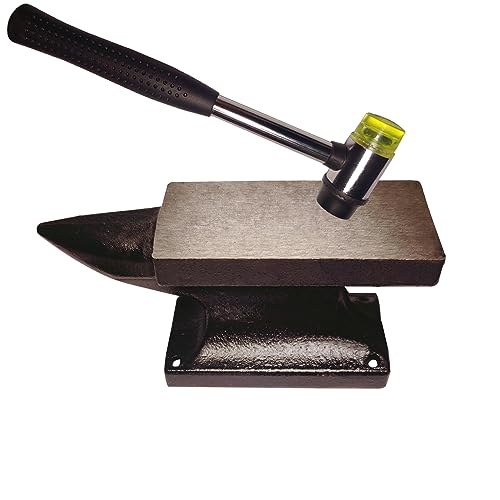
- 3-pound cast-iron anvil with rubber hammer
- Flat face and horn support varied shaping
- Base holes help secure it to a bench
Best For: Small jewelry studios wanting a versatile anvil-and-hammer bundle
Dual-Sided Precision Pick
Beadsmith Dual-Ended Horn Anvil

- Flat and rounded horn ends
- Solid stainless steel with polished finish
- Pritchel hole and base holes add utility
Best For: Compact jewelry and wire-shaping work
Stable Stamping Surface

- Hardened carbon-steel construction
- TPR base helps absorb impact
- 3-inch surface for stamping and flattening
Best For: Jewelry stamping, chasing, and small-part shaping
Hole-and-Slot Specialist
Hexagon Anvil for Jewelry Making

- 15 holes for riveting and forming
- Five tapered milled slots
- Compact jewelry-focused design
Best For: Small-part riveting and specialized forming work
Stable Stamping Base

- 3-inch mirror-finished steel surface
- Soft base reduces rebound
- Designed for stamping and flattening
Best For: Jewelry tags, blanks, and flat metalwork
Versatile Forming Choice
HimaPro Single Horn Mini Anvil

- Cast iron construction
- Flat face and round horn
- Supports bending and stamping
Best For: Compact jewelry forming and metal stamping
Compact Curved Forming Tool

- Steel mini anvil with double horns
- 500-gram lightweight design
- Small rectangular forming surface
Best For: Portable jewelry forming and detailed metalwork
Best Value Starter Set

- Includes a horn anvil and stamping hammer
- Polished cast-iron work surface
- Compact choice for light-duty jewelry work
Best For: Jewelry makers needing an affordable starter set
Best Mountable Compact Pick
QWORK Mini Cast Iron Horn Anvil

- Four slots allow workbench mounting
- Polished and hardened cast-iron body
- Compact 1-pound design for small projects
Best For: Space-limited benches needing a secured mini anvil
Best Complete Jewelry Set
NewFe Mini Iron Horn Anvil & Hammer

- Includes anvil, rubber hammer, and sandpaper
- Rubber hammer suits delicate metal surfaces
- Four mounting holes improve stability
Best For: Jewelry benches needing a ready-to-use tool set
Compact Horn Kit – Mini Horn Anvil Set
For small businesses looking for small jewelry anvils for small businesses, this 3-pound cast-iron set combines a compact horn anvil with a rubber hammer. Its polished, painted surface and stable base suit routine jewelry forming, wire work, and light metal shaping.
Best For: Jewelry makers who want an all-in-one, portable anvil and hammer set for bending, smoothing, straightening, and forming metal.
Pros:
- Includes a 3-pound cast-iron anvil and rubber hammer.
- Flat 4 x 2-inch work surface supports hammering tasks.
- Oblate horn helps with curved workpieces, bending, and shaping.
- Large base and four holes support secure bench placement.
Cons:
- Heavier than the smaller specialty anvils in this roundup.
- Its rubber hammer may be less suitable when a harder striking surface is needed.
This is a practical starter setup when you need both an anvil and a surface-friendly hammer, particularly for small jewelry studios handling varied forming tasks.
Dual-Sided Precision Pick – Beadsmith Dual-Ended Horn Anvil
This miniature stainless-steel anvil is a focused option for small businesses looking for small jewelry anvils for small businesses. Its flat and rounded horn ends, polished finish, and compact 0.82-pound build make it easy to fit into a small work area.
Best For: Jewelry designers and DIY metalsmiths working on wire hardening, riveting, stamping, bending, and other precision tasks.
Pros:
- Dual-ended design provides flat and rounded horn surfaces.
- Solid stainless-steel construction has a polished finish.
- Top face, flat sides, and Pritchel hole support multiple operations.
- Base holes allow attachment to a workbench.
Cons:
- Its miniature size offers less working area than a larger anvil.
- At 0.82 pounds, it may need bench attachment for heavier hammering.
Choose this model when versatility and a small footprint matter more than a broad striking surface. The two horn profiles are especially useful for detailed jewelry work.
Stable Stamping Surface – BESTNULE Steel Bench Block
For makers comparing small jewelry anvils for small businesses, this 3-inch hardened-steel bench block is a low-profile choice for stamping and flattening. Its polished surface is paired with a TPR soft-plastic bottom intended to reduce shock during impact work.
Best For: Jewelry businesses focused on stamping blanks, tags, and small metal pieces, along with flattening, chasing, and shaping.
Pros:
- Industrial-grade hardened carbon steel is rated for more than 10,000 impacts.
- Polished surface supports stamping, flattening, and forming.
- Soft rubber-plastic base helps absorb impact and reduce movement.
- Works with materials including brass, leather, aluminum, silver, and stainless steel.
Cons:
- It is a flat bench block rather than a horned anvil for curved forming.
- The 3-inch diameter limits the available working area.
This is a sensible workstation accessory for repeat stamping and impact tasks. It is less appropriate if your business needs a horn for bending or shaping curved pieces.
Hole-and-Slot Specialist – Hexagon Anvil for Jewelry Making
This compact hexagon anvil is a specialized choice among small jewelry anvils for small businesses. Its 15 holes and five milled slots are designed for riveting, forming, and working small parts where varied openings are more useful than a traditional horn.
Best For: Jewelry makers who need dedicated holes and tapered slots for riveting, forming, and detailed small-part work.
Pros:
- Provides 15 holes ranging from 0.5 to 6 mm in diameter.
- Includes five milled slots measuring 1.2 to 1.6 mm wide.
- Compact dimensions suit small workbenches and detailed tasks.
- Purpose-built for jewelry making and small-part forming.
Cons:
- It does not provide a horn or broad flat striking face.
- The specialized hole-and-slot layout may be less useful for general hammering.
Consider this an accessory for precision jewelry work rather than an all-purpose anvil. Its varied openings can be valuable when your workflow regularly involves riveting and forming small components.
Stable Stamping Base – Compact Steel Bench Block
For small businesses seeking small jewelry anvils for small businesses, the OWDEN bench block is a focused option for stamping, flattening, chasing, and shaping. Its 3-inch steel surface provides a compact work area, while the soft plastic base is designed to improve stability and reduce rebound during hammering.
Best For: Jewelry tags, metal blanks, stamping, and precision bench work where a flat surface is the priority.
Pros:
- Professional-grade steel construction with a mirror-finished, chrome-plated surface.
- Soft plastic base helps stabilize the block and reduce rebound force.
- Compact 3-inch diameter works well in space-conscious work areas.
- Supports stamping, flattening, chasing, shaping, and layout tasks.
Cons:
- Its flat, round design does not provide a horn for curved forming.
- The 3/4-inch height offers less versatility than a larger anvil profile.
This is a practical choice for businesses that primarily stamp or flatten small metal components and want a stable, compact surface rather than a full-forming anvil.
Versatile Forming Choice – HimaPro Single Horn Mini Anvil
The HimaPro is a useful contender among small jewelry anvils for small businesses because it combines a flat working face with a round horn. Its cast iron construction, 2.2-pound listed weight, and compact footprint provide a sturdy base for jewelry making, bending, shaping, and metal stamping.
Best For: Small-business makers who need both flat hammering and curved forming in one compact tool.
Pros:
- Cast iron construction is designed for strength and durability.
- Round horn supports bending and shaping tasks.
- Polished flat surface accommodates hammering and punching.
- Compact 5.5-inch-class profile fits smaller work areas.
Cons:
- Its 2.2-pound listed weight is lighter than many full-size anvils.
- The single-horn design offers less forming variety than a double-horn model.
Choose this model when your production work includes both flat stamping and occasional curves or bends. It offers broader shaping capability than a simple bench block while remaining sized for compact jewelry work.
Compact Curved Forming Tool – JTS Double Horn Anvil
JTS Double Horn Anvil Steel Block Jewelry Making Bench Tool Mini Forming Metal Work
Check Price On AmazonFor makers comparing small jewelry anvils for small businesses, the JTS Double Horn Anvil offers a narrow, steel construction suited to compact forming work. Its 500-gram weight and 2-by-1 5/32-inch rectangular top make it easy to position for jewelry-making and small metalworking tasks.
Best For: Jewelers and hobby-focused small businesses needing a small steel forming tool with double-horn access.
Pros:
- Steel construction provides a durable forming surface.
- Double-horn design supports curved and detailed metalwork.
- Compact dimensions suit limited bench space.
- Lightweight 500-gram design is easy to reposition.
Cons:
- The 500-gram weight may provide less mass for heavy hammering.
- Its rectangular top is smaller than the working surface of a 3-inch bench block.
- Supplied specifications do not indicate a rebound-reducing base.
This JTS model makes the most sense for portable or space-limited setups where access to double horns matters more than maximum anvil mass. It is a specialized compact tool rather than a heavy-duty production anvil.
Best Value Starter Set – Iron Horn Anvil Bench Block
For small businesses seeking small jewelry anvils for small businesses, this compact cast-iron horn anvil offers a polished work surface and includes a metal stamping hammer. Its 1.15-pound format is suited to light-duty jewelry and metal-forming tasks where bench space is limited.
Best For: Jewelry makers and small workshops needing an affordable anvil-and-hammer starter set for stamping, riveting, flattening, and forming.
Pros:
- Includes both a cast-iron horn anvil and metal stamping hammer.
- Polished surface provides a smooth work area for small metalworking tasks.
- Horn shape supports bending and forming work.
Cons:
- Compact 1.15-pound construction is intended for small-scale work rather than heavy forging.
- Bare-metal grip and metal handle may be less comfortable during extended use.
This is a practical entry-level option for businesses that want the basic tools in one package. Its small footprint makes it convenient for jewelry benches, while the limited size keeps it focused on light-duty applications.
Best Mountable Compact Pick – QWORK Mini Cast Iron Horn Anvil
QWORK Mini Cast Iron Horn Anvil 1lb Bench Block – Compact Tool for Jewelry, Metal Craft & Model Work
Check Price On AmazonAmong small jewelry anvils for small businesses, the QWORK Mini Cast Iron Horn Anvil stands out for its compact bench-block design and four mounting slots. The 1-pound cast-iron body is designed for light-duty jewelry, craft, model, and small hardware work.
Best For: Small workshops and hobby businesses that want a space-saving anvil they can secure to a workbench.
Pros:
- Compact 1-pound size is convenient for limited workspaces.
- Four base slots support secure mounting to a workbench.
- Polished and hardened surface is suited to light-duty use.
- Flat top measures approximately 2.5 by 1.38 inches for small projects.
Cons:
- Its small size limits it to light-duty and miniature work.
- The listing describes the anvil only, so a hammer is not included in the supplied notes.
The QWORK is a focused choice when stability and minimal bench footprint matter more than a larger striking area. Mounting it securely can make repetitive small-scale work more controlled.
Best Complete Jewelry Set – NewFe Mini Iron Horn Anvil & Hammer
For small businesses comparing small jewelry anvils for small businesses, the NewFe set combines a 1.1-pound horn anvil with an 8.2-inch hammer and sandpaper. Its polished 2.4-by-1.4-inch work surface, horn, and mounting holes cover several small-scale shaping and stamping needs.
Best For: Jewelry and silversmithing work that benefits from a ready-to-use anvil, hammer, and basic finishing accessory.
Pros:
- Complete package includes the anvil, hammer, and sandpaper.
- Rubber hammer is intended to minimize damage to delicate metal surfaces.
- Horn supports bending, curving, and forming intricate metalwork.
- Four mounting holes help anchor the anvil and reduce movement.
Cons:
- The 1.1-pound anvil and 2.4-by-1.4-inch surface are designed for small-scale work.
- Its compact striking area may be limiting for larger pieces or heavier forging.
This is the most convenient option for a business building a small jewelry bench from scratch. The included rubber hammer is particularly useful when working with delicate surfaces, while the mounting holes add practical stability.
How We Picked the Best Small Jewelry Anvils for Small Businesses
We focused on compact tools suited to jewelry studios, home workshops, repair benches, and small production businesses. The selection includes horn anvils for curved forming, flat bench blocks for stamping and texturing, dual-ended designs for added versatility, and kits that include a hammer.
Key considerations included material, approximate weight, usable surface shape, footprint, stability, finish, and the type of work each design supports. Because product specifications and accessories can vary by seller, confirm current dimensions and included components before ordering.
Quick Comparison
| Type | Best For | Main Advantage | Potential Limitation |
|---|---|---|---|
| Single-horn anvil | Curved forming and general jewelry work | Pointed horn reaches small areas | Less flat surface than a bench block |
| Dual-ended horn anvil | Mixed forming tasks | More than one shaping profile | Usually offers a smaller work area |
| Flat bench block | Stamping, riveting, and texturing | Stable, level striking surface | Not designed for deep curved forming |
| Anvil and hammer set | New studios and starter benches | Provides essential tools together | Included hammer may not suit every task |
Key Buying Factors for Small Jewelry Anvils for Small Businesses
Surface Shape and Size
Choose a flat block for stamping and planishing, or a horned profile for bending, doming, and shaping curved pieces. A compact surface is convenient, but extremely small anvils can limit larger components and require more repositioning.
Material and Durability
Steel and forged iron are common choices for repeated hammering. Look for a solid, well-finished striking surface and avoid visible casting defects around the working face. Stainless steel models may resist corrosion, while cast iron can provide useful mass at a lower cost.
Weight and Stability
Heavier tools generally move less during striking, improving control and reducing noise. Lightweight anvils are easier to store and transport, but may need a nonslip mat, clamp, or dedicated base. Check the tool’s footprint as carefully as its listed weight.
Noise, Finish, and Maintenance
A rubber-covered underside or padded base can protect the bench and reduce movement. Keep metal surfaces clean and dry, and inspect the face for burrs that could mark jewelry. A polished or smooth working area is especially important for finishing and planishing.
Who Should Buy Which Small Jewelry Anvils for Small Businesses?
Choose a flat bench block if your business primarily stamps names, textures sheet, sets rivets, or performs repairs. Choose a single-horn anvil for general forming and curved work. Choose a dual-ended model if you want multiple profiles in one compact tool. Choose a kit if you are building a first bench and need a compatible hammer immediately.
For most small jewelry businesses, the best choice is the heaviest compact model that fits the available workspace and matches the dominant task. If your work includes both stamping and curved forming, pairing a flat bench block with a small horn anvil may deliver more capability than relying on one highly specialized tool.