Choosing the right dovetail saw can make hardwood joinery cleaner, faster, and easier to control. The best option depends on whether you prefer a Japanese pull saw’s thin, flexible kerf or the rigid feel of a traditional British-style backsaw.
We’ve gathered 10 notable dovetail saws covering rip-cut and crosscut patterns, compact folding designs, and classic brass-backed models. Use the guide below to match blade geometry, tooth count, handle style, and maintenance needs to your work.
Best 10 Dovetail Saws for Hardwood Picks for 2026
Best Precision Pull Saw
SUIZAN Dozuki 7-Inch Dovetail Saw

- Thin 0.3 mm blade with a narrow 0.5 mm kerf
- 17 TPI teeth cut rip, cross, and angle cuts
- Replaceable blade with a comfortable nonslip grip
Best For: Fine hardwood joinery, dovetails, and cabinetry
Best Reversible Blade Option

- Spring-loaded blade reverses for either cutting direction
- Ergonomic ProTouch handle
- Lightweight 10-inch high-speed-steel blade
Best For: Flush-cutting and flexible hand-saw work
Best Versatile Japanese Saw
Temple Tool Co. 9.5-Inch Ryoba

- Rip teeth on one edge and crosscut teeth on the other
- Lightweight pull-stroke design for smooth cuts
- High-grade Japanese steel and solid wood handle
Best For: General hardwood work, stock preparation, and joinery
Best Traditional Backed Saw
Thomas Flinn Pax 8-Inch Gent Saw

- 20 TPI high-carbon steel blade for fine cuts
- Solid rolled brass back adds stiffness and weight
- Resharpenable plate with a walnut handle
Best For: Traditional hardwood dovetails and fine joinery
Best Japanese Rip-Cut Pick
Temple Tool Co. Japanese Pull Saw

- 18 TPI rip teeth for dovetails and tenons
- Thin, lightweight pull-stroke design
- Japanese steel with a solid wingnut handle
Best For: Hardwood dovetails and fine joinery cut with the grain
Best Traditional Western Saw
Lynx Thomas Flinn 8-Inch Dovetail Saw

- 20 TPI rip-filed blade for dovetails
- Rigid brass spine and folded brass back
- 2-3/8-inch maximum stated cut depth
Best For: Full-size hardwood dovetails with a traditional backsaw feel
Best Fine Crosscut Option
SUIZAN 6-Inch Dozuki Dovetail Saw

- 25 TPI crosscut teeth for crisp lines
- 0.5 mm kerf and rigid steel back
- Replaceable blade with rattan-wrapped handle
Best For: Fine crosscuts, dovetail baselines, and small hardwood projects
Compact Folding Precision Pick
JORGENSEN 6-Inch Folding Dovetail Saw
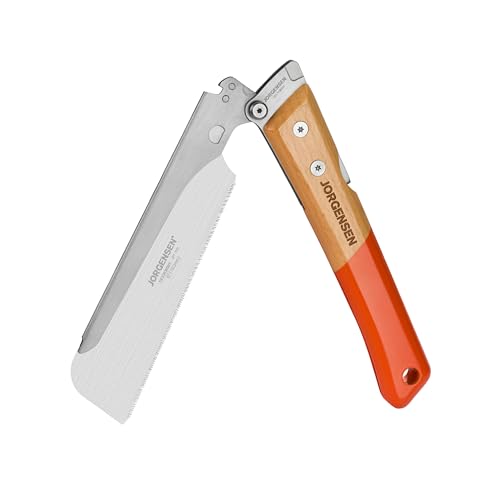
- 0.3 mm SK5 blade for narrow kerfs
- 21 TPI hardened teeth for clean cuts
- Tool-less blade change and folding design
Best For: Portable hardwood dovetails, tenons, and furniture restoration
Ultra-Fine Joinery Pick
SUIZAN 8-Inch Dozuki Dovetail Saw

- 0.2 mm Japanese steel blade
- 30 TPI crosscut teeth for fine cuts
- Replaceable blade with rigid steel back
Best For: Narrow-kerf hardwood dovetails, boxes, cabinetry, and kumiko
Versatile Japanese Craft Pick

- 25 TPI universal rip-and-crosscut teeth
- Compact 6-inch blade for control
- SK85 steel with brass-backed premium build
Best For: Hardwood dovetails, tenons, rip cuts, crosscuts, and fine joinery
Best Precision Pull Saw – SUIZAN Dozuki 7-Inch Dovetail Saw
For woodworkers comparing dovetail saws for hardwood, the SUIZAN Dozuki stands out for its thin, stiff blade and fine 17 TPI teeth. Its narrow 0.02-inch kerf supports controlled cuts for dovetails, tenons, and other detailed joinery.
Best For: Precise dovetails, cabinetry, furniture work, box making, and fine joinery where a smooth, narrow cut matters.
Pros:
- 0.3 mm blade and 0.5 mm kerf help produce accurate, smooth cuts.
- Universal 17 TPI teeth handle rip, cross, and angle cuts.
- Steel back keeps the blade straight and square.
- Comfortable nonslip grip and tool-free replaceable blade.
Cons:
- Replacement blades are sold separately.
- The fine blade is intended for controlled hand cutting rather than fast stock removal.
Its combination of Japanese steel, compact size, and replaceable blade makes this a versatile choice for hardwood joinery at a crowded bench or in a tool bag.
Best Reversible Blade Option – IRWIN 10-Inch Dovetail Saw
The IRWIN 10-Inch Dovetail Saw offers a different approach to dovetail saws for hardwood, using a spring-loaded reversible blade for left- or right-cutting. Its wide-body flush-cut design and ergonomic ProTouch handle suit practical trimming and joinery tasks.
Best For: Users who want a lightweight, reversible hand saw for flush-cutting and selected joinery work.
Pros:
- Spring-loaded blade reverses for left- or right-cutting.
- ProTouch handle is designed for ergonomic comfort.
- 10-inch high-speed-steel blade provides useful reach.
- Lightweight 1.6-ounce design is easy to handle.
Cons:
- Its 14-point tooth count is less fine than the 17–20 TPI options here.
- The supplied details identify engineered wood as the surface recommendation, so hardwood users should match expectations to the task.
This is a practical choice when blade direction and flush-cut versatility matter more than the ultra-fine kerf of a dedicated Japanese dozuki or traditional gent’s saw.
Best Versatile Japanese Saw – Temple Tool Co. 9.5-Inch Ryoba
If you need dovetail saws for hardwood that can also prepare stock, the Temple Tool Co. Ryoba is a versatile double-edge option. One edge uses rip teeth and the other crosscut teeth, allowing the same saw to handle joinery and cutting boards to length or width.
Best For: Woodworkers who want one Japanese pull saw for hardwood joinery, stock preparation, tenons, and general shop cuts.
Pros:
- Double-edge design provides dedicated rip and crosscut teeth.
- Pull-stroke cutting supports a thin kerf and lightweight feel.
- High-grade Japanese steel is intended to hold a sharp edge in soft and hardwoods.
- Solid wingnut handle with brass components adds a refined, traditional feel.
Cons:
- Its 9.5-inch general-purpose format is less specialized than a backed dovetail saw.
- The supplied notes do not specify tooth counts or kerf dimensions.
Choose this Ryoba when versatility is the priority: its two cutting edges reduce the need to switch tools between ripping, crosscutting, and medium-sized joinery.
Best Traditional Backed Saw – Thomas Flinn Pax 8-Inch Gent Saw
The Thomas Flinn Pax Gent Dovetail Saw is a traditional choice among dovetail saws for hardwood, pairing a 20 TPI high-carbon steel plate with a solid rolled brass back. The stiffened blade and walnut handle are designed for smooth, accurate fine joinery cuts.
Best For: Traditional hand-tool users seeking a stiff, resharpenable saw for precise dovetails and fine hardwood joinery.
Pros:
- Solid rolled brass back stiffens the blade and adds weight for controlled cuts.
- 20 TPI teeth suit fine dovetail work.
- High-carbon alloy steel plate can be resharpened.
- Walnut handle and brass ferrule provide a classic build.
Cons:
- At 0.028 inches, the stated kerf is wider than the SUIZAN’s 0.02-inch kerf.
- It is supplied as a bare tool with no replacement blade listed.
With its brass-backed blade, high tooth count, and resharpenable steel, this Pax saw is well suited to woodworkers who value traditional construction and long-term maintainability.
Best Japanese Rip-Cut Pick – Temple Tool Co. Japanese Pull Saw
Temple Tool Co. Japanese Pull Saw - Rip-Cut 9.5 - Hand Saw for Dovetails, Tenons, Fine Joinery
Check Price On AmazonFor dovetail saws for hardwood, the Temple Tool Co. Japanese Pull Saw is a strong choice when you want a fine, controlled rip cut along the grain. Its 18 TPI Japanese-steel blade, narrow kerf, and lightweight pull-stroke design suit dovetails, tenons, and other fine joinery.
Best For: Hardwood dovetails and fine joinery cut with the grain.
Pros:
- 18 TPI rip teeth are designed for dovetails and small tenons.
- Pull-stroke action supports a thin, narrow-kerf blade and easy control.
- Japanese steel is intended to maintain sharpness in soft and hardwoods.
- Solid wingnut handle, brass components, and included case add a polished feel.
Cons:
- Rip teeth are less suited to crosscutting across the grain.
- The compact blade and fine-joinery focus may be limiting for larger cuts.
This saw combines a lightweight Japanese pull-saw format with a rip profile tailored to dovetail work. It is especially appealing if you value clean hardwood cuts, a comfortable handle, and handcrafted Japanese construction.
Best Traditional Western Saw – Lynx Thomas Flinn 8-Inch Dovetail Saw
Among dovetail saws for hardwood, this 8-inch Lynx Thomas Flinn model offers the rigid, balanced feel associated with a traditional Western backsaw. Its 20 TPI rip-filed blade and brass spine are built for controlled dovetail cuts, with enough depth for substantial joinery.
Best For: Woodworkers who prefer a rigid Western-style saw for full-size dovetails.
Pros:
- 20 TPI teeth are filed for rip cutting and dovetail work.
- Thick brass spine and folded brass back help keep the plate rigid and straight.
- Taper-ground Sheffield alloy spring steel balances edge durability with sharpening ease.
- 8-inch blade provides a maximum stated cutting depth of 2-3/8 inches.
Cons:
- Its traditional backsaw construction is less compact than a Japanese pull saw.
- The supplied details describe it as a rip saw, so it is not the most versatile choice for crosscuts.
Choose this model for a solid, deliberate cutting experience rather than the lighter feel of a pull saw. The stained beech handle, brass hardware, and tensioned brass back make it a considered option for repeat dovetail work in hardwood.
Best Fine Crosscut Option – SUIZAN 6-Inch Dozuki Dovetail Saw
For dovetail saws for hardwood that need to handle fine crosscuts, the SUIZAN Dozuki provides a very thin 0.3 mm blade and 25 TPI crosscut teeth. Its steel back helps keep the blade straight while the narrow 0.5 mm kerf supports crisp baselines and small joinery cuts.
Best For: Fine dovetail baselines, tenon shoulders, boxes, frames, and other small hardwood projects.
Pros:
- 25 TPI crosscut teeth leave crisp lines with little effort.
- Steel spine supports straight, square tracking with the thin blade.
- Very narrow 0.5 mm kerf helps preserve material on detailed work.
- Replaceable blades and a rattan-wrapped handle add practical usability.
Cons:
- Crosscut teeth are not the ideal profile for rip-cutting dovetail pins and tails.
- The 6-inch blade is intended for small, precise work rather than deep cuts.
This is the most detail-oriented option of the group, particularly where crosscut accuracy matters. Its fine teeth and narrow kerf make it a useful companion for small hardwood joinery, though rip-focused users may prefer one of the other saws.
Compact Folding Precision Pick – JORGENSEN 6-Inch Folding Dovetail Saw
For woodworkers seeking dovetail saws for hardwood, the JORGENSEN combines a thin 0.3 mm SK5 steel blade with 21 TPI hardened teeth for controlled, fine cuts. Its compact folding design and short beechwood handle make it especially convenient for small joinery projects and portable tool kits.
Best For: Hardwood dovetails, tenons, furniture restoration, and users who value a compact, tool-less folding saw.
Pros:
- Thin blade supports narrow, precise kerfs.
- Hardened 21 TPI teeth are designed for sharp, clean cuts.
- Tool-less blade replacement and folding improve portability.
- Ergonomic beechwood handle supports single-hand operation.
Cons:
- The 6-inch blade offers less reach than larger dovetail saws.
- The shorter handle may feel less comfortable for extended work.
This is a practical choice when portability matters as much as precision. The fine blade and hardened teeth suit hardwood joinery, while the folding mechanism adds convenience for on-site or limited-space work.
Ultra-Fine Joinery Pick – SUIZAN 8-Inch Dozuki Dovetail Saw
The SUIZAN Dozuki is a strong option among dovetail saws for hardwood when narrow kerfs and highly controlled cuts are priorities. Its 0.2 mm blade and 30 TPI crosscut teeth are intended for fine joinery such as dovetails, boxes, cabinetry, and picture frames.
Best For: Fine hardwood joinery, kumiko, box making, cabinetry, and projects requiring a very narrow kerf.
Pros:
- Ultra-thin 0.2 mm blade creates a stated 0.3 mm kerf.
- 30 TPI crosscut teeth support clean, fine cuts.
- Steel back helps maintain blade rigidity.
- Replaceable blade extends serviceability.
Cons:
- Blade replacement requires a Phillips screwdriver.
- The fine crosscut tooth pattern is less specialized for rip cuts.
- Replacement blades are sold separately.
Choose this saw for delicate, accuracy-focused work rather than general-purpose cutting. The long blade and rattan handle provide a traditional pull-saw format, while the exceptionally thin blade is suited to precise hardwood joinery.
Versatile Japanese Craft Pick – Temple Tool Co. 6-Inch Dozuki
For shoppers comparing dovetail saws for hardwood, the Temple Tool Co. Dozuki stands out for its universal 25 TPI teeth. The combination of crosscut and “Oni-Ba” rip teeth is designed for dovetails, tenons, diagonal cuts, and other fine joinery in both softwoods and hardwoods.
Best For: Woodworkers who want one compact saw for hardwood rip cuts, crosscuts, dovetails, tenons, and kumiko.
Pros:
- Universal teeth handle crosscuts, rip cuts, and diagonal cuts.
- Compact 6-inch blade promotes control on fine joinery.
- Japanese SK85 steel is designed to retain sharpness.
- Solid brass back and wood handle provide a premium build.
Cons:
- The compact blade provides less reach than an 8-inch model.
- The premium brass-and-wood construction may prioritize aesthetics over lightweight portability.
This is the most versatile option of the three for users who switch between cutting directions. Its compact format favors accuracy, while the universal tooth pattern reduces the need to change saws between common hardwood joinery tasks.
How We Picked the Best Dovetail Saws for Hardwood
We focused on features that matter when cutting dense hardwood accurately: blade stiffness, tooth configuration, kerf width, tooth count, handle control, and the saw’s suitability for fine joinery. The selection includes Japanese pull saws, traditional backsaws, dedicated rip-cut models, and combination-blade designs so different woodworking styles are represented.
We also considered practical factors such as blade length, replaceability, folding or tool-less features, and whether the saw is better suited to dovetails, tenons, small crosscuts, or general shop use. Product specifications can vary by seller, so confirm the latest dimensions and replacement-blade availability before purchasing.
Quick Comparison
| Type | Best For | Main Advantage | Potential Trade-Off |
|---|---|---|---|
| Japanese dozuki | Fine, controlled joinery | Thin kerf and precise pull stroke | Blade can be less tolerant of twisting |
| Ryoba or combination pull saw | Rip and crosscut versatility | One tool handles multiple cuts | May be less specialized than a dedicated saw |
| Traditional backsaw | Rigid, guided dovetail cuts | Stable plate and familiar push stroke | Usually requires more sharpening knowledge |
| Folding pull saw | Portability and occasional work | Compact storage and quick blade changes | Handle balance may differ from fixed models |
Key Buying Factors for Dovetail Saws for Hardwood
Cut Direction and Tooth Geometry
Most dovetail baselines are rip cuts, so a rip-tooth pattern is the most specialized choice. A crosscut or combination pattern adds flexibility for trimming parts and cutting across grain. For repeated, precise dovetail work, prioritize a dedicated rip-cut blade or a saw clearly filed for rip cutting.
Blade Thickness and Stiffness
A thin blade creates a narrow kerf and removes less material, but it can be easier to deflect if you force the cut. A rigid brass-backed backsaw offers strong tracking, while a Japanese saw cuts on the pull stroke and can provide excellent control when used with light pressure. Hardwood rewards a steady feed rather than aggressive force.
Tooth Count and Finish
Higher tooth counts generally produce a smoother cut but remove material more slowly and can clog in some hardwoods. Lower tooth counts cut faster but may leave more cleanup. Choose fine teeth for small dovetails and visible furniture joints; a slightly coarser pattern can be more practical for larger joinery.
Handle, Length, and Maintenance
The handle should allow a relaxed grip and a straight wrist. Longer blades can provide smoother strokes, while shorter models offer better control in cramped spaces. Check whether replacement blades are available, keep the blade clean and dry, and avoid twisting thin Japanese blades in the kerf.
Who Should Buy Which Dovetail Saws for Hardwood?
- Choose a Japanese dozuki if you want a very thin kerf, clean tracking, and precise cuts in fine hardwood joinery.
- Choose a ryoba or combination saw if you want one compact tool for both rip and crosscut tasks.
- Choose a traditional brass-backed backsaw if you prefer a rigid blade, classic balance, and a controlled push stroke.
- Choose a folding model if portability, storage, and replaceable blades matter more than a traditional fixed-handle feel.
For most dedicated dovetail work, prioritize rip-cut teeth, a comfortable handle, and enough blade stiffness to track your layout line. The best Dovetail Saws for Hardwood are the ones you can control consistently across repeated cuts.