Creating and shipping custom merchandise is easier when your labels print quickly, cleanly, and without ink cartridges. The right thermal label printer can streamline order fulfillment for everything from handmade apparel to personalized gifts.
This roundup compares 10 popular 4×6 thermal printers, including USB and Bluetooth models, so you can match features such as device compatibility, portability, setup, and operating cost to your selling workflow.
Best 10 Thermal Label Printers for Custom Merchandise Picks for 2026
Commercial-Grade Pick
Rollo USB Shipping Label Printer

- Fast 150 mm/s direct thermal printing
- Supports custom labels from 1.57 to 4.1 inches
- Works with Windows, Mac, and major marketplaces
Best For: Online sellers needing fast, reliable USB label printing
Wireless Design Pick
Phomemo 241BT Bluetooth Label Printer

- Print wirelessly from iOS and Android devices
- Supports USB printing across several operating systems
- Accepts label widths from 1 to 4.6 inches
Best For: Creators wanting mobile and computer label design options
Template-Rich Pick
KNAON 4x6 Bluetooth Label Printer

- Includes 3,000+ templates and 5,000+ icons
- Prints up to 180 mm/s with Bluetooth or USB
- Supports labels from 1.38 to 4.41 inches
Best For: DIY sellers making diverse customized labels
Versatile Connectivity Pick
JADENS Bluetooth Thermal Printer

- Supports roll and fanfold labels from 1.57 to 4.1 inches
- Offers USB, Bluetooth, and app-based printing
- Prints at 203 DPI without ink or toner
Best For: Small shops handling varied shipping and custom labels
Best App-Based Customization
KNAON Y813BT Thermal Label Printer
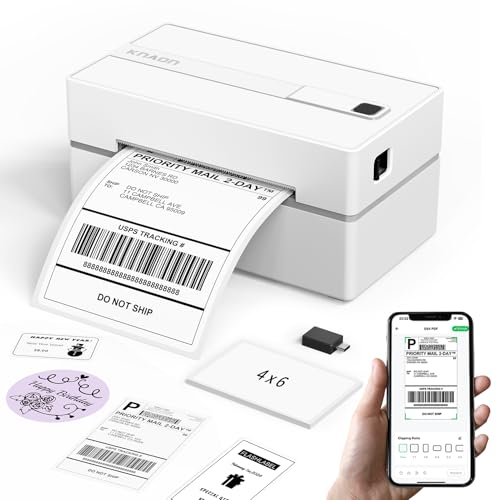
- 3,000+ templates, 5,000 icons, and 100 fonts
- Bluetooth and USB connectivity across major platforms
- Supports labels up to 4.2 inches wide
Best For: Creators needing flexible label designs for custom merchandise
Best Specialty Label Support
MUNBYN ITPP130B Bluetooth Printer

- Supports shipping, circle, rectangle, and specialty labels
- 3,500+ elements, 2,000 templates, and 80 fonts
- 203 dpi printing with mobile Bluetooth and USB options
Best For: Merchandise sellers making shipping and decorative labels
Best Simple Budget Setup

- 203 dpi printing at up to 160 mm/s
- Bluetooth for Android and iOS plus USB for computers
- Includes 30 test labels and essential setup accessories
Best For: Small sellers needing straightforward 4x6 label printing
Fast Bluetooth Pick

- Bluetooth app printing plus USB connectivity
- Up to 150 mm/s with 203 dpi output
- Works with major marketplaces and shipping platforms
Best For: Small businesses and home sellers needing fast, flexible 4x6 label printing
Compact Wireless Value

- Bluetooth app and USB computer printing
- Inkless 203 dpi thermal output
- Supports multiple-size labels and includes starter supplies
Best For: Home offices and small businesses wanting a simple wireless 4x6 printer
Space-Saving Versatility
ETIKEZ PL50E Bluetooth Printer

- App-based mobile printing with USB computer support
- 203 dpi output for labels, QR codes, and barcodes
- Supports multiple label sizes and major shipping platforms
Best For: Compact workspaces needing shipping, barcode, and price-tag printing
Commercial-Grade Pick – Rollo USB Shipping Label Printer
For sellers seeking thermal label printers for custom merchandise, the Rollo USB is a dependable wired option for shipping labels, product labels, barcodes, QR codes, and stickers. It connects to Windows or Mac computers through USB, prints at up to 150 mm/s, and supports label widths from 1.57 to 4.1 inches.
Best For: Online sellers and small businesses that prefer fast USB printing and broad platform compatibility.
Pros:
- Prints one 4×6 label per second using inkless direct thermal technology.
- Supports shipping, barcode, product, thank-you, QR code, and name labels.
- Works with Windows, Mac, major shipping platforms, and marketplaces.
- Includes access to Rollo Ship for shipping management and rates.
Cons:
- USB connectivity is wired rather than wireless.
- Monochrome printing is limited to black-and-white output.
With its 203 DPI resolution, compact 2.2-pound design, and wide software compatibility, the Rollo is a strong choice when custom merchandise operations prioritize speed and straightforward computer-based printing.
Wireless Design Pick – Phomemo 241BT Bluetooth Label Printer
The Phomemo 241BT is a flexible choice among thermal label printers for custom merchandise, combining Bluetooth printing with USB connectivity. Its Labelife app supports label design on iOS and Android, while computer users can print through compatible drivers and connections.
Best For: Home businesses and creators who want to design and print labels from phones, tablets, PCs, or Macs.
Pros:
- Supports wireless printing through Bluetooth on mobile devices.
- Also works through USB with PC, Windows, Mac, ChromeOS, and Linux systems.
- Handles label widths from 1 to 4.6 inches for shipping and custom designs.
- Prints at up to 150 mm/s without ink or toner.
Cons:
- Mobile printing requires the Labelife app.
- Only black-and-white printing is supported unless compatible color thermal paper is used.
- Computer setup requires downloading the appropriate driver.
The 241BT stands out for connection flexibility and app-based customization, making it practical for merchandise sellers who switch between mobile design work and desktop order fulfillment.
Template-Rich Pick – KNAON 4×6 Bluetooth Label Printer
The KNAON Y41BT is aimed at sellers who want thermal label printers for custom merchandise with built-in design resources. Its FlashLabel Pro app includes more than 3,000 templates, 5,000 icons, and 100 fonts, while USB and Bluetooth support broadens device compatibility.
Best For: Small businesses and DIY sellers creating varied product, thank-you, price, name, and shipping labels.
Pros:
- Offers thousands of templates, icons, and fonts for customization.
- Supports Bluetooth and USB connections across mobile and desktop platforms.
- Prints at speeds up to 180 mm/s.
- Supports paper widths from 1.38 to 4.41 inches and includes 20 test papers.
Cons:
- Mobile Bluetooth printing must be completed through the FlashLabel Pro app.
- Shipping-platform labels need to be saved as PDFs and imported into the app.
- The supplied information does not specify a color-printing mode.
Its extensive template library makes the KNAON especially appealing for custom merchandise workflows that involve more than standard 4×6 shipping labels, although app-based importing may add a step for some orders.
Versatile Connectivity Pick – JADENS Bluetooth Thermal Printer
The JADENS JD268BT is a practical option for thermal label printers for custom merchandise, supporting both fanfold and roll labels from 1.57 to 4.1 inches wide. It offers Bluetooth printing on supported computers, app-based mobile printing, and USB connectivity for Windows and Mac systems.
Best For: Online shops that need a flexible printer for shipping, warehouse, market, and small custom labels.
Pros:
- Uses a 203 DPI Japanese thermal print head without ink or toner.
- Supports Bluetooth on Windows 8 or later and Mac systems.
- Works with Android and iOS through the JADENS printer app.
- Compatible with roll and fanfold labels and numerous shipping platforms.
Cons:
- Mobile users must print through the JADENS app rather than direct Bluetooth.
- Labels require calibration when changing label sizes.
- Computer setup uses USB or supported Bluetooth connections rather than unrestricted wireless access.
The JD268BT offers broad label-format and platform support, plus a one-year warranty and setup resources, making it a well-rounded fit for small merchandise businesses managing multiple label types.
Best App-Based Customization – KNAON Y813BT Thermal Label Printer
For sellers comparing thermal label printers for custom merchandise, the KNAON Y813BT stands out for its app-based design tools. It supports labels from 1.5 to 4.2 inches wide and provides more than 3,000 templates, 5,000 icons, and 100 fonts for creating shipping, barcode, thank-you, price, and name labels.
Best For: Small businesses and creators who want broad customization options from a phone, tablet, or computer.
Pros:
- Bluetooth and USB connectivity supports iOS, Android, Windows, macOS, ChromeOS, and Linux.
- App includes extensive templates, icons, and fonts for custom merchandise labeling.
- Prints at speeds up to 180 mm/s and includes 10 test labels.
- Works with major marketplaces and shipping platforms, including Etsy, Shopify, USPS, and Amazon.
Cons:
- Mobile and Bluetooth printing requires the FlashLabel Pro app rather than a direct Bluetooth connection.
- Shipping-platform labels must be saved as PDFs and imported into the app.
The KNAON is a versatile choice when label design flexibility matters as much as shipping-label output. Its app dependency adds a step to the workflow, but the large template library and multi-platform support are useful for custom merchandise operations.
Best Specialty Label Support – MUNBYN ITPP130B Bluetooth Printer
The MUNBYN ITPP130B is a strong option among thermal label printers for custom merchandise because it supports more than standard 4×6 shipping labels. Its compatible label range includes circular, rectangular, gradient, glitter, rainbow, and other specialty formats, making it suitable for branding and product stickers.
Best For: Entrepreneurs who need both shipping labels and decorative or specialty labels for merchandise packaging.
Pros:
- Supports labels from 1.57 to 4.3 inches wide, including several specialty sizes and finishes.
- Offers more than 3,500 design elements, 2,000 templates, and 80 fonts.
- Prints at 203 dpi and supports PDF, TXT, and OCR-based label creation.
- Bluetooth printing works through the mobile app, while USB supports Bluetooth-less desktops.
Cons:
- MUNBYN recommends its genuine labels for consistent results.
- The product notes that it may not be compatible with UPS thermal paper.
- Bluetooth desktop design and printing use the Munbyn Editor in Google Chrome.
With its wide selection of label formats and design assets, the MUNBYN is particularly well suited to branded inserts, stickers, and packaging accents alongside routine shipping labels. Buyers should plan around the stated paper recommendations and workflow requirements.
Best Simple Budget Setup – Mvgges POS-9270 Label Printer
The Mvgges POS-9270 keeps the setup straightforward for sellers seeking thermal label printers for custom merchandise. It prints 4×6 labels at 203 dpi, works with Android, iOS, Windows, and Mac, and includes the cable, power adapter, and test labels needed to begin printing.
Best For: Home-based sellers and small businesses that need an uncomplicated printer for shipping and inventory labels.
Pros:
- Supports Bluetooth printing on Android and iOS and USB printing on Windows and Mac.
- 203 dpi output is suited to shipping labels and inventory management.
- Prints at speeds up to 160 mm/s and accepts labels from 1.37 to 4.1 inches wide.
- Includes 30 test labels, a Type-C cable, power adapter, and user manual.
Cons:
- Bluetooth is limited to Android and iOS; Wi-Fi is not supported.
- Mobile printing requires a Bluetooth printing app, while computer printing requires a driver.
- Shipping-platform labels need to be saved and downloaded as PDFs first.
The Mvgges is a practical pick for basic custom merchandise fulfillment where dependable 4×6 printing matters more than an extensive built-in design library. Its dual connection options and included test labels make it easy to put into service, though the workflow is more limited than app-centered alternatives.
Fast Bluetooth Pick – N40 4×6 Thermal Label Printer
For sellers comparing thermal label printers for custom merchandise, the N40 stands out for flexible wireless and wired connectivity. It prints 4×6 labels at up to 150 mm/s, supports iOS, Android, Windows, macOS, and Linux, and works with a broad range of marketplaces and shipping platforms.
Best For: Small businesses and home sellers who want fast 4×6 shipping-label printing with both Bluetooth and USB options.
Pros:
- Bluetooth printing through the Nada Print app for iOS, Android, and tablets.
- USB support for Windows, macOS, and Linux.
- Inkless 203 dpi printing at speeds up to 150 mm/s.
- Supports label widths from 1 to 4.2 inches and integrates with platforms including Etsy, Shopify, Amazon, and eBay.
Cons:
- Label size should be recalibrated when changing labels.
- Computer printing requires a USB connection rather than Bluetooth.
The N40 is a practical choice when speed, platform compatibility, and connection flexibility matter. Its included 20 sheets of 4×6 labels and two-year warranty add useful value for getting started.
Compact Wireless Value – Rongta RP425-PK Label Printer
The Rongta RP425-PK is a compact option for shoppers seeking thermal label printers for custom merchandise and everyday shipping. It supports Bluetooth printing from phones and USB printing from computers, while its inkless 203 dpi output is designed for clear labels.
Best For: Home offices, small businesses, and sellers who want a straightforward pink 4×6 printer with mobile and computer support.
Pros:
- Bluetooth printing through the RONGTA app on phones and tablets.
- USB connection supports PC and laptop printing.
- Inkless thermal printing produces 203 dpi monochrome output.
- Supports multiple-size labels and includes labels, a power cord, and a USB cable.
Cons:
- The one-year manufacturer warranty is shorter than some alternatives.
- Computer printing uses USB rather than wireless connectivity.
With a listed black-and-white speed of up to 72 pages per minute and support for 4×6 paper, the RP425-PK offers a simple workflow for routine shipping and small-business labels without ink cartridges.
Space-Saving Versatility – ETIKEZ PL50E Bluetooth Printer
The ETIKEZ PL50E suits sellers looking for thermal label printers for custom merchandise in a small workspace. It prints through the Labelnize app on Android and iOS, connects to Windows, macOS, and Chrome OS computers by USB, and supports label sizes from 1.57 to 4.1 inches.
Best For: Small businesses and home workspaces that need a compact printer for shipping labels, barcodes, and price tags.
Pros:
- Supports mobile printing through the Labelnize app on Android and iOS 13 or later.
- USB compatibility with Windows, macOS, and Chrome OS.
- 203 dpi output supports shipping labels, QR codes, and barcodes.
- Works with Amazon, eBay, Shopify, UPS, FedEx, and USPS.
Cons:
- Bluetooth connection is app-only; direct Bluetooth pairing is not supported.
- Computers cannot connect over Bluetooth and must use USB.
- Correct paper-size selection and setup steps are important for reliable printing.
The PL50E is appealing when footprint and media flexibility are priorities. Its app-guided setup and support for labels up to 4.1 inches make it useful beyond shipping, although its connection limitations are worth considering before purchase.
How We Picked the Best Thermal Label Printers for Custom Merchandise
We focused on features that matter when producing and shipping custom merchandise: dependable 4×6 label output, straightforward setup, connection options, compatibility with common operating systems and shipping platforms, and practical use at home or in a small business. We also considered whether each printer suits a fixed packing station, a shared workspace, or mobile fulfillment.
Because these are direct-thermal printers, they use heat-sensitive labels rather than ink or toner. That keeps routine printing costs simple, but it also means labels should be stored away from excessive heat, sunlight, and friction.
Quick Comparison
USB models are often the simplest choice for a dedicated Windows computer and can provide a stable connection during busy packing sessions. Bluetooth printers offer more flexibility for phones, tablets, and multiple devices, although setup and app compatibility deserve extra attention. Some models include starter labels, which is convenient for testing but should not be the deciding factor if you expect high shipping volume.
Key Buying Factors for Thermal Label Printers for Custom Merchandise
Connectivity and Device Support
Check whether the printer works with your preferred device before buying. USB is useful for desktop-based workflows, while Bluetooth is better for sellers who create labels from iOS or Android devices. If several people will print from different platforms, verify supported systems and software rather than relying only on a broad compatibility claim.
Label Size and Software Workflow
Most shipping services use 4×6 labels, but confirm the printer supports the label format and media type you already plan to buy. Look for automatic label detection, calibration, and software that makes resizing or repositioning designs easy. For custom merchandise, these features can help with branded packing slips, return labels, and barcode-heavy shipping layouts.
Speed, Clarity, and Workspace
Clear barcodes and readable addresses are more important than a headline speed rating. Consider how many orders you fulfill at once, how much desk space is available, and whether a compact or portable design would be useful. A printer that fits naturally into your packing area is more likely to improve your workflow.
Long-Term Running Costs
Compare the price and availability of compatible labels, not just the printer’s purchase price. Direct-thermal printing avoids ink replacement, but label quality and storage still affect reliability. Buying standard-size labels in bulk can reduce ongoing costs when order volume grows.
Who Should Buy Which Thermal Label Printers for Custom Merchandise?
Choose a USB model if you mainly print from one computer and want a straightforward packing-station setup. Choose Bluetooth if you need wireless printing from a phone, tablet, or several devices. A compact portable printer is a practical fit for sellers who pack orders in different rooms, at markets, or in temporary workspaces. For higher-volume shops, prioritize consistent feeding, clear output, broad software support, and readily available labels over included accessories.
Whichever model you choose, test it with your actual merchandise workflow before a major sales period. Confirm label alignment, barcode readability, platform compatibility, and connection stability so fulfillment remains predictable as your order volume increases.