When shipping volume rises, a dependable label printer can save time, reduce supply costs, and keep packages moving. The best thermal label printers for production work deliver consistent 4×6 output, straightforward setup, and dependable performance across busy workflows.
We selected 10 models spanning USB, Bluetooth, wireless, portable, and label-bin designs so you can match features to your operation—whether you run a small business, fulfillment station, or growing e-commerce store.
Best 10 Thermal Label Printers for Production Work Picks for 2026
Commercial-Grade Pick
Rollo USB Shipping Label Printer

- Prints about one 4x6 label per second
- Inkless 203 DPI thermal printing
- Supports Windows, Mac, and major platforms
Best For: High-volume wired shipping stations and warehouses
Wireless Setup Pick
JADENS Bluetooth Thermal Label Printer

- Bluetooth and USB connectivity
- Supports roll and fanfold labels
- 203 DPI printing for shipping and warehouse labels
Best For: Small businesses needing flexible wireless or USB printing
App-Driven Flexibility Pick
KNAON Bluetooth Shipping Label Printer
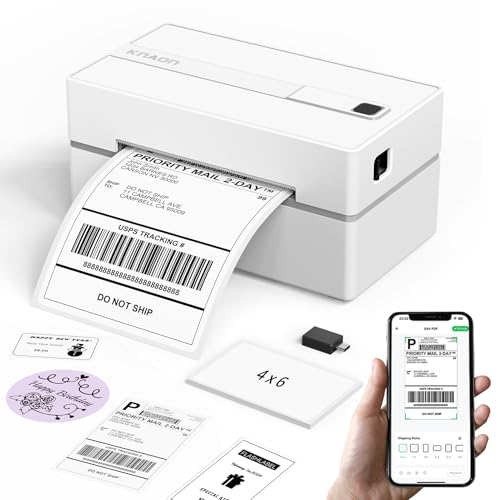
- Prints up to 180 mm/s
- Includes thousands of templates and design assets
- Supports Bluetooth, USB, and multiple operating systems
Best For: Custom-label workflows across mobile and desktop devices
Entrepreneur-Friendly Pick

- Bluetooth, USB, and browser-based printing
- Large library of templates and design tools
- 203 DPI output with a two-year warranty
Best For: Entrepreneurs printing shipping and customized business labels
Efficient Bluetooth Workhorse
Compact 4x6 Thermal Label Printer

- Up to 72 labels per minute at 203 DPI
- Bluetooth and USB connectivity
- Supports major shipping platforms and varied label widths
Best For: Small businesses with frequent shipping and barcode-label needs
Space-Saving Production Pick

- Built-in bin holds up to 250 4x6 labels
- Bluetooth and USB support across major systems
- Prints labels from 1 to 4.6 inches wide
Best For: Compact shipping stations and mixed-device small businesses
Flexible Wireless Choice
Nelko PL70E Bluetooth Label Printer

- Up to 72 labels per minute at 203 DPI
- Supports roll and fanfold labels from 1.54 to 4.1 inches
- Bluetooth app printing plus USB computer support
Best For: Users printing shipping, barcode, pricing, and small-format labels
Portable Bluetooth Pick
N40 4x6 Shipping Label Printer

- Bluetooth app control plus USB connectivity
- Automatic calibration and self-diagnostics
- Supports 25mm–110mm media widths
Best For: Small businesses and e-commerce sellers needing flexible wireless labeling
High-Speed Compact Choice
Rongta RP425 Bluetooth Label Printer
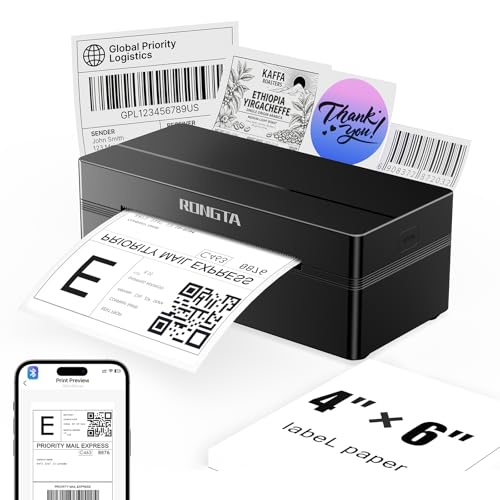
- Up to 150 mm/s printing speed
- Automatic label detection and feeding
- Works with mobile and desktop operating systems
Best For: Warehouses and offices producing frequent shipping and barcode labels
Template-Rich Workstation Pick
Arrvel A42BT 4x6 Label Printer

- Up to 72 labels per minute at 203 DPI
- Bluetooth and USB support across major platforms
- Thousands of templates, icons, and fonts
Best For: Sellers creating both shipping labels and customized business labels
Commercial-Grade Pick – Rollo USB Shipping Label Printer
For production work that depends on reliable wired printing, the Rollo USB is a practical choice among thermal label printers for production work. It prints one 4×6 label per second at 203 DPI, supports Windows and Mac, and works with major shipping platforms and marketplaces.
Best For: High-volume shipping stations, warehouses, and businesses that prefer a direct USB connection.
Pros:
- Prints at up to 150 mm/s, or approximately one 4×6 label per second.
- Uses inkless direct thermal printing, eliminating ink and toner purchases.
- Supports label widths from 1.57 to 4.1 inches for shipping, barcode, product, and sticker labels.
- Compatible with Windows, Mac, major carriers, shipping platforms, and marketplaces.
Cons:
- Connectivity is wired USB rather than wireless.
- The 203 DPI resolution is suited to standard labels but is not a higher-resolution option.
The Rollo stands out for straightforward, fast desktop production. Its USB-only setup is less flexible than Bluetooth models, but it is a solid fit when consistent wired operation and broad platform compatibility matter most.
Wireless Setup Pick – JADENS Bluetooth Thermal Label Printer
The JADENS Bluetooth printer adds wireless flexibility to production work while retaining USB connectivity. It supports roll and fanfold labels, prints at 203 DPI, and handles label widths from 1.57 to 4.1 inches for shipping and warehouse applications.
Best For: Small businesses that want Bluetooth printing from compatible computers or app-based printing from mobile devices.
Pros:
- Supports Bluetooth printing on Windows 8 or later and Mac, with app-based printing for Android and iOS.
- Also offers USB connectivity for Windows 7 or newer and Mac OS 10.9 or newer.
- Works with both fanfold and roll labels.
- Compatible with major shipping platforms and marketplaces, including Amazon, eBay, and Shopify.
Cons:
- Mobile users must print through the JADENS app rather than direct Bluetooth printing.
- Labels require feed-button identification and calibration when changing label types.
JADENS is a versatile option for smaller production environments that value wireless access. Its calibration step adds routine handling, but the combination of Bluetooth, USB, mobile support, and broad platform compatibility is useful for flexible label workflows.
App-Driven Flexibility Pick – KNAON Bluetooth Shipping Label Printer
The KNAON combines Bluetooth and USB connectivity with a design-oriented mobile app, making it useful when production work includes more than standard shipping labels. It supports widths from 1.5 to 4.2 inches and prints at speeds up to 180 mm/s.
Best For: Small businesses that need shipping, barcode, price, name, or custom labels from phones, tablets, or computers.
Pros:
- Offers wireless printing through the FlashLabel Pro app and USB support for Windows, macOS, ChromeOS, and Linux.
- Includes more than 3,000 templates, 5,000 icons, and 100 fonts for custom labels.
- Prints at up to 180 mm/s and supports paper widths from 1.5 to 4.2 inches.
- Works with major marketplaces and shipping services, including Etsy, Shopify, USPS, UPS, and Amazon.
Cons:
- Mobile and Bluetooth workflows require the FlashLabel Pro app.
- Shipping labels from online platforms must be saved as PDFs and imported into the app.
KNAON is appealing when label customization is part of the workflow, not just a convenience. The app-based process may add a step for shipping labels, but its template library, broad device support, and fast rated speed give it production flexibility.
Entrepreneur-Friendly Pick – MUNBYN RealWriter 130B
The MUNBYN RealWriter 130B is built for flexible business label production, combining Bluetooth, USB, and browser-based editing. It delivers 203 DPI printing, supports labels from 1.57 to 4.3 inches wide, and includes tools for custom designs, imported files, and OCR text recognition.
Best For: Entrepreneurs and small offices printing shipping, barcode, pricing, branding, and organization labels.
Pros:
- Supports Bluetooth printing through the MUNBYN app or Chrome-based Munbyn Editor, plus USB for desktops without Bluetooth.
- Provides more than 3,500 design elements, 2,000 templates, and 80 fonts.
- Supports PDF and TXT imports, OCR, and multiple languages.
- Includes a two-year warranty and prints at 203 DPI.
Cons:
- The 130B may not be compatible with UPS thermal paper.
- MUNBYN recommends using its branded thermal labels for consistent results.
The RealWriter 130B is a strong all-around option for businesses that need both shipping output and custom label creation. Its software ecosystem adds versatility, while the recommended-label limitation is worth considering when standardizing supplies.
Efficient Bluetooth Workhorse – Compact 4×6 Thermal Label Printer
For thermal label printers for production work, the NULLTONEX offers a practical mix of speed, connectivity, and flexible label support. Its direct-thermal 203 DPI printing reaches up to 150 mm/s, while Bluetooth and USB connections accommodate mobile and desktop workflows.
Best For: Small businesses handling frequent shipping, barcode, or mailing-label jobs from phones, tablets, laptops, or PCs.
Pros:
- Prints up to 72 4×6 labels per minute at 203 DPI.
- Supports Bluetooth and USB connections, including a dedicated mobile app.
- Works with major platforms such as Amazon, Shopify, Etsy, USPS, UPS, FedEx, and DHL.
- Supports label widths from 1.57 to 4.3 inches and includes 25 starter labels.
Cons:
- Prints in black and white only.
- The included app may be necessary for some Bluetooth workflows.
- Its 4×6 format and desktop design may be more than needed for occasional basic labeling.
The NULLTONEX is a strong choice when production work demands quick, repeatable shipping-label output without ink or toner. USB is useful for a stable office setup, while the app adds flexibility for wireless label creation.
Space-Saving Production Pick – D450BT Thermal Label Printer
Among thermal label printers for production work, the Omezizy D450BT stands out for its built-in label bin and compact footprint. It holds up to 250 4×6 labels internally, prints at up to 72 labels per minute, and connects through Bluetooth or USB.
Best For: Small shipping stations, home businesses, warehouses, and offices that need high-capacity label storage without a separate roll holder.
Pros:
- Built-in compartment stores up to 250 4×6 labels and helps reduce desk clutter.
- Supports Bluetooth across Android, iOS, Windows, macOS, Linux, and ChromeOS, plus USB.
- Handles label widths from 1 to 4.6 inches for shipping, barcode, pricing, and mailing labels.
- Uses direct thermal printing with 203 DPI clarity and automatic alignment.
Cons:
- Prints monochrome labels only.
- The compact internal bin is specified for compatible label supplies and may not suit every media setup.
- Wireless setup may require using the appropriate operating-system connection or app workflow.
The D450BT is especially practical when workspace and label handling matter as much as print speed. Its internal capacity can simplify a busy shipping station, while broad operating-system support makes it adaptable for mixed-device teams.
Flexible Wireless Choice – Nelko PL70E Bluetooth Label Printer
The Nelko PL70E is a versatile option for thermal label printers for production work, combining 150 mm/s printing with support for both roll and fanfold labels. Its 203 DPI output covers standard 4×6 shipping labels as well as smaller barcode, price, and name labels.
Best For: Home and commercial users who need wireless mobile printing plus USB support for Windows, Mac, or ChromeOS computers.
Pros:
- Prints up to 72 4×6 labels per minute without ink or toner.
- Supports Bluetooth through the Nelko app and USB computer connections.
- Accepts label widths from 1.54 to 4.1 inches, including roll and fanfold media.
- Compatible with platforms including Amazon, eBay, Shopify, USPS, UPS, Etsy, PayPal, and Poshmark.
Cons:
- Mac users must use USB rather than direct Bluetooth printing.
- Bluetooth printing requires the Nelko app, and logistics labels may need to be saved as PDFs before importing.
- Prints in monochrome only.
The Nelko PL70E offers useful media flexibility for operations that print more than one label type. It is a good fit when wireless phone printing is important, but Mac users should plan around its USB-only computer connection.
Portable Bluetooth Pick – N40 4×6 Shipping Label Printer
For small businesses seeking thermal label printers for production work, the N40 combines Bluetooth convenience with automatic calibration and label positioning. It prints 203-DPI monochrome labels and supports 4×6 shipping labels plus media from 25mm to 110mm wide.
Best For: Online sellers, small offices, warehouses, and mobile labeling tasks that benefit from app-based wireless printing.
Pros:
- Bluetooth and USB connectivity with support for phones and tablets through the Nada Print app.
- Automatic calibration, intelligent paper ejection, and self-diagnostics help reduce waste and jams.
- Supports shipping labels, barcodes, QR codes, price tags, warehouse labels, and other small formats.
- Print-head lifespan is rated at approximately 1.25 million shipping labels.
Cons:
- Bluetooth printing requires the Nada Print app.
- Its 203-DPI resolution is suited to standard labels rather than highly detailed graphics.
- The included label supply is limited to 20 test sheets.
The N40 is a flexible, compact option for production workflows that need varied label sizes and straightforward wireless control. Its broad app and platform support adds convenience for e-commerce operations.
High-Speed Compact Choice – Rongta RP425 Bluetooth Label Printer
The Rongta RP425 is a practical choice among thermal label printers for production work, offering printing speeds up to 150 mm/s at 203 DPI. Its automatic label identification and support for Bluetooth, USB, Windows, macOS, and Chrome OS make it adaptable to mixed-device workspaces.
Best For: Warehouses, offices, and small businesses that need fast 4×6 shipping labels from computers or mobile devices.
Pros:
- Prints at speeds up to 150 mm/s for efficient label production.
- Automatically detects, grabs, and feeds compatible labels.
- Supports direct thermal media from 0.98 to 4.37 inches wide, including 4×6, barcode, QR, and circular labels.
- Includes Bluetooth support for iOS and Android plus USB drivers for Windows, macOS, and Chrome OS.
Cons:
- Maximum listed resolution is 203 DPI.
- The compact design supports common label formats but does not indicate color printing.
- Computer setup requires downloading drivers from Rongta’s website.
With fast output and automatic media handling, the RP425 is well suited to repeat shipping and inventory tasks. Its one-year warranty is also useful for businesses adding a printer to a regular workflow.
Template-Rich Workstation Pick – Arrvel A42BT 4×6 Label Printer
The Arrvel A42BT is designed for production work that combines recurring shipping labels with custom designs. It offers Bluetooth and USB connectivity, output up to 72 labels per minute, 203-DPI printing, and app features such as AI Smart Cropping for 4×6 logistics PDFs.
Best For: Sellers and offices that want a label stand, multi-platform connectivity, and extensive templates for shipping and custom labels.
Pros:
- Prints up to 72 labels per minute using inkless thermal technology.
- Supports Bluetooth through the FlashLabel Pro app and USB connections for Windows, macOS, ChromeOS, and Linux.
- Handles fanfold and roll labels from 40mm to 110mm wide.
- Includes more than 3,000 templates, 5,000 icons, and 100 fonts, plus AI Smart Cropping.
Cons:
- Mobile devices and macOS must connect through the FlashLabel Pro app rather than system Bluetooth settings.
- ChromeOS requires a separate FlashLabel extension.
- The printer is limited to monochrome thermal output.
The A42BT stands out when label production includes customization as well as standard shipping. Its included stand, broad operating-system support, and design tools make it a convenient desktop setup for growing sellers.
How We Picked the Best Thermal Label Printers for Production Work
We focused on practical production requirements rather than isolated headline features. Each selected printer supports the widely used 4×6 shipping-label format and is suited to recurring label output. We compared connection options, operating-system support, ease of setup, footprint, label handling, and the workflow advantages of features such as wireless printing, built-in bins, and stands.
Because production needs vary, this list includes both straightforward USB models and Bluetooth or wireless printers designed for flexible placement. Compatibility should still be verified before purchase, especially if you print from phones, tablets, Macs, or specialized shipping software.
Quick Comparison
| Best For | Look For | Why It Matters |
|---|---|---|
| Dedicated packing station | USB connection and stable drivers | Reliable, repeatable printing from a primary computer |
| Flexible workstation placement | Bluetooth or wireless connectivity | Reduces cable clutter and supports mobile workflows |
| Small or crowded workspaces | Compact design or built-in label storage | Keeps supplies organized without using extra shelf space |
| Growing shipping volume | Commercial-grade construction and consistent feeding | Helps minimize interruptions during longer print runs |
Key Buying Factors for Thermal Label Printers for Production Work
Connection and Software Compatibility
USB is often the simplest choice for a fixed packing computer, while Bluetooth is more convenient when labels are created from phones, tablets, or multiple nearby devices. Check compatibility with your operating system and shipping platforms before ordering. A printer that connects easily but lacks suitable drivers can slow production.
Print Consistency and Workflow Speed
Look for dependable automatic label detection, accurate alignment, and a feed mechanism that does not require frequent adjustment. Production performance is about more than maximum speed: consistent output and fewer jams usually have the greater effect on daily throughput.
Size, Storage, and Placement
Measure the available counter space and consider where label rolls will sit. A built-in bin or stand can improve organization, while a compact portable model may suit pop-up operations or shared workstations. Make sure the printer remains easy to load and access for routine maintenance.
Label Costs and Operating Requirements
Direct thermal printers avoid ink and toner, but you still need compatible labels and regular cleaning. Confirm the supported label dimensions, roll or fanfold format, and whether the printer works reliably with the labels you already use. Keep spare rolls available so a busy shipping day does not stop unexpectedly.
Who Should Buy Which Thermal Label Printers for Production Work?
Choose a USB commercial-style model if you run a dedicated shipping station and value a stable computer connection. Pick Bluetooth or wireless equipment if staff need to print from multiple devices or move around the workspace. A compact printer suits low-volume sellers, mobile businesses, and limited counters, while a model with an integrated bin or stand is useful when organization and quick access matter most.
For high-volume production, prioritize dependable feeding, broad software compatibility, and easy label replacement over decorative extras. Whichever model you choose, confirm its device support and 4×6 label requirements before buying.