Choosing a full body 3D scanner for artists means balancing capture size, surface detail, speed, and ease of cleanup. The right model can streamline character work, costume studies, archival scans, and 3D printing prep.
In this roundup, we focus on scanners that are practical for real creative workflows, from portable handheld options to higher-precision systems for more demanding full-body capture.
Best 10 Full Body 3D Scanner for Artists Picks for 2026
Artist-Friendly Handheld Scan
Shining 3D Einstar for Hair and Body

- 0.1 mm point distance for dense capture
- Hair Mode improves human scan completeness
- RGB color camera and broad export support
Best For: Artists and educators scanning people, hair, and creative subjects
High-Precision Detail Scanner
Revopoint MetroY Pro Blue Laser

- Up to 0.01 mm precision for detailed work
- Five modes include laser, structured light, and turntable
- Wi-Fi 6 supports wireless scan monitoring
Best For: Detail-focused creators and studios needing precision scan data
Fast Wireless Scan Option

- Up to 90 FPS for fast capture
- Wi-Fi 6 and battery grip improve mobility
- Scans dark and shiny surfaces without spray
Best For: Artists and pros needing fast, mobile, detail-oriented scanning
Studio-Grade Full-Body Capture
Metrology-Grade 20s Auto-Scan System
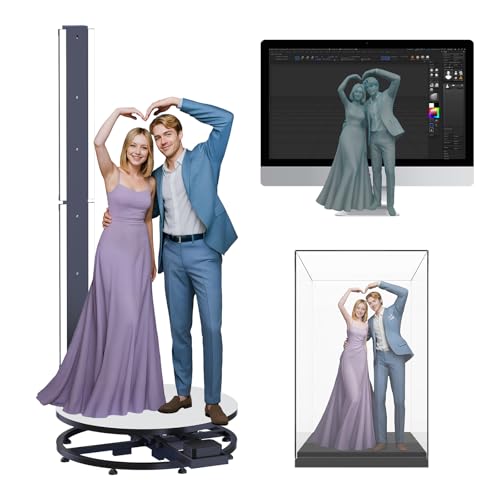
- 20-second 360° auto-rotation scanning
- Six 12MP cameras with LED fill light
- Bundled software, computer box, and flight case
Best For: Professional studios and figurine creators
Portable Large-Object Scanner
RANGE 2 Body and Outdoor Scanner

- 0.1 mm precision with 16 fps scanning
- Large capture area for people and big objects
- Wi‑Fi 6, USB-C, and cross-platform support
Best For: Mobile artists scanning people and large props
Ultra-Precision Artist Scanner
0.01mm Full-Body Modeling System

- Claims 0.01 mm precision for fine detail
- 20-second automatic full-body scanning
- All-in-one software, computer box, and credits
Best For: Precision-focused studios and figurine makers
Versatile body-and-object scanner
Handheld 3D scanner bundle with turntable

- 0.03 mm single-frame accuracy
- Five scanning modes for broad coverage
- AI segmentation and 3DGS support
Best For: Artists scanning full bodies, props, and complex objects
Automated studio body scanner
6-camera automatic 360 full-body scanner
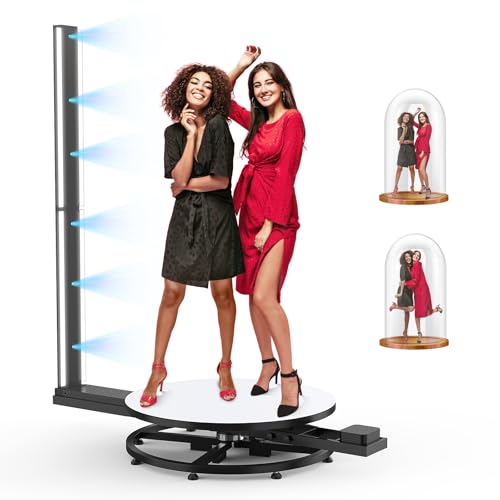
- Six 12MP camera arrays for 360 capture
- Automatic rotation helps reduce blind spots
- About 20-second scan time
Best For: Studios wanting automated full-body scans for 3D printing
Portable scan-and-turntable bundle
Handheld scanner with electric turntable bundle

- 0.03 mm single-frame accuracy
- Turntable supports up to 200 kg
- AI segmentation reduces background noise
Best For: Artists needing a flexible scanner for people and large objects
Artist-Friendly Handheld Scan – Shining 3D Einstar for Hair and Body
If you want a full body 3D scanner for artists that balances ease of use with solid color capture, the Shining 3D Einstar is a practical handheld option. It’s built to collect high-density point cloud data, supports hair scanning with Hair Mode, and uses a built-in RGB camera for color-fidelity work.
Best For: Artists, educators, and creators scanning people, hair, and medium-to-large subjects for 3D printing or digital archiving.
Pros:
- Up to 0.1 mm point distance for dense data capture
- Hair Mode helps improve human scan completeness
- Built-in RGB camera supports high color fidelity
- Works with OBJ, STL, PLY, ASC, 3MF, and P3 exports
Cons:
- 14 FPS scanning is slower than top industrial systems
- No projector light during scanning may not suit every workflow
- Best suited to practical capture rather than ultra-fine metrology
The Einstar is a strong fit if you need an approachable scanner for artistic body capture and broad file compatibility. Its combination of hair support, stable outdoor scanning, and straightforward post-processing makes it easier to use in creative pipelines.
High-Precision Detail Scanner – Revopoint MetroY Pro Blue Laser
For creators who need a full body 3D scanner for artists only when precision matters most, the Revopoint MetroY Pro leans toward detail-heavy scanning rather than casual body work. Its blue laser and structured-light modes are designed for accurate data capture, with full-color support and flexible scanning options.
Best For: Artists, technical creators, and studios needing high-accuracy scans for detailed objects, figurines, and reverse-engineering workflows.
Pros:
- Up to 0.01 mm precision and 0.02 mm accuracy
- Five scanning modes cover lasers, structured light, and turntable use
- No scanning spray needed in laser modes for shiny or dark surfaces
- Wi-Fi 6 and real-time streaming improve workflow flexibility
Cons:
- Minimum system requirements are demanding, especially on Windows
- Revo Design and Revo Measure are paid and Windows-only
- Optimized more for precision objects than easy whole-body capture
The MetroY Pro is best viewed as a precision tool for artists who care about measured detail and polished scan data. If your workflow includes small-to-medium subjects, reverse engineering, or high-end model prep, it offers strong capability.
DIY Camera-Based Scan System – Portable Body Scanner System
If you’re looking for a full body 3D scanner for artists on a budget or want a more hands-on workflow, this portable photogrammetry-based system takes a different approach. It works with smartphones or DSLR cameras and uses multiple photos to build 3D models with or without texture.
Best For: DIY-minded artists and beginners who want a flexible, camera-based path to body and object scanning.
Pros:
- Compatible with smartphones and DSLR cameras
- Uses photogrammetry to create textured or texture-free 3D models
- DIY kit format offers flexibility and modification potential
Cons:
- Depends on separate cameras and photogrammetry software
- No built-in scanning speed or hardware specs are provided
- Less turnkey than handheld scanner options
This kit is a good fit if you want to build your own capture workflow and already have the camera gear. It’s more of a flexible scanning system than an all-in-one device, so expect more setup in exchange for customization.
Fast Wireless Scan Option – Revopoint MetroY Ultra 90 FPS
If you need a full body 3D scanner for artists with speed, mobility, and strong detail capture, the Revopoint MetroY Ultra is the most performance-focused option here. It combines blue laser and structured light modes with wireless operation, outdoor scanning support, and high frame-rate capture.
Best For: Artists and professionals who need fast, flexible scanning for detailed objects, field use, and higher-output workflows.
Pros:
- Up to 90 FPS scanning speed on NVIDIA GPU systems
- Five modes cover rapid scans, detail scans, deep holes, and turntable work
- Can scan dark, shiny, and metallic surfaces without spray in laser modes
- Wi-Fi 6 and 5500 mAh battery grip support mobile scanning
Cons:
- Minimum PC requirements are high for best performance
- Best for small-to-medium objects rather than broad whole-body capture
- Full benefits depend on compatible hardware and software setup
The MetroY Ultra stands out if your priority is speed, wireless convenience, and outdoor scanning capability. For artists who need responsive capture and strong detail handling, it offers a more advanced workflow than entry-level handheld scanners.
Studio-Grade Full-Body Capture – Metrology-Grade 20s Auto-Scan System
If you want a full body 3D scanner for artists that favors speed, consistency, and an all-in-one workflow, this MWE system is built for production-style use. It combines automatic 360° scanning, six 12MP cameras, and bundled CHACKTOK-3D software so you can move from capture to editable models without piecing together multiple tools.
Best For: Studios, event photographers, and creators making mini-me figurines or collectible full-body scans.
Pros:
- 20-second automatic 360° full-body scanning on a silent rotating platform.
- Six 12MP cameras plus LED fill light for fine-detail capture, including hairline textures.
- Includes CHACKTOK-3D software and a computer box for scanning, modeling, editing, and export.
- Portable flight case design makes it easier to move between venues.
Cons:
- CHACKTOK-3D is paid software, though free credits are included.
- This is the scanner system only; it does not include a 3D printer.
- At 241 pounds, it is not a lightweight desktop setup.
For artists who want a controlled, repeatable capture workflow and the ability to output printable models, this is a strong turnkey option. The tradeoff is size and software cost, but the bundled hardware and fast scan process make it well suited to a professional studio environment.
Portable Large-Object Scanner – RANGE 2 Body and Outdoor Scanner
The Revopoint RANGE 2 is a practical full body 3D scanner for artists who need portability and flexibility rather than a fixed studio rig. With handheld operation, Wi‑Fi 6 support, and compatibility across Windows, Android, iOS, and macOS, it fits workflows where you want to scan people, large props, or other big subjects on location.
Best For: Artists who scan on the move, especially for bodies, large props, furniture, or outdoor sessions.
Pros:
- Up to 0.1 mm single-frame precision for detailed large-object capture.
- 60% bigger capture area and 16 fps scanning speed help cover full body scans quickly.
- Wi‑Fi 6 and USB Type-C connectivity support mobile or laptop-based scanning.
- Free Revo Scan software includes one-click processing and editing tools.
Cons:
- Revo Design is paid software and sold separately.
- Best results still depend on steady handheld technique and good scan setup.
- Not a dedicated enclosed full-body booth like automatic turntable systems.
For artists who value mobility and broad device support, RANGE 2 is the most adaptable option here. It is less of a studio automation machine and more of a versatile capture tool for scanning people and large objects wherever the project takes you.
Ultra-Precision Artist Scanner – 0.01mm Full-Body Modeling System
This full body 3D scanner for artists is aimed at users who want extremely fine detail and a streamlined scan-to-model workflow. With 6×12MP cameras, automatic 360° scanning, and built-in CHACKTOK-3D software, it is designed to turn full-body captures into printable models with minimal manual setup.
Best For: Detail-focused creators, studios, and figurine businesses that want high-precision body scans.
Pros:
- Claims 0.01 mm ultra-high precision for fine surface detail.
- 20-second automatic full-body scans with blind-spot-free stitching.
- All-in-one system includes modeling software, built-in computer box, and free credits.
- Portable flight case helps with transport and quick setup at different venues.
Cons:
- CHACKTOK-3D is a paid software platform, even though credits are included.
- This package is the scanner system, not a 3D printer.
- It is a large professional unit rather than a casual handheld scanner.
If your priority is detail and a complete capture-to-output workflow, this model is the most specialized of the group. It makes the most sense for artists and businesses focused on polished figurines, studio scans, and high-precision full-body reproduction.
Versatile body-and-object scanner – Handheld 3D scanner bundle with turntable
If you want a full body 3D scanner for artists that can also handle big props, the Revopoint POP 4 bundle is built around speed, precision, and flexible capture modes. Its blue laser and structured light options make it a strong pick for detailed character work, object modeling, and scan-to-3D workflows where clean geometry matters.
Best For: Artists who need a versatile scanner for full-body capture, large objects, and detailed modeling.
Pros:
- Up to 0.03 mm single-frame accuracy for fine detail capture.
- Multi-line laser mode reaches up to 105 fps with NVIDIA GPU acceleration.
- AI object segmentation helps remove background noise and streamline post-processing.
- Five scanning modes cover indoor and outdoor use cases, including deep holes and dark or reflective surfaces.
Cons:
- Some AI and 3D Gaussian Splatting features require Windows or NVIDIA GPU support.
- Outdoor filter is sold separately.
- The feature set is broad, which may be more than needed for simple scans.
Overall, this is the most flexible option here for artists who want one system that can move between body scans, props, and production-ready models. The included large electric turntable also makes it easier to scan bigger subjects with less manual repositioning.
Automated studio body scanner – 6-camera automatic 360 full-body scanner
The MWE system is a full body 3D scanner for artists who want a highly automated capture setup rather than a handheld workflow. With six HD cameras, automatic 360-degree rotation, and software-guided scanning, it is designed to capture people quickly for 3D printing and detailed character modeling.
Best For: Studios and creators who want fast, automated full-body scans with minimal manual scanning.
Pros:
- Six 12-megapixel camera arrays capture the body from all sides.
- Automatic 360-degree rotation reduces blind spots like the back, neck, waist, and ankles.
- Claims up to 0.01 mm accuracy for very fine detail capture.
- A 360-degree scan takes about 20 seconds, with model building taking about 15 minutes.
Cons:
- Requires the Chacktok software workflow to operate.
- Supports only indoor use with the built-in lighting setup.
- The system is large and heavy at 110 kg.
For artists focused on fast full-body capture, this is more of a dedicated scanning station than a portable scanner. Its automation and blind-spot reduction make it appealing when repeatable people scans matter more than portability.
Portable scan-and-turntable bundle – Handheld scanner with electric turntable bundle
If you need a full body 3D scanner for artists but also want a handheld option for larger creative workflows, the Revopoint POP 4 bundle focuses on accuracy and speed. It combines laser and structured light scanning with a heavy-duty electric turntable, making it practical for body scans, large props, and detailed modeling.
Best For: Artists who want a portable scanner plus a turntable for full-body and large-object capture.
Pros:
- Up to 0.03 mm single-frame accuracy for detailed scans.
- Up to 105 fps in multi-line laser mode with NVIDIA GPU acceleration.
- AI object segmentation can automatically filter background noise.
- The included turntable supports up to 200 kg, which is useful for larger subjects.
Cons:
- Some advanced features require Windows and/or an NVIDIA GPU.
- Outdoor filter is not included.
- Best results depend on choosing the right scan mode for the subject.
This version delivers the same core capture capabilities as the other POP 4 bundle, but its value is in the combination of handheld scanning flexibility and a large turntable. That makes it a strong fit for artists who switch between portraits, body scans, and object work.
How We Picked the Best Full Body 3D Scanner for Artists
We prioritized scanners that make sense for artists working with people, costumes, props, and large forms. That means looking at body-capable scan range, usable accuracy, tracking stability, speed, software support, and how much post-processing is likely required. We also weighed portability and setup time, since many creators need to scan in studios, classrooms, or on location.
Quick Comparison
In general, handheld scanners are the most flexible for studios that need movement and fast setup, while turntable or system-based options can be better for controlled indoor capture and repeatable results. If you need a Full Body 3D Scanner for Artists that favors ease of use, look for broader capture area and forgiving tracking. If you need finer geometry for 3D printing or digital sculpting, prioritize higher stated precision and stronger detail modes.
Key Buying Factors for a Full Body 3D Scanner for Artists
Capture Size and Working Distance
Full-body work is not just about resolution. The scanner must maintain stable tracking across large, uneven surfaces like clothing folds, hair, and limbs. Check whether the scanner is designed for human bodies or only for large objects in general.
Accuracy Vs. Usability
Very high precision is valuable, but only if the scan is practical to complete. For character reference and artistic modeling, a scanner that is easy to align and finish often beats a spec sheet with impressive but hard-to-achieve numbers.
Lighting and Surface Handling
Hair, dark fabric, reflective materials, and skin texture can all affect results. Blue laser and structured-light systems often handle different surfaces differently, so match the scanning method to your typical subjects.
Software Workflow
Look for tools that reduce manual cleanup, support mesh export, and integrate cleanly with sculpting or printing software. For artists, the best scanner is often the one that gets scans into your pipeline with the least friction.
Who Should Buy Which Full Body 3D Scanner for Artists?
Character artists and sculptors should favor models that balance body coverage with clean geometry and manageable post-processing. 3D printing users may want tighter precision and more consistent reconstruction. Studios and educators should lean toward reliable, easier-to-operate systems that can be used repeatedly by different operators. If mobility matters, a handheld unit is usually the best fit; if repeatability matters most, a more controlled full-body system may be the smarter choice.