The best inverter generators balance usable power, fuel efficiency, manageable noise, and safe operation. This roundup compares 10 options ranging from compact 2,550-watt models to high-output tri-fuel and dual-fuel units.
Whether you need emergency home backup, RV-ready power, or a portable source for demanding equipment, use the buying guide below to match capacity and features to your priorities.
Best 10 Inverter Generators Picks for 2026
Whole-Home Power Pick

- 12,000 peak watts on gasoline
- Dual fuel with low THD
- 50A outlet and remote start
Best For: Whole-home backup and high-demand RV power
Most Fuel-Flexible

- 10,500 peak watts
- Runs on three fuel types
- ATS, CO sensor, and remote start
Best For: Flexible residential backup with natural-gas access
RV-Friendly Quiet Choice

- 4,000 rated watts
- Dual fuel with RV outlet
- CO Watchdog and electric start
Best For: RV camping and portable essential power
Lightweight Budget Option
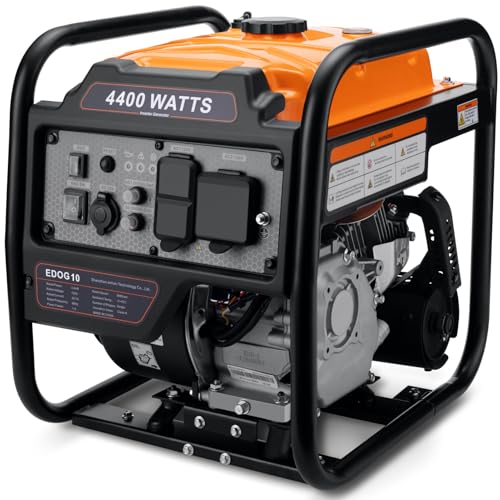
- 56-pound portable design
- 4,400 peak watts
- 14-hour ECO-mode runtime
Best For: Camping and lighter emergency backup loads
Best Compact Dual-Fuel Pick

- Gasoline and propane operation
- Quiet, clean inverter power
- RV-ready and weighs 49 pounds
Best For: Portable camping and RV power
Best Long-Run Value
BILT HARD 4500W Dual-Fuel Generator
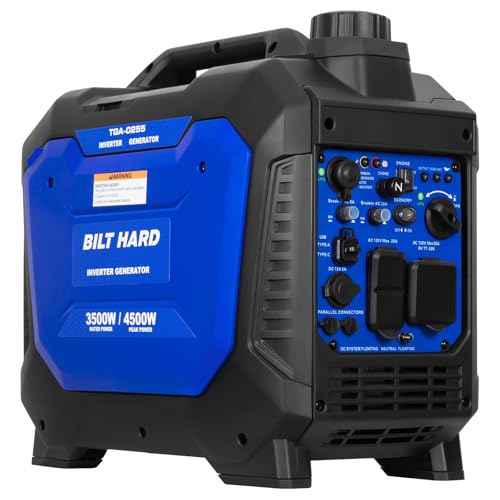
- Up to 13 hours of listed runtime
- 3,500 rated gasoline watts
- Quiet, RV-ready, and parallel capable
Best For: Extended camping and RV trips
Best High-Output EV Backup

- 6,800 starting watts and dual fuel
- 240V support for low-power Level 2 charging
- Electric start with wheels and pull handle
Best For: Higher-demand backup and EV support
Compact Camping Pick
2550W Quiet Portable Inverter Generator

- 2,550W starting output for moderate loads
- 59 dB operation for quieter use
- Up to 10 hours at 25% load
Best For: Camping and basic home backup
Whole-Home Flexibility Pick
Westinghouse 8200W Tri-Fuel Inverter

- Up to 8,200 peak watts
- Runs on gas, propane, or natural gas
- Less than 3% THD with a 50A outlet
Best For: Home backup with multiple fuel options
High-Output Gasoline Pick
Westinghouse 10000W Open-Frame Inverter

- 10,000 peak and 7,600 running watts
- Up to 12 hours of runtime
- Remote, push-button, and recoil start
Best For: High-demand gasoline-powered backup
Whole-Home Power Pick – Westinghouse iGen12000DFc
For shoppers comparing inverter generators for serious home backup, the Westinghouse iGen12000DFc stands out with high output, dual-fuel flexibility, and low THD for sensitive electronics. It delivers up to 12,000 peak watts on gasoline and includes transfer-switch-ready 50A and 30A outlets.
Best For: Whole-home backup, RV use, and users who need substantial power with gasoline or propane flexibility.
Pros:
- Up to 9,000 running watts on gasoline and 8,100 on propane
- Low THD, CO sensor, and transfer-switch-ready outlets
- Remote electric start, digital data center, and parallel capability
- Runs up to 19 hours at 25% load on its 7.9-gallon tank
Cons:
- At 187.4 pounds, it is considerably heavier than compact portable models
- Its high-capacity design is more suited to home backup than lightweight travel
This is a powerful, feature-rich choice when dependable backup capacity matters more than portability. Its enclosed design and rated 64 dBA minimum noise level add practicality for residential use.
Most Fuel-Flexible – GENMAX GM10500XiT
The GENMAX GM10500XiT is a versatile option among inverter generators, combining 10,500 peak watts with tri-fuel operation. It can run on gasoline, propane, or natural gas, while its low-THD inverter output is designed for electronics and its 50A connection supports substantial backup loads.
Best For: Home backup users who want natural-gas capability, multiple starting methods, and flexible fuel choices.
Pros:
- Tri-fuel operation supports gasoline, LPG, and natural gas
- Produces 7,800 rated watts and 10,500 peak watts
- Includes remote, one-button, and recoil starting options
- CO alarm, digital display, ATS support, and parallel capability
Cons:
- Its open-frame design may offer less enclosure than fully enclosed models
- The supplied details do not specify an exact unit weight or outlet layout beyond the 50A feature
With tri-fuel support and automatic-start compatibility, the GM10500XiT is built for adaptable backup setups. It is especially compelling when natural-gas access or advanced control features is a priority.
RV-Friendly Quiet Choice – WEN DF480iX
The WEN DF480iX is a practical middle-ground option for shoppers seeking inverter generators that are portable, quiet, and ready for RV use. Its dual-fuel engine supplies 4,000 rated watts on either gasoline or propane and includes clean power for sensitive electronics.
Best For: RV camping, tailgating, and household essentials where quiet operation and manageable weight matter.
Pros:
- Dual-fuel operation with 4,000 rated watts on gasoline or propane
- RV-ready TT-30R outlet plus 120V, 12V DC, and USB connections
- CO Watchdog automatically shuts down the generator at dangerous CO levels
- Wheels, telescoping handle, electric start, and fuel shutoff improve usability
Cons:
- Its 1.9-gallon tank provides a listed runtime of up to 7 hours
- With 4,800 surge watts, it is less suited to whole-home or high-demand loads
At 78.5 pounds, this WEN offers a useful balance between output and portability. Its RV outlet, quiet operation, and safety shutdown make it a strong fit for recreational and essential-power applications.
Lightweight Budget Option – Oxseryn EDOG10
For buyers who prioritize easy transport, the Oxseryn EDOG10 is a compact gasoline inverter generator with 4,400 peak watts and 3,400 running watts. Its ECO mode, RV outlet, and claimed 14-hour runtime at 25% load make it suitable for camping and limited emergency backup.
Best For: RV camping, portable home essentials, and users who want a 56-pound generator with basic fuel-saving features.
Pros:
- Lightweight 56-pound design with a 4,400-watt peak output
- Runs up to 14 hours at 25% load with ECO mode
- Includes an RV outlet, two 120V AC ports, and a 12V DC port
- Fuel gauge, low-oil shutdown, and overload protection are included
Cons:
- Gasoline-only operation offers less fuel flexibility than dual-fuel models
- Its 3,400 running-watt output is intended for lighter loads
- The listed warranty is one year
The EDOG10 is a straightforward, transportable choice when weight and runtime matter more than premium features. It can cover common camping needs and selected home essentials, but its output is not designed for whole-home backup.
Best Compact Dual-Fuel Pick – WEN DF360iX
For shoppers comparing inverter generators for camping, RV use, or backup power, the WEN DF360iX offers a compact dual-fuel setup with clean electricity for sensitive electronics. It runs on gasoline or propane, operates at conversation-like volume, and includes an RV-ready outlet.
Best For: Campers and RV owners who want quiet, flexible fuel options in a relatively lightweight generator.
Pros:
- Dual-fuel operation provides gasoline and propane flexibility.
- Clean inverter power helps protect phones, tablets, and laptops.
- CO Watchdog, fuel shut-off, RV outlet, USB ports, and a three-year warranty add useful convenience.
- At 49 pounds, it is comparatively easy to transport.
Cons:
- Its 2,600 rated gasoline watts are lower than larger models in this roundup.
- The listed runtime is five hours.
- It uses recoil starting rather than electric start.
The DF360iX is a practical choice when quiet operation, portability, and dual-fuel capability matter more than maximum output. Its RV receptacle and clean power make it especially useful for mobile power needs.
Best Long-Run Value – BILT HARD 4500W Dual-Fuel Generator
The BILT HARD 4500W is one of the more versatile inverter generators for camping, RVs, and general portable power. Its dual-fuel engine delivers up to 3,500 rated watts on gasoline, while ECO mode, a quiet enclosed design, and a claimed 13-hour runtime support extended use.
Best For: Users who prioritize longer runtime, RV compatibility, and more running power without moving to a much larger generator.
Pros:
- Gasoline and propane operation adds fuel flexibility.
- Provides clean inverter power rated below 3% THD for sensitive electronics.
- Includes a TT-30R RV outlet, USB ports, ECO mode, and parallel capability.
- Conversation-friendly 58 dBA operation and a listed 13-hour runtime are useful for extended outings.
Cons:
- The parallel kit required to connect two units is not included.
- At 57.7 pounds, it is heavier than the compact WEN DF360iX.
- It uses recoil start and carries a one-year warranty.
This model balances output, runtime, and portability well. It is a strong middle-ground option for RV users and campers who want more sustained power while retaining inverter-style electrical output.
Best High-Output EV Backup – WEN DF680iX
For higher-demand applications, the WEN DF680iX stands out among inverter generators with 6,800 starting watts, dual-fuel operation, and a 240V bonded-neutral configuration designed for low-power Level 2 charging of battery and hybrid electric vehicles. Electric start, wheels, and a telescoping handle make its 99.2-pound frame easier to manage.
Best For: Homeowners and vehicle owners who need substantial portable output, RV connectivity, or limited EV and hybrid charging support.
Pros:
- Offers 5,100 rated gasoline watts and 4,500 rated propane watts.
- 240V configuration supports low-power Level 2 charging for compatible battery and hybrid vehicles.
- Electric start, onboard wheels, and a telescoping handle improve mobility and startup convenience.
- Includes an RV outlet, 120V/240V receptacle, CO Watchdog, and fuel shut-off.
Cons:
- At 99.2 pounds, it is substantially heavier than the other listed models.
- The listed runtime is six hours.
- Its higher output and larger 2.9-gallon tank make it less compact for simple camping needs.
The DF680iX is the power-oriented choice in this group. Its EV-related 240V capability and broad outlet selection add flexibility, but buyers should be prepared for a heavier unit that is better suited to substantial backup or vehicle-support needs.
Compact Camping Pick – 2550W Quiet Portable Inverter Generator
For shoppers comparing inverter generators for camping, emergency use, or light residential needs, this gasoline-powered model emphasizes portability, low noise, and extended operation. Its 2,550-watt starting output and 59 dB operating level make it a practical fit where moderate power and quieter performance matter.
Best For: Camping, outdoor activities, and basic home backup power.
Pros:
- 2,550 watts of starting power for common appliances and equipment.
- Produces a reported 59 dB of noise during operation.
- 4-liter fuel tank can run for up to 10 hours at 25% load.
- Portable design with electric start and a one-year warranty.
Cons:
- Gasoline-only operation provides less fuel flexibility than dual- or tri-fuel models.
- Its output is aimed at moderate loads rather than whole-home backup.
- At 43.9 pounds, it may still require two-handed handling for some users.
This is a sensible choice when portability and quieter operation are more important than maximum capacity. Keep fuel management in mind, and drain the oil before extended storage as recommended by the manufacturer.
Whole-Home Flexibility Pick – Westinghouse 8200W Tri-Fuel Inverter
Among inverter generators, the Westinghouse iGen8200TFc stands out for combining substantial output with gasoline, propane, and natural-gas capability. Its transfer-switch-ready 50A outlet, low-THD output, and remote electric start make it well suited to demanding home backup scenarios.
Best For: Home backup users who want tri-fuel flexibility and 120/240V power.
Pros:
- Delivers up to 8,200 peak watts and 6,600 running watts on gasoline.
- Supports gasoline, propane, and natural gas.
- Less than 3% THD is designed to be suitable for electronics.
- Offers a 50A transfer-switch-ready outlet, remote start, and a CO sensor.
Cons:
- At 134.5 pounds, it is substantially less portable than compact inverter generators.
- Its three-fuel system may involve more setup considerations than gasoline-only models.
- Only three total power outlets are listed in the supplied specifications.
Choose this model when backup capability and fuel options take priority over easy transport. The 17-hour runtime at 25% load and enclosed design add practical value for extended outages, while the low-THD output broadens the range of devices it can power.
High-Output Gasoline Pick – Westinghouse 10000W Open-Frame Inverter
This Westinghouse model is one of the higher-output inverter generators in the group, providing 10,000 peak watts and 7,600 running watts from a gasoline engine. Its open-frame design, transfer-switch-ready outlets, remote start, and long runtime make it a strong option for substantial residential or jobsite power demands.
Best For: High-demand home backup, camping, and worksite use where gasoline is available.
Pros:
- Provides 10,000 peak watts and 7,600 running watts.
- Less than 3% THD helps support electronics such as TVs and computers.
- Runs for up to 12 hours on its 5.28-gallon tank.
- Includes remote, push-button, and recoil starting options plus a CO sensor.
Cons:
- Gasoline-only operation offers less fuel flexibility than tri-fuel alternatives.
- At 147.7 pounds, it is difficult to treat as a highly portable generator.
- Its open-frame construction may be less enclosed than quieter fully enclosed designs.
This is a capable choice for buyers who need considerable wattage and multiple household-style outlets. The 120/240V transfer-switch-ready outlet supports home backup applications, while the digital display and fuel gauge make operation easier to monitor.
How We Picked the Best Inverter Generators
We evaluated this selection by comparing advertised starting and running wattage, fuel options, portability, RV compatibility, starting methods, safety features, and convenience equipment. We also considered whether each model supports parallel operation, transfer-switch connection, or automatic transfer equipment where specified.
Because generator performance depends on load, fuel, altitude, maintenance, and operating conditions, treat listed wattage as a planning reference rather than a guarantee of continuous real-world output. Always confirm the manufacturer’s specifications before connecting sensitive equipment or household circuits.
Quick Comparison
| Best For | What to Prioritize | Models to Consider |
|---|---|---|
| Home backup | High running wattage, transfer-switch readiness, remote or electric start | Westinghouse 12,000W, GENMAX 10,500W, Westinghouse 8,200W |
| RV use | RV-ready outlet, manageable noise, electric start, dual-fuel capability | WEN 4,800W, WEN 3,600W, BILT HARD 4,500W |
| High-demand equipment | Large surge capacity, 50A connection, fuel flexibility | GENMAX 10,500W, WEN 6,800W, Westinghouse 10,000W |
| Lightweight backup | Lower fuel consumption, compact design, quiet operation | 2,550W portable model, WEN 3,600W |
Key Buying Factors for Inverter Generators
Wattage and Load Planning
Add the running watts of the appliances you expect to use at the same time, then account for the higher starting demand of refrigerators, pumps, air conditioners, and power tools. Leave headroom instead of choosing a generator that operates continuously at its maximum rating.
Fuel Type and Runtime
Dual-fuel models can run on gasoline or propane, while tri-fuel units add natural gas for another emergency-power option. Gasoline usually offers stronger output, propane stores longer, and natural gas can be convenient for stationary home use. Compare runtime at a stated load, not only the tank size.
Noise, Portability, and Outlets
Inverter technology generally provides cleaner power and can reduce noise and fuel use when paired with an economy mode. Check the weight, wheel kit, handles, and footprint before buying. Confirm that the outlet configuration includes the 120V, 30A, or 50A connection your RV, transfer equipment, or appliances require.
Safety and Connection Features
CO sensors, low-oil shutdown, overload protection, and fuel shutoff improve day-to-day safety. Never operate a generator indoors, in a garage, or near doors and windows. Use a properly installed transfer switch for household circuits; never backfeed a home through a standard wall outlet.
Who Should Buy Which Inverter Generators?
Choose a high-output Westinghouse or GENMAX model if your priority is whole-home emergency backup or large startup loads. The tri-fuel options make the most sense when natural gas availability matters, while dual-fuel units offer a practical balance of flexibility and portability.
For RV owners, focus on RV-ready models in the 3,600W-to-4,800W range unless your air conditioner or other equipment requires more capacity. A 6,800W unit is better suited to heavier RV loads, electric-vehicle backup planning, or multiple appliances.
If you mainly need lights, electronics, a refrigerator, or occasional small tools, a compact 2,550W or 3,600W inverter generator can reduce fuel use and simplify transport. Before purchasing, verify running watts, outlet types, dimensions, weight, warranty terms, and local fuel and noise regulations.